
Credit Card Mathematics / Consumer Architecture
The Credit Card Minimum Payment Trap: The 3-Step Escape
When your monthly credit card statement arrives, the “Minimum Payment Due” looks harmless—often just 2% of what you owe. But that small number is mathematically engineered by banks to keep you paying interest for decades while barely touching your principal.
If you have ever made your required payments on time every single month only to wonder why your total balance hasn’t shrunk, you are not alone. You have encountered the minimum payment trap. Credit card issuers design minimum payments not to clear your balance, but to maximize the lifetime interest they collect before you default.
To break free, you have to understand the predatory formula behind minimum payments and transition to an aggressive, interest-optimized payment protocol (like the Blitz Protocol).
How Banks Calculate Your Minimum Payment
Most major issuers (Chase, Citibank, Capital One, Discover) use a two-tiered formula to determine your minimum required payment:
The Standard Minimum Payment Formula
Minimum Due = Monthly Interest Accrued + (1% of Principal Balance)
The Floor Clause
If (Interest + 1% Principal) < $35, Minimum Due = $35
Notice the intentional architecture of this formula: the bank pays themselves all accrued interest first, and leaves only a tiny 1% sliver to reduce your actual debt. On a $10,000 balance at 26.99% APR (as detailed in how to calculate your daily interest bleed), your first month’s minimum payment is roughly $325—but $225 goes directly to interest, leaving only $100 to touch your principal.
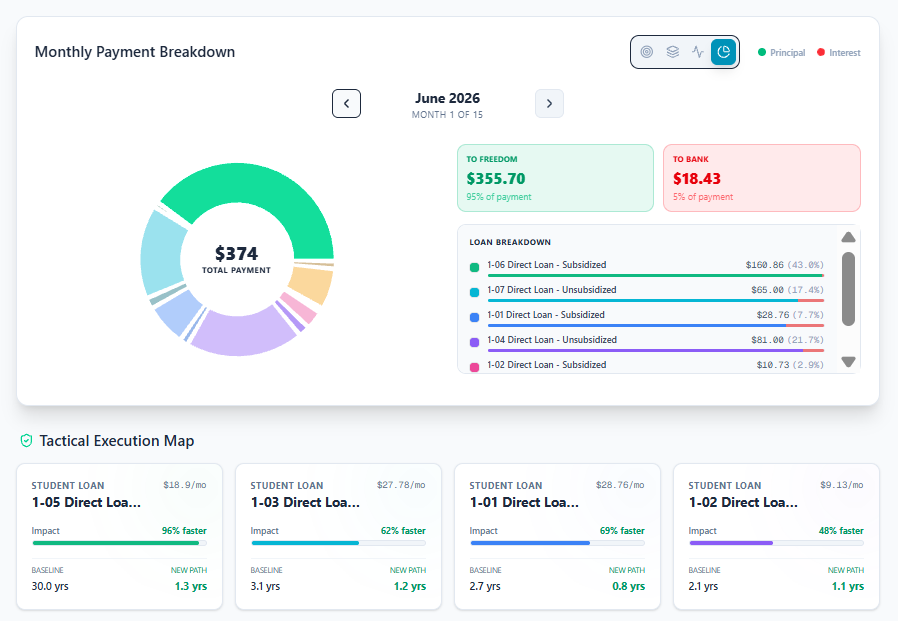
Figure 1: How contractual minimum payments are silently consumed by interest before paying down your loan balance.
The 24-Year Trap vs. The 18-Month Escape
To see how drastically this formula slows your progress, compare three different payment approaches on a $10,000 credit card at 26.99% APR:
| Repayment Strategy | Monthly Outflow | Time to Zero | Total Interest Paid | Total Cost |
|---|---|---|---|---|
| 1. Minimum Payments Only | Decreases over time ($325 down to $35) | 24.7 Years | $15,842 | $25,842 |
| 2. Fixed Fixed-Payment ($400/mo) | Fixed $400 / month | 3.1 Years | $4,520 | $14,520 |
| 3. Dynamic Blitz + Extra ($650/mo) | Optimized cash flow allocation | 1.5 Years (18 mos) | $2,140 | $12,140 |
By fixing your payment amount and using a debt payoff calculator with extra payments, you instantly save over $13,700 in pure interest and erase 23 years of payments.
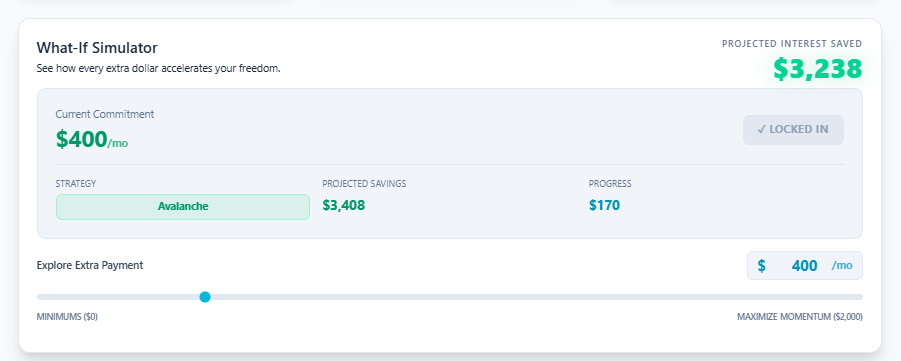
Figure 2: Simulating how fixed extra payments cut decades off compounding minimum payment schedules.
The 3-Step Formula to Escape the Trap Today
1. Freeze Your Minimum Payment Baseline
Never let your monthly payment decrease as your balance drops. If your initial minimum was $325, lock in $325 as your permanent fixed payment floor. As balance drops, more of that $325 attacks principal rather than interest.
2. Target Highest Dollar Bleed with Extra Cash
When allocating extra funds (tax refunds, side income, or monthly surplus), do not scatter it across accounts. Direct 100% of the surplus to the card generating the highest daily interest dollars (the Dynamic Blitz approach).
3. Map Your 12-Month Construction Blueprint
Use a visual roadmap to track sequential progress. Knowing the exact month each account hits zero eliminates decision fatigue and keeps you committed.
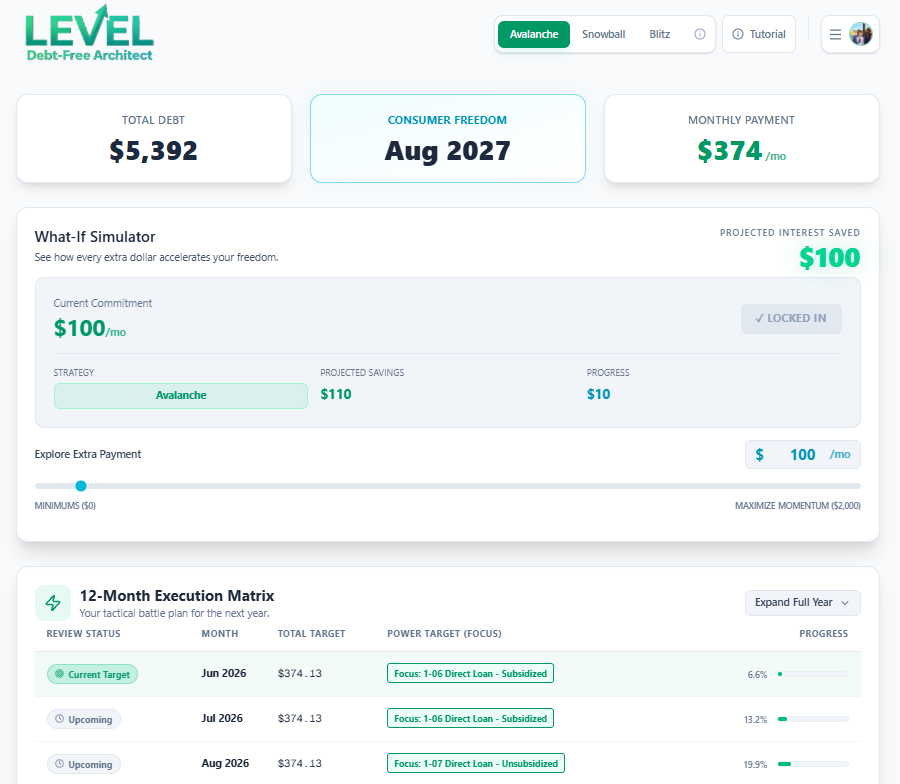
Figure 3: Interactive 12-month blueprint mapping exact payoff milestones to zero debt without bank sync.
Frequently Asked Questions
Why does my minimum payment decrease each month if I owe high interest?
Will paying only the minimum hurt my credit score?
What is the fastest way to calculate my escape timeline?
Escape the Minimum Payment Trap
Stop letting banks dictate your payoff timeline.
Test your custom debt-free timeline today with LEVEL Debt-Free Architect. Simulate extra payments, compare strategies (Snowball, Avalanche, Dynamic Blitz), and build your visual 12-month construction blueprint—100% private, with zero bank logins required.