
Software Architecture / Payoff Methodologies
Debt Snowball Calculator: How It Works, Worked Example, & When to Switch
The debt snowball is the most widely recommended debt payoff strategy in personal finance. But while paying off your smallest balance first provides fast psychological dopamine, static snowball calculators have an expensive blindspot: they ignore daily interest bleed.
If you are searching for a debt snowball calculator or debt payoff planner, you already understand that minimum payments are a trap. Paying minimums is like bailing out a flooded basement with a teaspoon—it keeps you profitable to the credit card company for 20+ years (as explored in our minimum payment trap analysis).
The debt snowball method provides a proven, sequential way to build momentum. However, to eliminate debt efficiently without lighting thousands of dollars on fire, you need to understand both the mechanical math of the snowball and the exact moment when switching to an interest-optimized engine saves months of your life.
How a Debt Snowball Calculator Works: The 4-Step Sequence
A debt snowball calculator organizes your debts purely by balance size, completely disregarding the interest rates (APR). Here is the four-step execution sequence:
1. List Debts Smallest to Largest
Order every liability—credit cards, medical bills, personal loans, auto loans—by outstanding balance from lowest to highest.
2. Lock in Statutory Minimums on Accounts 2 Through N
Maintain the minimum required monthly installment on every account to protect your credit profile and prevent late penalties.
3. Channel All Surplus Capital to Account 1
Direct every extra dollar—budgeted surplus, bonus cash, side hustle income—straight at the smallest balance until it hits zero.
4. Roll the Freed-Up Payment into Account 2 (The Snowball)
Once Account 1 is eliminated, take its entire minimum payment plus your surplus and combine them against Account 2. The payment rolls forward like a snowball rolling down a hill.

Figure 1: Comparing the Snowball (psychological wins), Avalanche (pure APR math), and Blitz (dynamic daily interest bleed) repayment engines.
Worked Example: The Snowball Cascade on a $24,500 Balance Sheet
To see how a debt snowball calculator accelerates cash flow, consider a deliberate planner managing 4 accounts with an extra $200/month in surplus payment capacity:
| Account | Balance | APR | Minimum | Snowball Allocation | Status |
|---|---|---|---|---|---|
| Card A (Store Card) | $1,100 | 28.9% | $40 | $240 / mo ($40 min + $200 extra) | Eliminated in Month 5 |
| Card B (Bank Card) | $3,400 | 22.4% | $105 | $105 min → $345 / mo (Month 6+) | Eliminated in Month 14 |
| Auto Loan | $8,000 | 7.9% | $230 | $230 min → $575 / mo (Month 15+) | Eliminated in Month 27 |
| Personal Loan | $12,000 | 11.5% | $275 | $275 min → $850 / mo (Month 28+) | Eliminated in Month 40 |
In this simulation, the borrower eliminates their first credit card in just 5 months. That first victory closes an open mental tab and immediately frees up $240/month of dedicated repayment force for the next target.
The Psychology of the Snowball: Mental RAM & Open Tabs
From a pure mathematical standpoint, personal finance academics often critique the debt snowball because it does not prioritize highest interest rates first. But financial architecture is not executed in a laboratory—it is executed by human beings balancing careers, families, and cognitive load.
When you carry five separate debt accounts, your brain is running five background applications 24/7. Every balance is a mental tab demanding due date tracking, statement reviews, and subconscious anxiety. Eliminating a $1,100 store card isn’t just about saving interest—it is about closing a tab in your mind and building unstoppable momentum.
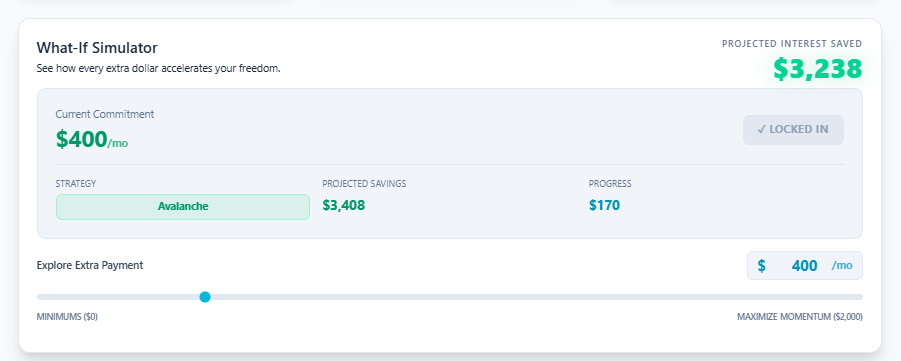
Figure 2: Testing what-if extra payment scenarios to visualize how surplus capital collapses repayment schedules.
The Snowball Blindspot: When Should You Switch Strategies?
While the snowball is extraordinary for initiating momentum, it has a serious structural flaw when large, predatory credit card balances lurk further down your list.
Consider what happens if Account 3 has a $15,000 balance at 27% APR. While you spend 18 months chipping away at a low-rate auto loan, that 27% credit card is actively leaking $11.10 every single day in pure interest bleed (as detailed in how to calculate daily interest bleed). Over two years, you might pay an extra $3,500 in avoidable interest just to follow an inflexible, static snowball rule.
This is why advanced payoff planners use the Dynamic Blitz Protocol (explored in the hybrid payoff strategy guide):
Phase 1: Snowball
The Psychological Kickstart
Use the Snowball engine to knock out your smallest 1 or 2 balances rapidly. Free up cash flow, close open mental tabs, and prove the system works.
Phase 2: Dynamic Blitz
The Interest Bleed Pivot
Once initial momentum is locked in, pivot surplus capital to the account generating the highest daily dollar cost (Balance × APR ÷ 365) to maximize cash savings.
Why Static Spreadsheets Fail (And Why Zero Bank Sync Matters)
Most borrowers start their snowball journey with a free Excel or Google Sheets template (see why you should ditch the debt payoff spreadsheet). But spreadsheets break whenever an unexpected expense occurs, interest rates adjust, or extra payments fluctuate.
Conversely, big-tech budgeting applications demand your bank credentials, passwords, and sensitive transaction histories through third-party aggregators like Plaid. A dedicated debt architect doesn’t need to spy on your grocery receipts. You only need to enter 3 numbers per debt—balance, APR, and minimum payment—to generate a 12-month visual construction blueprint with 100% privacy.
Frequently Asked Questions
How does a debt snowball calculator calculate payoff dates?
Is the debt snowball or debt avalanche faster?
Can I add one-time extra payments to the debt snowball?
Does this debt snowball planner require connecting my bank accounts?
Interactive Debt Snowball & Payoff Simulator
Stop managing minimums. Engineer your exact payoff date.
Run your custom payoff roadmap today on LEVEL Debt-Free Architect. Compare Snowball, Avalanche, and Dynamic Blitz side by side, test what-if extra payment simulations, and map your 12-month visual blueprint—100% free to start, with zero bank sync required.