
Capital Routing / Tactical Execution
When to Apply Dynamic Debt Payoff Strategies: 4 Portfolio Triggers
Static debt repayment plans assume your finances never change. A dynamic paying strategy adapts in real time—routing your capital where it yields maximum financial leverage as balances, rates, and cash flow shift.
Most borrowers start their debt-free journey by choosing one rigid rulebook: the emotional quick wins of the Snowball method or the pure interest rate hierarchy of the Avalanche method. But when applied to a real portfolio containing high-APR credit cards, auto notes, and promotional balance transfers, static formulas quickly break down.
As we detailed in our guide on the Blitz Protocol and hybrid payoff strategies, locking your balances into an unyielding queue creates friction. Knowing when to deploy dynamic capital routing is what separates years of sluggish repayment from an accelerated, stress-free path to zero.
Why Static Payoff Plans Fail in Mixed Portfolios
Static plans fail because debt is dynamic. Every time you make an extra payment, your daily interest accrual changes. If you manage your payments with rigid spreadsheets or traditional zero-based budget trackers (as explored in why debt architecture beats zero-based budgeting), you are forced to manually recalculate every single time life happens.

Figure 1: Comparing static queues (Snowball/Avalanche) against dynamic interest-dollar routing (Dynamic Blitz).
4 Critical Triggers: When to Switch to a Dynamic Strategy
If your balance sheet meets any of the following four conditions, switching from a static formula to a dynamic payoff protocol will immediately accelerate your timeline:
Trigger 01
Wide Divergence Between Balance Size and APR
The Scenario: You have a $24,000 credit card balance at 21.99% APR alongside a $1,200 store card balance at 28.99% APR.
The Static Trap: Pure Avalanche tells you to attack the $1,200 card because 28.99% is higher than 21.99%. But as we proved in our breakdown on how to calculate your daily interest bleed, the $24,000 card bleeds $14.46 every single day ($433/mo), while the store card bleeds just $0.95/day. A dynamic strategy recognizes this volume disparity and targets the dollar hemorrhage first.
Trigger 02
The Mid-Journey “Avalanche Plateau” (Burnout Phase)
The Scenario: You started with Avalanche, knocked out a small balance, and are now staring down an $18,000 card requiring 14 months of grinding before your next milestone.
The Dynamic Solution: When motivation flags, decision fatigue and financial burnout skyrocket. A dynamic strategy detects when an account milestone is close and dynamically injects a tactical psychological win by targeting a quick sub-balance, re-energizing your momentum without sacrificing long-term interest math.
Trigger 03
Impending 0% Promotional Rate Cliffs
The Scenario: You completed a balance transfer with a 0% APR window expiring in 7 months, after which the rate spikes to 26.99% retroactively or going forward.
The Dynamic Solution: Static models ignore expiration timers and treat 0% cards as lowest priority until the exact day they explode. Dynamic architecture monitors promo cliffs, calculating the precise monthly pacing required to bring that balance to zero on Month 6.9, preventing sudden interest shocks.
Trigger 04
Fluctuating Cash Flow & Surplus Windfalls
The Scenario: Your income includes quarterly bonuses, tax refunds, commissions, or variable side-gig revenue.
The Dynamic Solution: Instead of guessing where to dump an unexpected $2,500 injection, dynamic algorithms run a live simulation to determine which allocation eliminates the maximum lifetime interest across all accounts simultaneously.
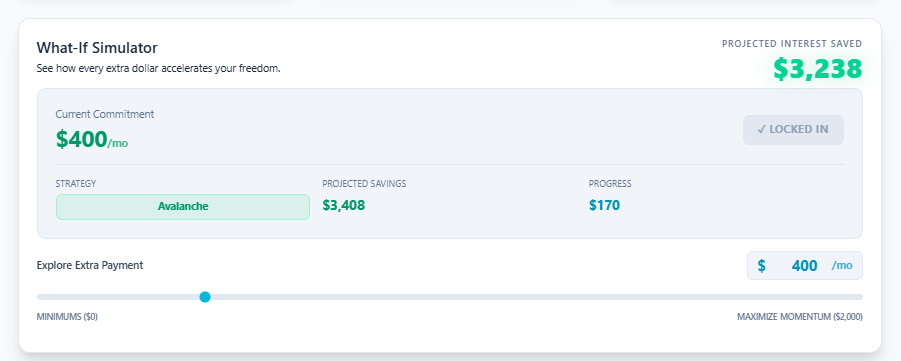
Figure 2: Testing lump-sum and recurring extra payment injections to measure instant debt-free date acceleration.
How to Execute Dynamic Routing in Practice
Executing dynamic capital routing does not require complex formulas or sacrificing your privacy to third-party bank aggregators. Follow this simple 3-step cadence (as detailed in how to update your debts monthly):
Step 1: Perform a 5-Minute Monthly Balance Audit
At the start of each month, record your updated statement balances. Notice how your daily dollar bleed shifts as balances decrease.
Step 2: Recalibrate Your Extra Payment Vector
Maintain contractual minimum payments across all active liabilities, but route 100% of your extra cash flow to the single highest interest-dollar drain.
Step 3: Track Your Visual Milestone Blueprint
Watch your debt-free milestone bricks turn green. Visualizing sequential progress eliminates ambiguity and reinforces discipline.
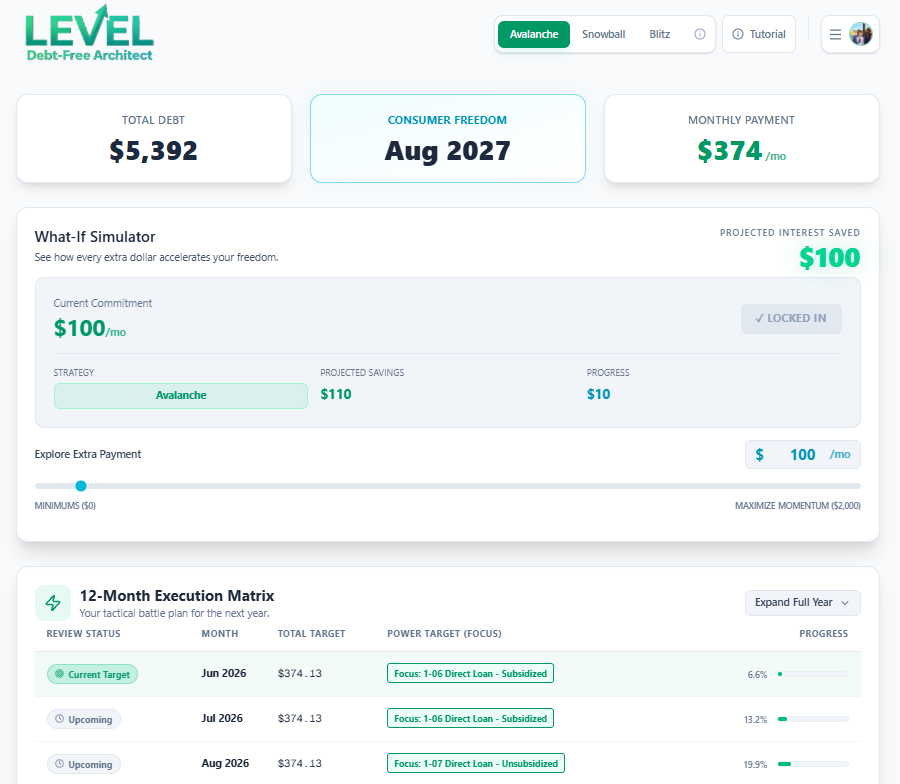
Figure 3: An interactive 12-month construction blueprint tracking dynamic payoff milestones without bank logins.
Frequently Asked Questions
Is a dynamic strategy more complicated than the Snowball method?
When should I NOT use a dynamic paying strategy?
Do I need to sync my bank accounts to use dynamic debt payoff?
Simulate Your Dynamic Strategy
Ready to see how much faster dynamic capital routing eliminates your debt?
Try LEVEL Debt-Free Architect. Compare Snowball, Avalanche, and our proprietary Dynamic Blitz protocol side by side, test what-if payment injections, and map your visual 12-month blueprint—100% private, with zero bank sync required.