
Amortization Mechanics / Surplus Optimization
How Extra Payments Slash Debt: The Math & Calculator Guide
When you make an extra payment on debt, that dollar bypasses the bank’s interest collection mechanism entirely and attacks pure principal. Understanding how to model extra payments in real time is the single fastest lever to accelerate your debt-free date.
Most borrowers assume that adding $150 or $300 a month to their debt payments produces a modest linear payoff. But high-interest credit card debt does not compound linearly. As we demonstrated in our guide on how to calculate your daily interest bleed, interest accumulates every 24 hours based on your average daily balance.
Using a dynamic debt payoff calculator with extra payments reveals the non-linear “multiplier effect”: every dollar of extra principal paid today permanently stops compounding interest from recurring for the next 200 months.
The 3 Ways to Inject Extra Payments
When modeling your payoff plan with a debt payoff calculator with extra payments, your extra capital generally falls into three distinct strategic categories:
Method 01: Recurring Monthly Surplus
Consistent Baseline Acceleration
Committing a fixed extra amount (e.g., +$200/mo from freed cash flow) creates a relentless downward pressure on compounding interest, cutting overall timelines by 60% to 75%.
Method 02: Opportunistic Lump Sums
Surgical Principal Injections
Deploying tax refunds, quarterly bonuses, or side-gig revenue ($1,500 to $3,000) directly to the highest daily-bleed card provides an instant multi-month leap forward.
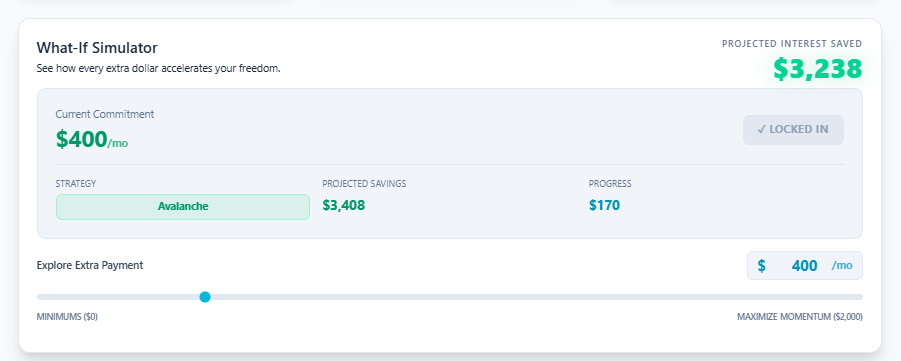
Figure 1: Testing what-if recurring and lump-sum extra payment scenarios in real time to calculate exact debt-free dates.
Case Study: The Extra Payment Math in Action
To see how extra payment allocation changes your trajectory, examine a representative borrower carrying $32,000 across three debts:
- Card A (Store Card): $3,500 @ 28.99% APR ($105 min)
- Card B (Primary Visa): $18,500 @ 24.99% APR ($460 min)
- Auto Loan: $10,000 @ 7.25% APR ($285 min)
| Payment Scenario | Total Monthly Outflow | Payoff Timeline | Total Interest Paid | Total Savings |
|---|---|---|---|---|
| 1. Minimums Only (Trap) | $850 (Decreasing) | 21.4 Years | $22,480 | $0 (Baseline) |
| 2. +$150/mo Extra Payment | $1,000 / month | 4.8 Years | $7,840 | Save $14,640 & 16.6 Yrs |
| 3. +$350/mo Extra Payment | $1,200 / month | 2.7 Years | $4,120 | Save $18,360 & 18.7 Yrs |
| 4. +$350/mo + $2,000 Lump Sum | $1,200/mo + $2k Bonus | 2.1 Years | $3,140 | Save $19,340 & 19.3 Yrs |
Notice that moving from minimum payments to an extra $350/month doesn’t just save a few dollars—it eliminates over $18,300 in predatory bank interest and gives you back nearly two decades of your financial life (see how to escape the minimum payment trap).
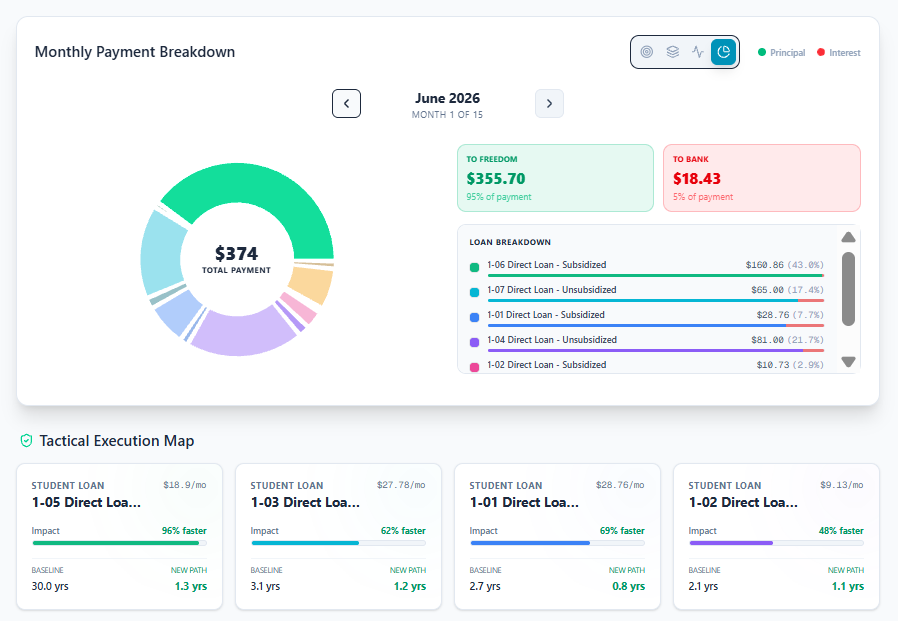
Figure 2: Visualizing how extra payment dollars bypass interest and directly reduce principal balances.
How to Route Extra Payments: Snowball vs. Avalanche vs. Blitz
When you have extra money to deploy, the sequence of which card receives that extra cash dictates your final payoff speed (as detailed in when to apply dynamic payoff strategies):
The Snowball Approach (Psychological Wins)
Routes 100% of extra cash to the smallest balance ($3,500 Card A). Once Card A hits zero, its $105 minimum rolls into the extra payment pool for Card B.
The Avalanche Approach (Pure APR Focus)
Routes extra cash to the highest interest rate card (28.99% Card A) first, minimizing mathematically calculated interest charges.
The Dynamic Blitz Protocol (Dollar-Bleed Suppression)
Targets the exact account producing the largest daily dollar drain (as outlined in the Blitz Protocol). Recalibrates dynamically each month as balances change.
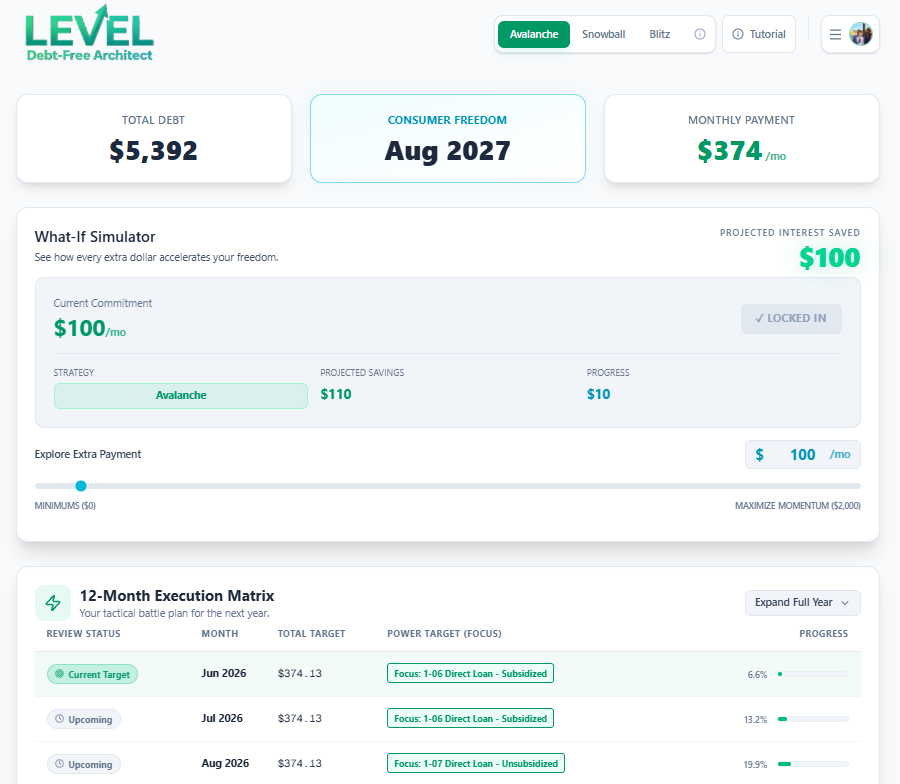
Figure 3: Mapping extra payment progress across a sequential 12-month visual construction roadmap.
Frequently Asked Questions
Does making extra payments mid-month save more interest than waiting for the due date?
Should I put extra money toward debt or an emergency fund?
Where can I test my own extra payment scenarios for free?
Interactive What-If Extra Payment Simulator
Stop guessing your payoff timeline. Calculate your exact debt-free date.
Model your custom scenario today with LEVEL Debt-Free Architect. Simulate extra payments in real time, compare Snowball, Avalanche, and Dynamic Blitz strategies side by side, and map your visual 12-month blueprint—100% private, with zero bank sync required.