Should You Sell Stocks to Pay Off Credit Card Debt?
A borrower holds $25,000 in index funds inside a regular taxable brokerage account. Over three years, the portfolio has gained $7,000 in value. At the same time, life emergencies and rising costs led them to accumulate $22,000 in credit card debt across two cards at an average 26.5% interest rate.
Their required monthly minimum payments total $660. Nearly $485 of that payment is immediately consumed by interest charges, burning almost $16 every single day. The borrower feels torn: “I spent years building my investment portfolio. Should I sell my shares to wipe out the debt, or should I leave my stocks alone to compound while chipping away at the cards each month?”
The Direct Answer in the First 100 Words
If your stocks are in a regular taxable brokerage account, you should almost always sell them to pay off high-interest credit card debt. Eliminating a 25% to 29% credit card balance delivers a guaranteed, risk-free return of 25% or more, which vastly exceeds the long-term historical 8% to 10% average return of the stock market.
Even after setting aside cash for capital gains taxes, the math heavily favors selling. However, do not liquidate tax-advantaged retirement accounts like a traditional 401(k) or traditional IRA, where early withdrawal penalties and ordinary income taxes create severe financial penalties.
The Rate Spread: Guaranteed Drag vs. Uncertain Returns
When you invest money while simultaneously carrying credit card debt, you are taking a leveraged bet with negative expected odds.
Consider the mathematical reality of holding both assets side by side:
- Credit Card Interest: At 26.50% APR, your debt charges you a guaranteed negative return of 26.50% per year. On a $22,000 balance, that equals $5,830 in yearly interest ($15.97 per day).
- Stock Market Performance: Broad stock market indexes (such as the S&P 500) have historically returned roughly 8% to 10% annually before taxes over long multi-decade horizons. On $22,000, a generous 10% return produces $2,200 per year, but this return is volatile and never guaranteed.
The net result is an annual interest drag of negative 16.50% to 18.50%. Every single year you hold both the stocks and the credit card debt, you are effectively paying an external lender $3,630 to $4,070 in net cash just to keep your stock ticker active on your phone screen.
The 3-Tier Account Hierarchy: Where Your Money Sits Matters
Before selling a single share, you must identify what kind of account holds your investments. Liquidating stocks carries drastically different rules, taxes, and penalties depending on account structure:
| Account Type | Tax & Penalty Rules | Verdict for Credit Card Debt | Status |
|---|---|---|---|
| Taxable Brokerage Account Standard non-retirement account |
Only profit (capital gains) is taxed. Long-term rate is usually 0% or 15%. Zero early withdrawal penalties. | Sell Immediately. The interest savings dwarf the capital gains tax in the first year alone. | Green Light |
| Roth IRA (Contributions Only) Post-tax retirement account |
Original contributions (your principal) can be withdrawn tax-free and penalty-free at any time. Earnings cannot. | Use With Caution. Safe from tax penalties, but that contribution space is permanently lost ($7,000 annual limit). | Yellow Light |
| 401(k) or Traditional IRA Pre-tax retirement accounts |
Early withdrawals incur a 10% IRS penalty plus your full ordinary income tax rate (often 22% to 32% total haircut). | Do Not Liquidate. You lose 30% to 40% of your money off the top, destroying your future retirement foundation. | Red Light |
1. Taxable Brokerage: The Clear Green Light
In a standard brokerage account, you only owe taxes on your realized profit (capital gain), not the total amount you withdraw.
If you bought shares for $18,000 and they are now worth $25,000, your total gain is $7,000. If you held those investments for longer than one year, they qualify for long-term capital gains tax rates (typically 15% for most single earners making between $47,025 and $518,900 in 2026, or 0% below that threshold).
When you sell $22,000 to wipe out your cards:
- Your proportional capital gain is roughly $6,160.
- At a 15% long-term tax rate, your total tax owed next spring is $924.
- In exchange for paying $924 in taxes, you permanently stop $5,830 per year in credit card interest charges.
That is an immediate 530% return on the cost of the tax. You can leave the remaining $3,000 in your brokerage account and keep $1,000 in cash to cover the tax bill when you file your return.
2. Roth IRA: The Yellow Light
The IRS allows you to withdraw your direct contributions (the original dollars you deposited) from a Roth IRA at any time, for any reason, with zero taxes and zero penalties.
The hidden cost is not taxes; it is lost contribution limit capacity. Once you pull $15,000 out of a Roth IRA, you cannot simply put it back next year. You are strictly capped by the annual IRS contribution limit ($7,000 in 2026). If you are on the brink of missing payments and facing a severe credit score drop, tapping Roth contributions is acceptable, but it should be secondary to liquidating a regular brokerage account.
3. 401(k) and Traditional IRA: The Red Light
Cashing out a pre-tax retirement account to pay off credit card debt is one of the most destructive financial mistakes a borrower can make.
If you are under age 59½, the IRS imposes a mandatory 10% early withdrawal penalty on traditional retirement accounts. Furthermore, the entire withdrawal is added to your taxable income for the year, pushing you into higher tax brackets.
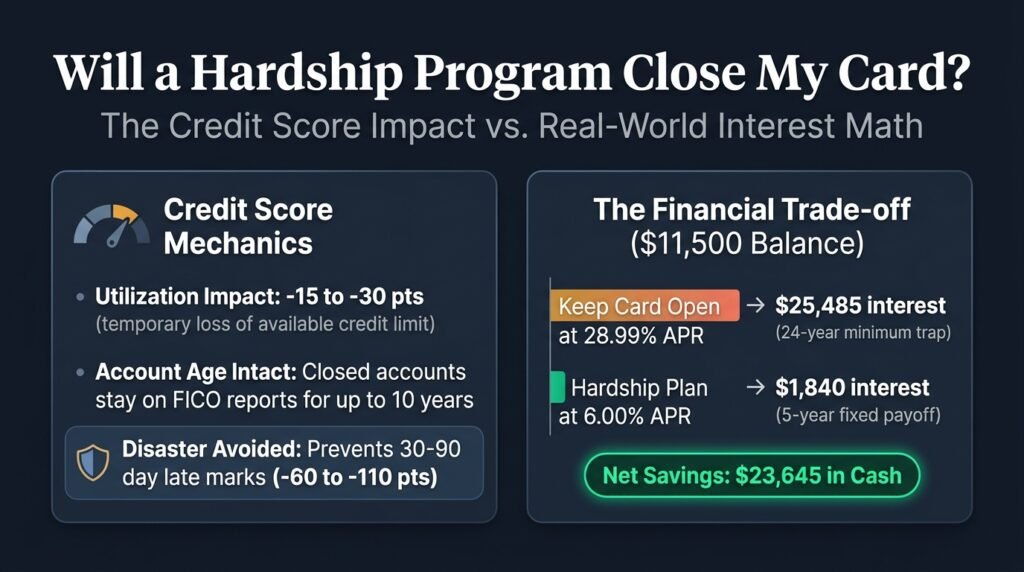
To clear a $22,000 debt balance, you might have to withdraw nearly $34,000 from your 401(k) to cover federal withholding, state taxes, and the 10% penalty. You sacrifice $34,000 in tax-deferred compounding assets to resolve $22,000 in debt. If you are struggling with payments, explore our guides on Credit Card Hardship Programs or Will a Hardship Program Close My Account? before ever touching a 401(k).
The 5-Year Simulation: Keeping Stocks vs. Rebuilding Clean
Many borrowers resist selling because they fear missing out on future stock market growth. Let us compare the exact 5-year mathematical reality of both decisions:
| Decision Path | Monthly Outflow | Debt Interest Paid | Portfolio Value (Month 61) | Net Financial Position |
|---|---|---|---|---|
| Option A: Keep Stocks, Pay Minimums Leaves $22,000 in stocks, pays $660/mo to debt |
$660/mo | $18,254.09 | $35,280.00 (assuming 8% return) |
+$17,025.91 |
| Option B: Sell Stocks, Reinvest Monthly Cash Flow Sells $22,000, wipes debt Day 1, invests $660/mo |
$660/mo | $0.00 | $49,807.88 (rebuilt at 8% return) |
+$49,807.88 |
The results are decisive:
- In Option A, you spend 61 months (over 5 years) battling compound interest, surrendering $18,254 of your hard-earned income directly to credit card companies. Your remaining net wealth is approximately $17,000.
- In Option B, your debt is wiped out immediately. You redirect that exact same $660 monthly cash flow straight into broad market index funds. After 61 months, your rebuilt portfolio reaches $49,807.
By liquidating the taxable stocks on Day 1, you end up $32,781 richer after five years. You also eliminate five years of payment stress, protect your credit score against missed payments, and avoid downside market risk. If the stock market experiences a 20% correction while you hold credit card debt, Option A crushes your net worth from both sides.
3 Execution Rules for Liquidating Your Shares
If you decide to sell stocks in your taxable account to eliminate credit card balances, follow these three rules to ensure a smooth transition:
- Identify Cost Basis and Specific Lots: In your brokerage dashboard, check the tax lots for your holdings. Sell lots held for longer than 365 days first to secure long-term capital gains rates (0% or 15%) rather than short-term gains, which are taxed as ordinary income.
- Carve Out the Tax Reserve Immediately: Calculate your estimated capital gains tax (gain multiplied by your capital gains rate) and move that amount directly into a high-yield savings account. Do not leave yourself empty-handed when tax season arrives next April.
- Automate the Reinvestment Immediately: The moment your credit cards are paid to zero, review our blueprint on what to do after paying off credit cards, and set up an automatic recurring monthly transfer from your checking account back into your brokerage index funds for the exact amount of your old minimum payments. This guarantees that your freed cash flow builds true wealth rather than disappearing into lifestyle inflation.
If you have multiple cards and want to determine whether to wipe them completely or prioritize specific interest rates, review our analysis on Got a Lump Sum? Where to Put It When You Have Multiple Cards and Why Paying Extra on Every Card Doesn’t Work (and the Fix).
Map Your Payoff and Wealth Rebuild in LEVEL
Whether you are deciding how to allocate an investment liquidation or building a systematic debt payoff roadmap, guessing the math costs you money.
LEVEL is a private, zero-bank-sync payoff engine. Test lump-sum allocations, track daily interest bleed, and map your complete transition from debt elimination to automated investing.
Frequently Asked Questions
Should I sell stock at a loss to pay off credit card debt?
Yes, selling stocks at a loss in a taxable account can actually work in your favor. When you sell at a loss, you can use those capital losses to offset any realized capital gains, plus deduct up to $3,000 of excess losses against ordinary income on your tax return (tax-loss harvesting). Meanwhile, eliminating high-APR debt provides an immediate guaranteed return.
Can I take a 401(k) loan instead of selling stocks?
A 401(k) loan is significantly safer than a permanent 401(k) withdrawal because you pay the interest back to yourself rather than paying taxes and a 10% penalty. However, it carries major risks: if you leave or lose your job, the loan balance typically becomes due in full within a short window, or it is treated as a taxable distribution subject to full penalties.
What if I expect my stocks to gain 30% this year?
While individual stocks can occasionally gain 30% or more, stock returns are never guaranteed. In contrast, credit card interest at 26% is 100% guaranteed. Holding speculative equities while carrying 26% debt is essentially gambling on borrowed margin at extreme rates. Securing a risk-free 26% return by paying off the debt is the mathematically superior choice.
How long does it take to rebuild my portfolio once debt is gone?
Because eliminating your debt frees up hundreds or thousands of dollars in monthly minimum payments, your ability to save and invest accelerates dramatically. In our simulation, redirecting freed monthly payments back into the market rebuilt the entire portfolio in approximately three to four years, leaving the borrower with significantly higher net worth than if they had retained the debt.