Can’t Afford Your Credit Card Minimum Payments? The Cash-Flow Deficit Plan
When your income cannot cover both essential living costs and minimum credit card payments, you are in an operational cash-flow deficit. Your immediate priority is survival: secure the Four Walls (food, shelter, basic utilities, and transportation to work) before giving a single dollar to unsecured debt. Never skip groceries or risk eviction to make partial credit card payments. Unsecured creditors cannot seize your paycheck without a lengthy court process, whereas missing rent or utility shutoffs causes immediate personal catastrophe. Stop spreading payments evenly and initiate structured debt triage today.
Realizing that you do not have enough money in the bank to cover this month’s required credit card minimum payments triggers intense panic. Most households respond by frantically dividing whatever cash remains evenly across all accounts, hoping to appease their creditors. That instinct feels responsible, but mathematically it is the fastest way to accelerate insolvency.
When you make partial payments that fall short of each card’s contractual minimum, card issuers treat every single account as delinquent. You incur multiple late fees, your interest rates skyrocket to penalty APRs, and within 30 days, multiple delinquency marks hit your credit bureaus. Worst of all, you have emptied your checking account of the cash needed to purchase food or put gasoline in your car.
To survive a cash-flow deficit, you must replace panic with an objective, mechanical triage protocol.
The Situation: An anonymized household brings home $3,400 per month in net take-home pay. Essential living expenses (rent, groceries, electricity, water, and commuter fuel) require $2,900. They have four credit cards with minimum monthly payments totaling $1,100 ($350, $300, $250, and $200). That creates an immediate monthly deficit of $600 ($3,400 income minus $4,000 total required obligations).
The Panic Move: For three months, they divided their remaining $500 evenly across all four cards, sending $125 to each creditor. Because every single payment was below the required minimum, all four cards incurred $40 late fees ($160 total per month). All four accounts were reported delinquent, their credit score plummeted by 95 points, and when an unexpected plumbing repair hit, they had $0 in reserves.
The Fix: Shifting to the Cash-Flow Deficit Plan stopped the bleeding, restored a basic emergency cushion, and eliminated $620 per month in recurring minimum obligations.
Step 1: Secure the Four Walls (The Survival Hierarchy)
Not all bills carry equal weight. When money is short, you must organize your financial obligations into two distinct categories: essential survival costs and unsecured creditor claims.
The Four Walls must always be funded first in full cash:
- Food: Modest, nutritious groceries for your household. Dining out and delivery services drop to zero immediately.
- Shelter: Rent or mortgage payments, property taxes, and necessary condominium fees. Keeping a roof over your family is non-negotiable.
- Basic Utilities: Electricity, water, natural gas, and basic mobile phone service. Premium subscription services and streaming apps must be paused.
- Transportation: Fuel, transit passes, basic auto insurance, and car loan payments necessary to get to your job. If you lose transportation, you lose your income.
Credit card debt is unsecured. You did not pledge your home, your car, or your refrigerator as collateral. While falling behind on credit cards damages your credit score and generates collection calls, a credit card company cannot show up at your home tomorrow, shut off your water, or repossess your vehicle.
An unsecured creditor cannot garnish your wages or touch your bank accounts without first hiring an attorney, filing a formal civil lawsuit, serving you with legal notice, and winning a court judgment. That process typically takes between six and eighteen months. You have time to maneuver, but you must keep your household fed and housed today.
Step 2: Stop the “Peanut Butter” Partial Payment Trap
The single most destructive mistake in personal finance is spreading scarce money evenly across multiple credit cards. If Card A requires a $300 minimum and you pay $150, the card issuer does not grant you 50% credit. Under standard cardholder agreements, a partial payment is treated as a missed payment.
When you send partial payments across four cards:
- Every issuer charges a late fee (typically $30 to $40 per card, burning $120 to $160 of your cash).
- Penalty APRs of 29.99% or higher can be triggered on every balance.
- All four issuers report your accounts as delinquent to Equifax, Experian, and TransUnion once the 30-day threshold passes.
- You have drained your cash reserves while accomplishing zero downside protection.
In our deep-dive analysis on why paying extra on every credit card doesn’t work, we demonstrated how spreading payments dilutes your power. In a deficit, spreading payments does not just delay progress; it actively accelerates collapse.
Step 3: Understand the 30-Day Credit Reporting Clock
Many consumers panic the moment their due date arrives and passes. Understanding how delinquency actually works gives you breathing room to execute a calm strategy:
| Timeline | What Happens Internally | Impact on Credit Report | Recommended Action |
|---|---|---|---|
| Days 1 to 29 Past Due | Late fee assessed; automated emails, texts, and reminder calls begin. Account remains in early-stage collections. | Zero credit bureau impact. Federal law prohibits reporting missed payments until a full 30 days past due. | Protect cash reserves; evaluate hardship options; do not make panic partial payments. |
| Day 30 Past Due | Issuer formally reports a “30-day late” delinquency mark to credit bureaus. | Credit score drop of 40 to 80 points depending on your starting score. | Initiate contact with the issuer’s hardship assistance department immediately. |
| Day 60 Past Due | Second late fee; penalty APR applied; outgoing calls escalate to loss-prevention units. | “60-day late” mark added; cumulative credit score damage deepens. | Enroll in an internal hardship program or seek nonprofit credit counseling before charge-off. |
| Day 120 to 180 Past Due | Account is charged off as bad debt; balance assigned or sold to third-party debt collection agencies. | Severe derogatory entry (“Charge-Off”) recorded for up to 7 years. | Settle for lump sum or consult licensed legal counsel if formal legal summons is served. |
Notice the critical window between Day 1 and Day 29: you have nearly a full month before any damage appears on your public credit record. That window exists for you to analyze your cash flow, secure food and shelter, and reach out to card issuers.
Step 4: Request an Internal Hardship Program
Credit card companies maintain internal hardship programs designed specifically for borrowers facing temporary job loss, medical emergencies, divorce, or steep income reductions. These are not third-party settlement schemes; they are formal, in-house concessions provided directly by your card issuer.
As detailed in our guide to credit card hardship programs, enrolling in an internal plan can dramatically reshape your math:
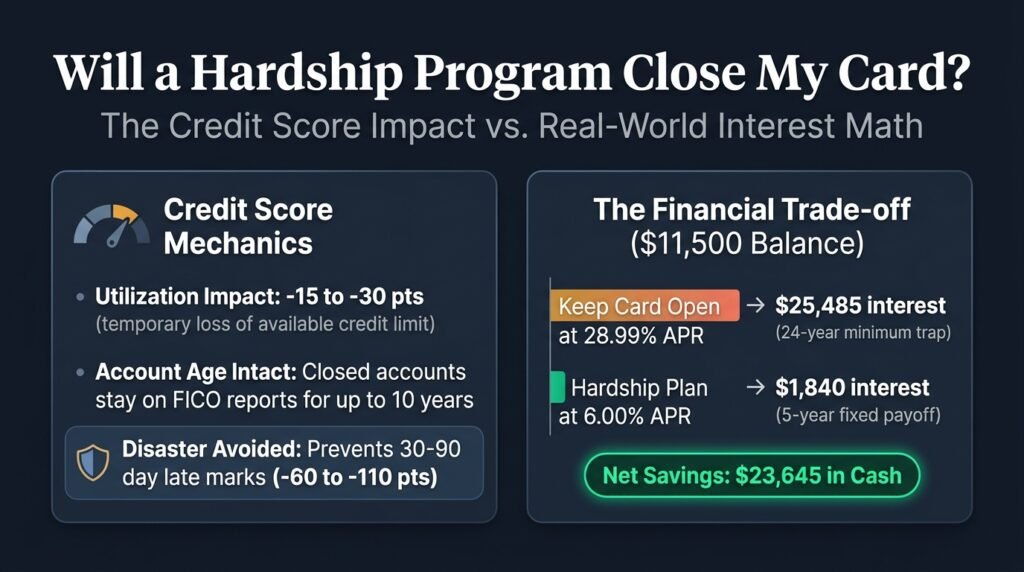
- Interest Rate Reduction: Standard 24% to 29.99% APRs are frequently lowered to between 0% and 9.99%.
- Payment Reduction: Monthly minimum payments often drop by 40% to 60%, transforming an unsustainable bill into an affordable fixed payment.
- Fee Waivers: Late fees and over-limit charges are stopped and often retroactively credited.
- Account Status: The account is kept current, preventing progressive 60-day, 90-day, and charge-off marks.
While enrolling will almost always require closing or suspending the credit line (as explored in will a hardship program close my account?), preserving cash flow and preventing legal judgments far outweighs keeping a line of credit that you can no longer afford to service.
“Hello, I am calling because my household has experienced an unexpected cash-flow deficit. I want to honor my obligations, but my current minimum payment is beyond my reach. Before my account falls further past due, I would like to speak with your internal hardship or retention department about enrolling in a payment assistance program that lowers my interest rate and reduces my monthly minimum to something sustainable.”
Step 5: Nonprofit Debt Management (DMP) vs. Settlement Scams
If you have multiple cards across multiple institutions and negotiating with each issuer individually feels overwhelming, an accredited nonprofit credit counseling agency is your strongest ally.
Through a Debt Management Plan (DMP), a certified counselor at an agency accredited by the National Foundation for Credit Counseling (NFCC) consolidates your payments into one monthly draft. They use pre-negotiated concession agreements to slash your interest rates across all cards, waiving fees and establishing a clear 36- to 60-month payoff roadmap.
Before deciding whether to hire assistance or manage the process yourself, read our full comparison of whether a debt management plan is worth it.
Never confuse an NFCC-accredited nonprofit DMP with for-profit “debt relief” or “debt settlement” companies. For-profit settlement companies instruct you to stop paying all your creditors, let your accounts default, and deposit money into a private escrow account while they wait for issuers to charge off your debt. This destroys your credit, generates dozens of collection calls, exposes you to creditor lawsuits, and costs thousands in predatory contingency fees.
Worked Math: The Three Strategies Compared
Let us return to our case study: $3,400 monthly take-home pay, $2,900 in essential Four Walls living expenses, and $1,100 in required minimum payments across four cards, leaving a $500 monthly pool for debt against a $600 shortfall.
| Strategy | Monthly Debt Outlay | Accounts Delinquent | Monthly Late Fees | Cash Buffer Remaining | Outcome After 6 Months |
|---|---|---|---|---|---|
| Option A: Blind Spreading (Panic) | $500 ($125 to each card) | 4 accounts | $160 / month | $0 | All accounts delinquent; $960 wasted on fees; credit score crushed; $0 emergency savings. |
| Option B: Strategic Triage | $450 (Full minimum on Card 3 & 4; Card 1 & 2 deferred) | 2 accounts | $80 / month | $50 | Two accounts kept 100% spotless and open; two accounts targeted for immediate hardship terms. |
| Option C: In-House Hardship / DMP | $480 total across all cards (rates slashed to 7%) | 0 accounts | $0 | $20 | Deficit eliminated; zero late fees; principal drops every month; full debt freedom in 48 months. |
Notice the massive difference between Option A and Option C. In Option A, the household spent every dollar they had and ended up in ruins. In Option C, restructuring the interest rates reduced their monthly payments below their available cash flow, instantly turning a catastrophic monthly deficit into a sustainable surplus.
Simulate Your True Cash-Flow Break-Even
When money is tight, guessing your debt payoff timeline leads to costly errors. LEVEL is a private, deterministic debt planner that lets you model payment adjustments, test hardship scenarios, and visualize your exact debt-free date without ever linking your bank accounts or sharing login credentials.
Frequently Asked Questions
What happens if I cannot afford my minimum credit card payment?
If you fail to make your minimum payment, your card issuer will assess a late fee (typically up to $40) and may apply a higher penalty APR. However, if your payment is less than 30 days past due, it will not be reported to the credit bureaus. Use this 29-day window to contact your issuer’s hardship assistance department to request reduced payments and waived fees before public credit damage occurs.
Will paying part of my minimum credit card payment protect my credit?
No. Under standard credit card agreements, partial payments are treated as missed payments. If your minimum is $200 and you pay $100, the issuer will still assess a full late fee and will report your account as 30 days delinquent once 30 days pass from the original due date. Never sacrifice grocery or utility money to make ineffective partial payments.
Can a credit card company garnish my wages if I stop paying?
A credit card issuer cannot garnish your wages or seize funds from your bank account without first filing a civil lawsuit against you, serving you with court papers, and winning a formal legal judgment. This legal process generally takes between six and eighteen months. Creditors cannot simply take your paycheck upon a missed payment.
Should I take a 401(k) loan or cash out retirement to pay credit card minimums?
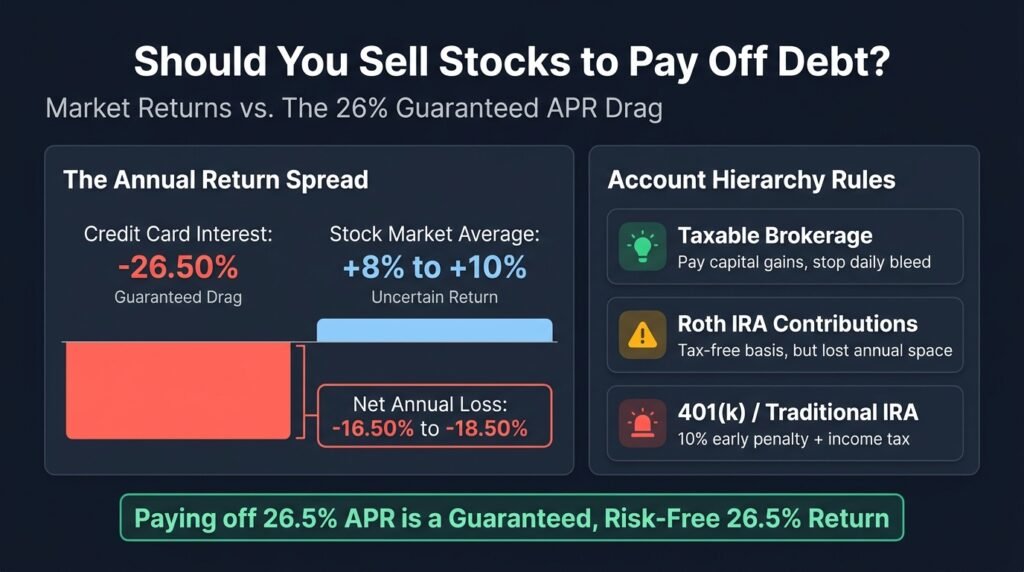
Generally, no. Retirement accounts like 401(k) plans and IRAs are protected from unsecured creditors under federal ERISA law in almost all states. Cashing out retirement funds triggers substantial income taxes and early withdrawal penalties to pay off unsecured debt that could otherwise be restructured through a hardship program, a debt management plan, or discharged in an extreme situation.
What should I tell my credit card company when I call?
State clearly that your household has experienced a documented cash-flow disruption and that you want to pay what you owe, but your current contractual minimum payment is unmanageable. Ask specifically for their internal hardship or payment assistance program, request a reduced interest rate, and ask for a lower fixed monthly payment that fits within your basic living budget.