
Is a Debt Management Plan Worth It? The Real Math Behind “Only $60 Lower”
Yes—a nonprofit Debt Management Plan (DMP) is almost always worth it when you are carrying high-interest credit card debt, even if the quoted monthly payment looks barely lower than your current minimums. Borrowers frequently walk away from a DMP quote that drops their payment from $560 to $500 a month, thinking, “Why close my cards just to save $60?” That hesitation mistakes monthly cash flow for principal velocity: under the hood, a DMP slashes your APR from ~28% to ~7.5%, flipping $308 per month from wasted bank interest directly into principal reduction and saving over $18,000.
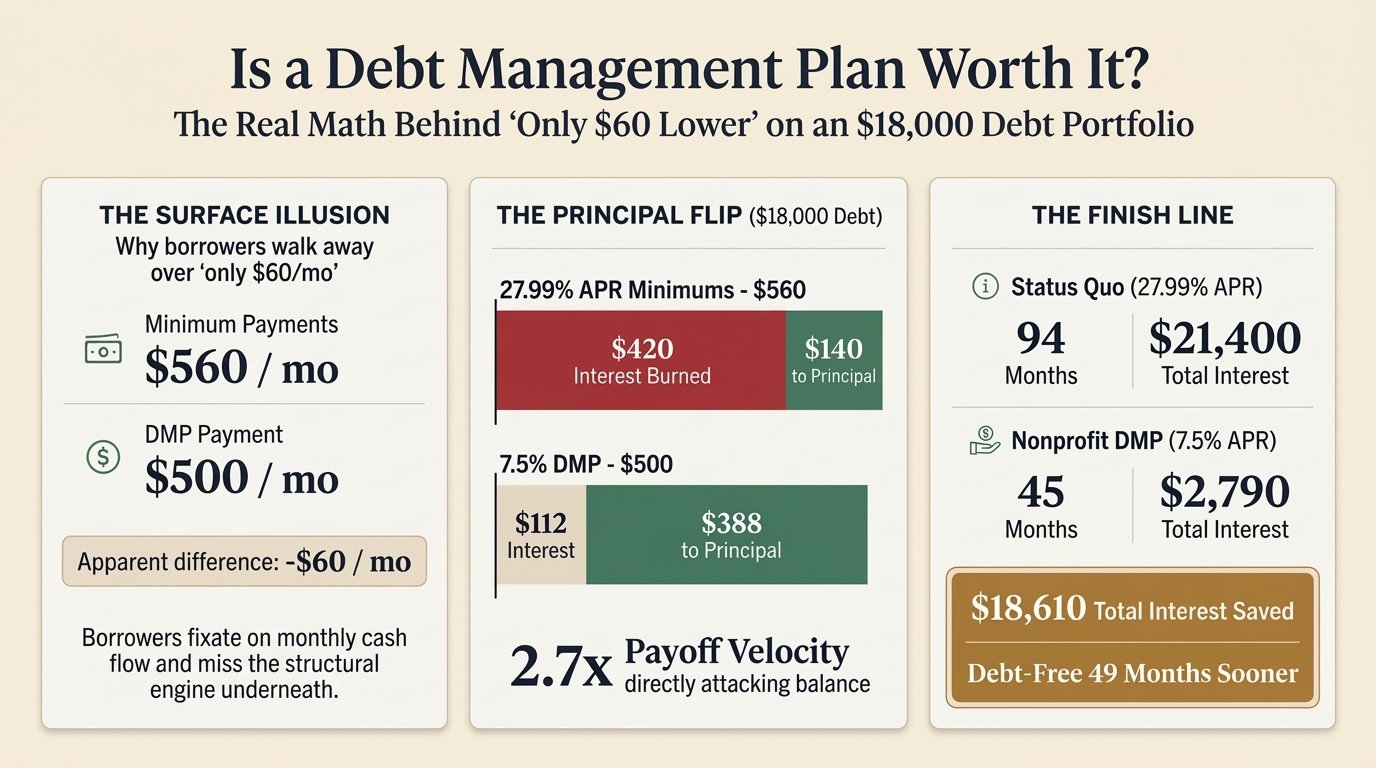
A household carries $18,000 in revolving credit card debt spread across four major cards at an average 27.99% APR. Together, their required minimum payments total $560 per month. Exhausted by balances that never seem to budge, they call an accredited nonprofit credit counseling agency to get a Debt Management Plan quote.
After reviewing their accounts, the counselor presents the numbers: one consolidated monthly payment of $500 per month (including the agency’s $40 monthly maintenance fee), with every card paid off in 45 months. In exchange, all four credit cards must be closed upon enrollment.
The borrower’s immediate gut reaction is disappointment: “Wait—I have to shut down all my credit lines just to lower my monthly bills by $60? How is that worth it?”
The Optical Illusion of Minimum Payments
The reason so many borrowers hesitate when they see a DMP quote is that human intuition judges financial relief by immediate monthly cash flow. If you are paying $560 a month and a program offers you a $500 payment, your brain registers a meager 10.7% improvement.
What your brain misses is the internal composition of that payment. Revolving credit card minimum payments are engineered by major card issuers to keep you in profitable perpetual debt—typically calculated as 1% of your principal balance plus 100% of that month’s accrued interest.
When you are carrying $18,000 at 27.99% APR, your daily interest bleed is $13.80 every single day (Daily Interest = [Balance × APR] ÷ 365). Over a 30.4-day billing cycle, that equals $420 in pure finance charges.
Look at what happens in Month 1 on an $18,000 debt portfolio when you compare your existing minimum payments against a nonprofit DMP:
- Status Quo ($560/mo at 27.99% APR): Out of your $560 payment, $420.00 is immediately incinerated in interest. Only $140.00 actually reduces your $18,000 balance. Seventy-five percent of your hard-earned cash vanishes into thin air.
- Nonprofit DMP ($500/mo at 7.5% Concessionary APR): Accredited nonprofit counseling agencies have pre-negotiated institutional contracts with major card issuers that drop APRs to ~6% to 9% (7.5% average). At 7.5% APR, your monthly interest charge collapses from $420 down to $112.50.
- The Principal Flip: Even if $35 to $40 of your $500 payment goes toward the nonprofit agency’s monthly administrative fee, roughly $350 to $388 per month goes straight into your principal balance.
- The Bottom Line: You are paying $60 less out of pocket every month, yet you are paying down your actual debt 2.7 times faster ($388/mo vs. $140/mo).
Why DMP Quotes Aren’t Lower by $250 a Month
Why doesn’t the credit counseling agency drop your payment from $560 down to $250 a month if the interest rate falls to 7.5%? Because institutional DMP contracts between nonprofit agencies and major lenders mandate a strict 36-to-60-month full amortization schedule.
Rather than stretching your lower interest rate over 20 years—which is how credit card minimum formulas work—a DMP locks your monthly payment at roughly 2.2% to 2.7% of your starting balance so the entire debt is mathematically guaranteed to reach $0 within three to five years. Furthermore, unlike a minimum payment that shrinks slightly as your balance drops (dragging out the tail of your payoff for decades), a DMP payment stays fixed until the final dollar is cleared.
What a Nonprofit DMP Actually Is (and What It Isn’t)
One of the biggest sources of anxiety on financial forums is confusing a nonprofit Debt Management Plan (DMP) with a for-profit debt settlement company. As we broke down in our deep dive on debt settlement vs. debt consolidation, the two could not be more different:
- 100% Principal Repayment (Zero Default): In a nonprofit DMP (typically accessed through agencies accredited by the National Foundation for Credit Counseling, or NFCC), you repay 100% of the principal you borrowed. You never stop paying your bills, and your accounts are never sent to collections.
- No Tax Bomb: Because no principal is forgiven for less than you owe, the IRS does not issue a Form 1099-C for canceled debt income.
- Bypasses Frontline Rejections: Even if you called your card company directly and were denied a lower APR by customer service, major issuers honor institutional DMP rate cuts automatically upon receiving the electronic proposal from an accredited nonprofit agency.
- Capped Administrative Fees: By law and accreditation standards, nonprofit DMP setup fees and monthly maintenance fees are strictly capped (usually $30 to $60 per month total, and frequently waived for severe financial hardship).
| Metric ($18,000 Debt Portfolio) | Status Quo (Minimums at 27.99%) | Nonprofit DMP (Fixed at 7.5%) | For-Profit Debt Settlement |
|---|---|---|---|
| Initial Monthly Outflow | $560 / month | $500 / month | ~$340 / month (into escrow) |
| Month 1 Principal Paid | $140 (25% of payment) | $388 (77% of payment) | $0 (deliberate default) |
| Time to Debt-Free | 94+ Months (7.8 Years) | 45 Months (3.75 Years) | 36 – 48 Months |
| Total Interest + Fees Paid | $21,400+ | ~$2,790 | $4,500+ in settlement fees + IRS tax |
| Credit Score Trajectory | Stagnant (High utilization drag) | Steady climb after initial closure dip | Severe 100–150+ pt crash for 7 years |
The Real Trade-Offs: What You Give Up in a DMP
While the interest savings of a DMP are undeniable, enrolling is a binding structural commitment. Before signing your agreement, you must weigh three non-negotiable trade-offs:
- Mandatory Account Closure: Every credit card enrolled in the DMP will be permanently closed by the issuer. While you can often keep one unencumbered card outside the plan for travel or emergencies (provided it has a $0 balance), closing multiple credit lines will temporarily reduce your total available credit limit and shift your credit utilization ratio until the balances amortize down.
- Zero Tolerance for Missed Payments: Institutional DMP concessions are contingent on strict on-time monthly electronic drafts. If an unexpected car repair causes you to miss a monthly DMP draft, creditors can revoke the 7.5% concessionary APR and reinstate your original 28% rate—plus retroactive penalty APRs.
- Loss of Payment Flexibility: Because the agency distributes a fixed monthly draft across all enrolled creditors according to pre-set creditor rules, you cannot easily drop down to a smaller payment during a tight month.
If a DMP lowers your monthly outflow by $60 to $200 a month, do not absorb that savings back into lifestyle spending. Route 100% of the monthly difference into a dedicated high-yield savings account until you have a $1,000 to $1,500 emergency buffer, and set your DMP autopay to draw two days after your paycheck clears. That cash buffer ensures an unexpected medical bill or car deductible never forces you to miss a DMP payment and lose your negotiated rates.
When a DMP Is Worth It vs. When to Go DIY
How do you know whether to sign the DMP paperwork or execute a self-directed payoff plan?
- A Nonprofit DMP Is Worth It If: Your average APR exceeds 22%, your debt-to-income ratio prevents you from qualifying for a low-rate credit union refinance or 0% balance transfer, and you only have enough room in your budget to pay roughly what your current minimums cost. In that scenario, cutting the APR from 28% to 7.5% is the single highest-leverage move available.
- A DIY Payoff Plan Is Better If: You have strong monthly surplus cash flow ($300 to $800+ above your minimums) or only one or two high-interest cards that you can negotiate directly via an internal credit card hardship program. By directing a concentrated Debt Avalanche at your highest-APR balance, you can often eliminate the debt in 18 to 24 months while keeping your oldest credit lines open and avoiding monthly agency fees.
Compare Your DIY Payoff Velocity Against a DMP Quote
Before closing your credit cards in a 5-year program, see what your exact numbers look like side by side. LEVEL calculates your daily interest bleed down to the cent and lets you test how a targeted Avalanche sequence—or an internal 7% hardship rate—changes your exact debt-free date. No bank logins or credit pulls required.
Run Your Custom Payoff Numbers With LEVEL →