
Denied a Lower APR? 6 Moves That Still Work
You dialed the number on the back of your card, asked politely for an interest rate reduction, and were met with the dreaded scripted wall: “Our automated system shows no promotional rate offers for your account at this time.” Getting shut down by frontline customer support feels like a dead end. In reality, it is simply a sign that you hit an algorithm with zero manual override power. Here are the six procedural and mathematical moves that still work.
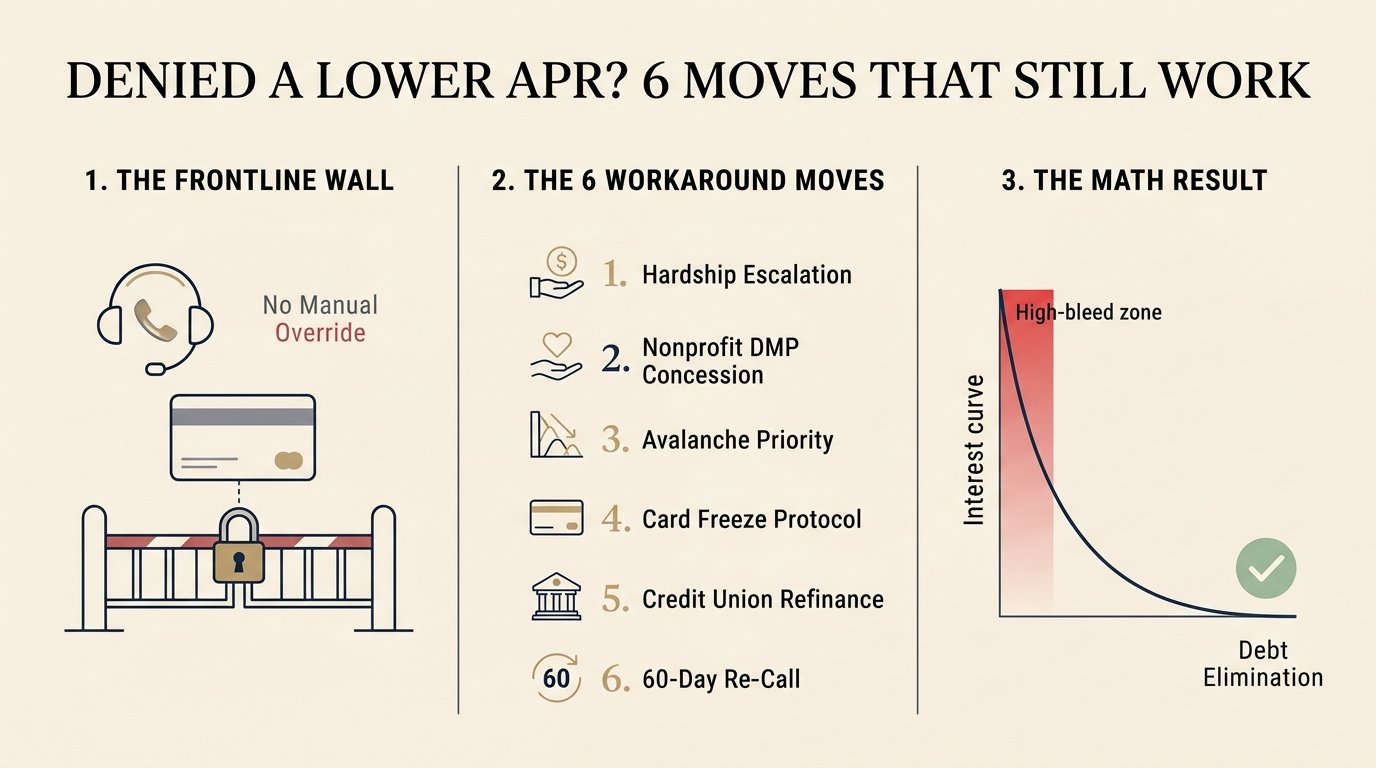
A borrower carries an $8,500 balance on a major credit card at a punishing 28.99% APR. Their required minimum payment is $275 per month. But because interest accumulates daily, over $205 of that monthly payment is immediately incinerated in interest, leaving less than $70 to reduce the actual balance.
Having read financial blogs advising them to “call and ask for a courtesy rate cut,” they dial customer service. The representative is polite but firm: “I apologize, but our system does not allow us to manually adjust APRs. The rates are fixed based on automated risk assessments.”
The cardholder hangs up, convinced they are trapped under 29% interest for the next six years. They do not realize that frontline phone reps have zero rate-adjustment authority—and that five completely different institutional and mathematical levers remain entirely untouched.
Why Frontline Customer Service Rejects You
To understand why your request was denied, you must understand the operational architecture of modern revolving lenders. Frontline telephone representatives work inside customer care call centers. Their terminals are locked down by compliance software designed specifically to prevent manual discretion.
When you ask a general representative for a lower interest rate, their software queries a pre-configured promotional marketing database. If an automated algorithm has not already flagged your account for a retention offer (typically reserved for profitable borrowers who pay their full statement balance each month), the button simply does not exist on their screen. Pleading with, arguing with, or trying to charm a frontline agent is mathematically useless—they cannot press a button that is not there.
When frontline customer care denies your request, you do not accept the 29% interest rate. You shift immediately into the six alternative moves that bypass their terminal entirely.
Move 1: The Formal Hardship Escalation
The single most common mistake borrowers make is confusing a promotional rate discount with a financial hardship restructuring. Frontline agents handle promotional discounts; an entirely separate department handles distress concessions.
Call the issuer back, bypass general inquiries, and ask directly for the Loss Mitigation, Account Retention, or Financial Hardship Unit. As detailed in our foundational guide on how credit card hardship programs work, loss-mitigation officers operate under completely different underwriting guidelines. When presented with a verifiable financial life event (such as reduced overtime, emergency healthcare costs, or marital transition), they possess the institutional authority to slash your interest rate to 6% to 9% fixed for 12 to 60 months in exchange for freezing the card while you amortize the balance.
Move 2: The Nonprofit Debt Management Plan (DMP) Workaround
What happens if your card issuer’s internal hardship department also refuses—often citing that your account is still current and has not fallen 60 days delinquent?
You execute the institutional flank: enroll through an accredited nonprofit credit counseling agency affiliated with the National Foundation for Credit Counseling (NFCC). Almost every major revolving card issuer maintains pre-negotiated institutional agreements with accredited nonprofit DMPs. These agreements are binding corporate contracts that grant automatic interest rate reductions—typically dropping 28%+ APRs down to 6%–9% across the board—even when an individual borrower calling the customer service desk is repeatedly told “no.”
Observe the mathematical trajectory of an $8,500 balance at 28.99% APR with a fixed $275 monthly payment under three distinct scenarios:
- Path A (Accepting the Frontline Rejection): You pay $275/mo under standard terms. Total time to zero: 68 months (5.7 years). Total interest paid: $5,432.
- Path B (The Nonprofit DMP Workaround at 7.5% Fixed): Your DMP forces an institutional rate cut to 7.5%. With that exact same $275/mo payment, total time to zero drops to 35 months (under 3 years). Total interest paid: $972. Net savings: $4,460 in cash.
- Path C (The LEVEL Avalanche Strike): Your issuer refuses a rate cut, but you use LEVEL to freeze the card, keep all other debts at bare minimums, and route an extra $200/mo into this account ($475/mo total). Payoff time drops to 23 months and total interest drops to $1,652—saving $3,780 even with zero cooperation from the bank.
Move 3: The Focused Debt Avalanche (Mathematical Nullification)
If you cannot lower the interest rate through negotiation, you can mathematically destroy the rate’s power through principal acceleration. This is known as rate nullification.
Interest on a credit card compounds daily based on your Average Daily Balance (Daily Interest = [Balance × APR] ÷ 365). The lender only collects high interest if the principal remains large over time. Under the Debt Avalanche strategy:
- Freeze minimum payments on every other credit card and installment loan you own.
- Direct every available surplus dollar from side gigs, spending cuts, or windfalls (as outlined in our guide on how to deploy a lump sum) straight into this single uncooperative card.
- By driving the principal down aggressively, you shrink the daily balance on which the 29% APR is calculated—robbing the lender of their interest profits months before their amortization schedule predicted.
Move 4: The Digital Friction Freeze Protocol
A high-APR card becomes fatal when it remains an active spending instrument. When an issuer denies an APR reduction, treat that account as an active leak in your financial hull:
- Sever Digital Wallets: Remove the card from Apple Pay, Google Wallet, and Samsung Pay immediately.
- Scrub Recurring Subscriptions: Audit your statement for recurring streaming, gym, or software subscriptions and redirect them to a debit card or secondary zero-balance card. A $15 subscription left on a 29% card you are paying down compounds into unnecessary finance charges every billing cycle.
- Physical Isolation: Place the physical card in a block of ice in the freezer or lock it in a safe. Keep the line open to protect your credit utilization ratio, but ensure new charges drop to zero.
Move 5: The Credit Union Personal Loan Refinance
Why pay an uncooperative revolving lender 28.99% when community credit unions operate under non-profit, member-owned charters? Federal credit unions have legal caps on loan interest rates that sit substantially lower than commercial credit card companies.
If your credit score remains in fair-to-good standing (660+) and your debt obligations fit within standard lending guidelines, apply for a fixed-rate unsecured personal loan through a local credit union. Replacing an $8,500 revolving credit card at 28.99% with a 36-month credit union personal loan at 10.5%–12% APR cuts your daily interest bleed by more than half, establishes a guaranteed three-year finish line, and immediately lowers your revolving credit utilization to zero.
Before applying, run your numbers through our Debt-to-Income (DTI) ratio calculator to ensure your monthly debt obligations qualify for prime credit union underwriting.
Move 6: The 60-Day Automated Recalibration
Lender risk assessment models are not permanent; they re-score cardholders on automated 30-day and 60-day cycles. An account denied an APR reduction in January may suddenly become eligible in March if account behavior shifts.
Set a calendar reminder for 60 days from your initial rejection. In the interim:
- Make two consecutive on-time payments of at least double the minimum amount.
- Refrain from adding any new charges to the card.
- Ensure no new hard inquiries or new credit applications appear on your credit profile.
When you call back in 60 days, their automated risk scoring engine will register two cycles of rapid balance reduction and positive payment velocity—frequently unlocking the very promotional concessions that were grayed out during your first call.
| Workaround Move | Execution Difficulty | Typical Rate Impact | Account Status | Credit Score Impact |
|---|---|---|---|---|
| 1. Hardship Escalation | Moderate (Requires qualifying event) | Drops to 6% – 9% Fixed | Temporarily frozen or closed | Neutral (Temporary utilization shift if closed) |
| 2. Nonprofit DMP Route | Low (Agency negotiates for you) | Drops to 6% – 9% Institutional | Enrolled cards closed | Temporary dip, rapid long-term recovery |
| 3. LEVEL Avalanche Strike | Zero negotiation needed | Rate stays same; interest dollars collapse | Account remains open & active | Significant boost as balance falls |
| 4. Digital Friction Freeze | Immediate (10 minutes) | Prevents new balance compounding | Account remains open | Neutral / protective |
| 5. Credit Union Refinance | Moderate (Requires 660+ FICO) | Replaces 29% with 10% – 12% Fixed | Original card hits $0 balance | Major boost (Revolving utilization drops to 0%) |
| 6. 60-Day Recalibration | Low (Calendar follow-up) | Potential 3% – 8% APR reduction | Account remains open & active | Positive payment history built |
Take Control of Your Payoff Architecture with LEVEL
When lenders refuse to lower your interest rate, mathematical precision is your best weapon. LEVEL calculates your exact daily interest bleed down to the cent, models customized Avalanche payoff sequences, and proves how small cash-flow adjustments eliminate debt years ahead of schedule. Zero bank account logins required.
Model Your Custom Payoff Roadmap Free →