
Debt Settlement vs. Debt Consolidation: What’s the Real Difference?
Late-night television commercials and direct mail flyers promise to “cut your debt in half with one low monthly payment.” What they rarely disclose is whether they are offering a legitimate loan refinancing or a high-risk debt settlement program that will destroy your credit score, trigger IRS tax liabilities, and expose you to creditor lawsuits. Here is the unvarnished mathematical truth behind debt settlement versus debt consolidation.
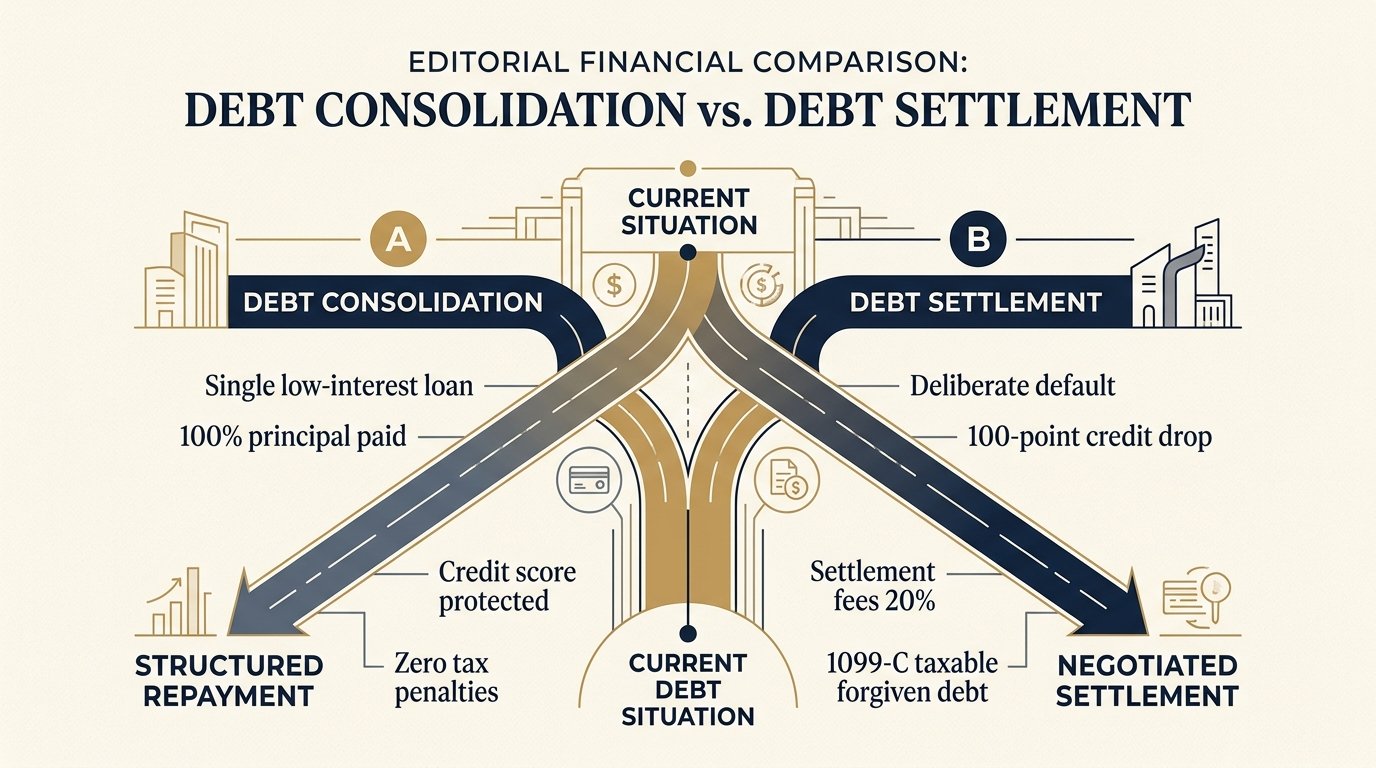
- The Critical Distinction: Debt Consolidation is an act of refinancing (paying 100% of your principal through a new loan at a lower APR). Debt Settlement is an act of deliberate default (stopping payments entirely so creditors agree to accept less than you owe).
- Credit Score Consequences: Consolidation protects or even improves your credit score by slashing revolving credit utilization. Settlement deliberately destroys your credit—dropping scores by 100 to 150+ points and leaving charge-off notations that last 7 years.
- The 15%–25% Fee Burden: For-profit settlement companies charge steep fees calculated as a percentage of your enrolled balance, significantly eroding the advertised savings.
- The IRS Form 1099-C Tax Bomb: In the United States, forgiven debt over $600 is treated by the IRS as ordinary taxable income. A $15,000 settlement discount can trigger a surprise $3,500+ tax bill next April.
- The Non-Profit Alternative (DMP): Before considering for-profit settlement, examine a Debt Management Plan through an NFCC-accredited credit counseling agency, which slashes interest rates to 6%–10% without deliberate defaults.
1. The Deliberate Marketing Blur
If you have ever opened a glossy mailer offering to “consolidate your credit card payments into a single payment 50% lower than what you pay now,” you have encountered the financial industry’s most lucrative marketing sleight of hand.
Predatory debt relief firms routinely use the word “consolidation” in their headlines because consumers associate it with responsible financial restructuring. But buried in the fine print on page four is the actual business model: Debt Settlement (often rebranded as “debt resolution” or “debt negotiation”).
These two mechanisms are not variations of the same strategy. They represent opposite financial philosophies with radically different legal, credit, and tax outcomes.
2. Path A: How Debt Consolidation Works
Debt consolidation is a conventional refinancing transaction. You take out a single new loan—or transfer balances to a 0% APR credit card—and use the proceeds to pay off multiple higher-interest credit cards or medical bills in full.
Instead of tracking four different due dates, minimum payments, and interest rates averaging 24% to 29% APR, you have a single monthly payment with a fixed interest rate (typically 8% to 15% APR) and a fixed 3- to 5-year repayment term.
Common Vehicles for Debt Consolidation:
- Unsecured Personal Loans: Fixed-rate installment loans offered by banks, credit unions, or online lenders that require no collateral.
- 0% APR Balance Transfer Cards: Promotional cards offering 12 to 21 months of zero interest in exchange for a 3% to 5% upfront transfer fee.
- Home Equity Loans or HELOCs: Secured loans borrowing against home equity. While they offer low rates, they convert unsecured credit card debt into debt secured by your primary residence (putting your home at foreclosure risk if you default).
Consolidation is generally positive or neutral for your credit profile.
When your personal loan proceeds pay off $20,000 of maxed-out credit cards, your revolving credit utilization ratio plummets from 95% down to near 0%. Because utilization accounts for 30% of your FICO score, borrowers often see their credit scores jump by 25 to 50 points within 60 days, even after accounting for the minor 3- to 5-point dip from the initial hard inquiry (as mapped in our guide to credit score changes during payoff).
3. Path B: How Debt Settlement Actually Works
Debt settlement operates on a completely different premise: it exploits your creditors’ fear of bankruptcy to force a discounted payout.
Major banks (Chase, Citi, Capital One, American Express) will never forgive 40% or 50% of your balance if you are actively making payments on time. Why should they? You are honoring the contract.
Therefore, the operational mechanics of a debt settlement program unfold in a very specific, high-risk sequence:
The settlement company instructs you to immediately stop paying your creditors. Instead, you redirect a monthly payment into a third-party escrow account controlled by the settlement firm. As your accounts go 30, 60, 90, and 120 days delinquent, creditors assess late fees, apply penalty APRs (often 29.99%+), and unleash collection departments.
At approximately 180 days of non-payment, federal accounting rules require credit card banks to “charge off” the debt as a bad-debt loss. The account is either placed with an aggressive third-party debt collector or sold to a debt buyer for pennies on the dollar.
Once you have accumulated several thousand dollars in your escrow account and the creditor believes you are insolvent, the settlement firm approaches the collector with a lump-sum offer (e.g., $4,000 to resolve a $9,000 balance). If accepted, the escrow funds are wired to the creditor.
Federal Trade Commission (FTC) rules prohibit settlement firms from charging upfront fees before a settlement is reached. However, once settled, they collect a fee—typically 15% to 25% of the total enrolled debt balance. If you enrolled $30,000 of debt, the firm takes $4,500 to $7,500 in fees directly from your escrow funds.
4. The Hidden Traps of Debt Settlement
While eliminating a portion of your principal sounds alluring on paper, debt settlement comes with three severe pitfalls that marketing brochures conveniently omit:
1. Creditor Lawsuits and Wage Garnishment
Creditors are not legally required to negotiate with settlement companies. When you stop paying, major banks frequently bypass negotiations and file formal civil lawsuits in county court.
If a creditor obtains a court judgment, they can legally garnish your wages, place a lien on your real estate, or levy your checking accounts. Debt settlement companies have no legal authority to stop court proceedings—only a formal bankruptcy filing creates an automatic statutory stay.
2. The IRS Form 1099-C Tax Bomb
Under the Internal Revenue Code (Section 61(a)(11)), canceled debt is treated as taxable gross income.
If a credit card company agrees to settle a $20,000 balance for $10,000, you saved $10,000 in debt. However, in January of the following year, the lender files IRS Form 1099-C (Cancellation of Debt) and sends a copy to you and the IRS.
That $10,000 of “forgiven” debt is added directly on top of your earned wages on your Form 1040. If you are in the 22% federal tax bracket plus a 5% state tax bracket, you owe $2,700 in cash taxes to the government on money you never actually held in your hand.
The Insolvency Exception: You can only avoid paying tax on canceled debt if you can prove to the IRS (via Form 982) that your total liabilities exceeded the fair market value of all your total assets immediately before the settlement took place.
3. Severe 7-Year Credit Scorching
Because settlement requires defaulting on all accounts for 6 to 12 months, your credit report will be peppered with 30-, 60-, 90-, and 120-day late marks, charge-offs, and collections. Once settled, the account status updates to “Settled for Less Than Full Balance” or “Paid In Full for Less Than Agreed.”
These derogatory notations remain on your credit history for up to 7 years from the date of initial delinquency, preventing you from qualifying for conventional mortgages, auto financing, apartment rentals, or employment security clearances.
5. The Overlooked Alternative: Non-Profit Debt Management Plans (DMP)
Before resorting to for-profit settlement, consumers should evaluate a Debt Management Plan (DMP) offered by certified, non-profit credit counseling agencies (affiliated with the National Foundation for Credit Counseling at NFCC.org).
A DMP is not settlement and it is not a new loan. Instead, the non-profit agency uses pre-established concessions with major credit card issuers to:
- Slash your interest rates from 26%+ down to 6% to 10% APR.
- Waive ongoing late fees and penalty charges.
- Consolidate your payments into a single monthly disbursement handled by the agency over a structured 36- to 60-month window.
Because you repay 100% of your principal, there are zero 1099-C tax consequences, zero risk of creditor lawsuits, and your credit report shows accounts being paid on time under credit counseling—preserving your score far better than deliberate settlement charge-offs.
6. Comprehensive 3-Way Comparison Table
| Strategic Metric | Debt Consolidation Loan | Debt Settlement (Relief) | Non-Profit Debt Management Plan |
|---|---|---|---|
| Principal Paid | 100% of original balance | 40% to 60% of original balance | 100% of original balance |
| Credit Score Impact | Neutral to Positive (utilization drops) | Severe damage (-100 to -160 pts, lasts 7 yrs) | Mild temporary impact; improves as paid down |
| IRS Tax Consequences | None (it is a standard loan) | Forgiven balance taxed as ordinary income (1099-C) | None (full principal repaid) |
| Creditor Lawsuit Risk | Zero (accounts paid in full immediately) | High (delinquency triggers court filings) | Zero (formal agreement with creditors) |
| Program Fees | 1% to 6% origination fee (rolled into loan) | 15% to 25% of enrolled debt | Modest non-profit monthly fee ($25–$50/mo) |
| Credit Score Required | Good to Excellent (typically 650+ FICO) | No credit score requirement | No credit score requirement |
| Typical Timeline | 3 to 5 years (fixed term) | 2 to 4 years (unpredictable negotiations) | 3 to 5 years (structured repayment) |
7. Decision Framework: Which Path Matches Your Situation?
Your credit score is 650 or higher, you have steady earned income, and your total non-mortgage debt is less than 40% of your gross annual income. You want to stop interest bleeding while protecting your credit score for future home purchases or job applications.
Your credit score has slipped below 640 (disqualifying you from prime consolidation loans), you cannot afford 26% APR minimum payments, but you still have steady income to pay reduced interest (6%–9%) and want to avoid credit destruction and tax penalties.
You are facing deep insolvency, your total unsecured debt exceeds 50% of your gross income, and you have zero ability to service minimums even under reduced rates.
Critical Warning: If you are truly insolvent, consult a licensed bankruptcy attorney before paying a settlement firm thousands in fees. Chapter 7 bankruptcy often resolves debt in 4 to 6 months for a fraction of the cost, provides statutory legal immunity from lawsuits, and carries zero 1099-C tax liability.
Model Your Self-Directed Payoff Before Paying Predatory Fees
Before committing thousands of dollars in fees to a settlement firm or taking out an expensive loan, run the numbers yourself. LEVEL gives you an engineered financial simulator to model dynamic avalanche payoffs, test lump-sum debt blitzes, and pinpoint your exact zero-debt date—100% privately, with zero bank logins.
Architect Your Payoff at DebtFreeArchitect.com →Available on desktop and on mobile via the new LEVEL Mobile View. Zero bank credentials required.