
Paying Off Debt Before Retirement: A Realistic Timeline
Entering retirement with debt isn’t just an inconvenience—it is a mathematical multiplier of portfolio risk. In your working years, a $1,200 monthly debt payment is serviced by active human labor. In retirement, that same payment forces aggressive, non-negotiable distributions from your investment nest egg during severe bear markets. Discover how pre-retirement debt amplifies Sequence of Returns Risk, resolve the great mortgage debate, and execute a realistic 5-year chronological elimination timeline.
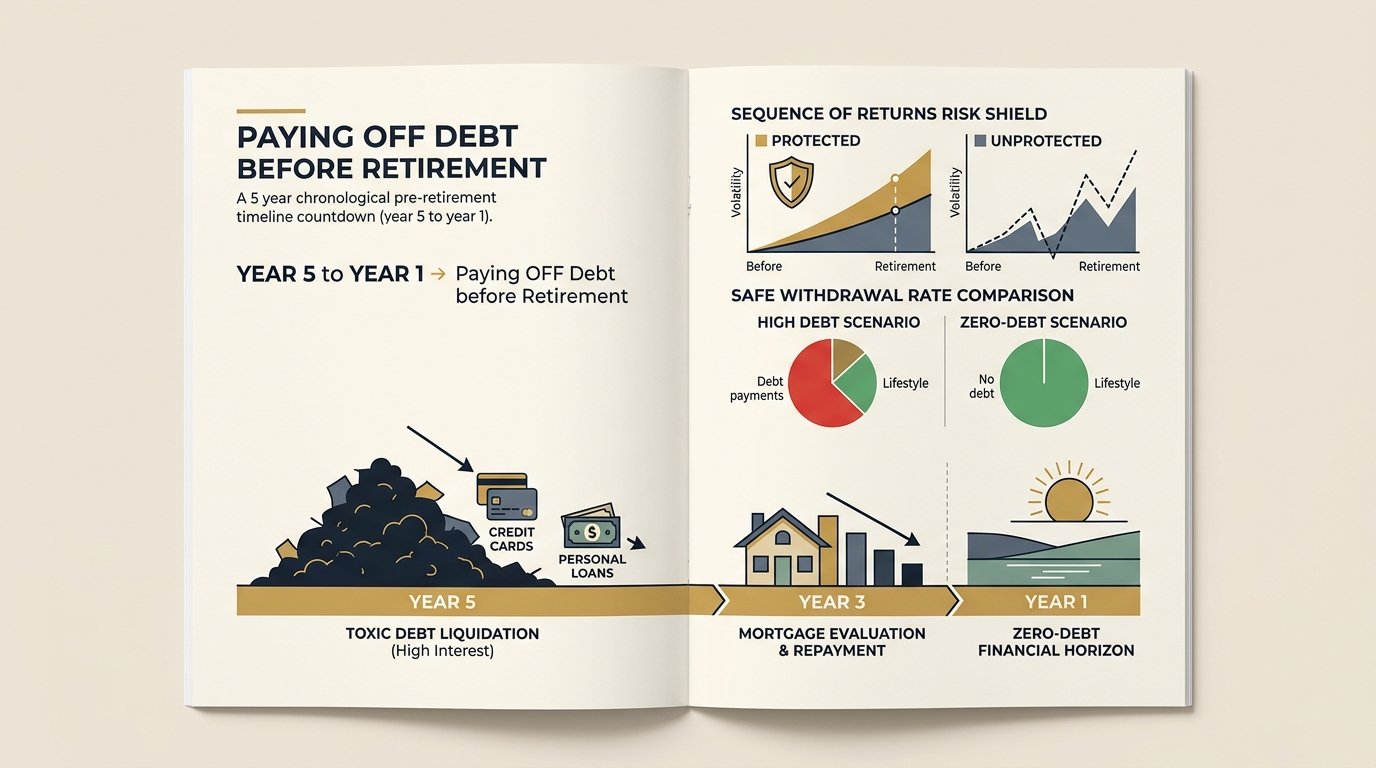
- The Sequence of Returns Risk Multiplier: Fixed monthly debt service forces mandatory retirement portfolio withdrawals even when markets drop 30%, permanently depleting principal and doubling the probability of portfolio failure.
- The Debt Classification Hierarchy: Unsecured high-APR debt (credit cards, personal loans) must be eliminated 100% prior to retirement. Low-interest mortgages require a nuanced balance between guaranteed cash-flow relief and liquid emergency reserves.
- The Safe Withdrawal Rate Impact: Eliminating $1,500/month in mandatory debt service reduces your required annual portfolio draw by $18,000. Under the standard 4% rule, this lowers your required retirement nest egg by an astounding $450,000!
- Avoid the 401(k) Lump-Sum Trap: Pulling a $50,000 to $100,000 lump sum from a traditional 401(k) or IRA to clear debt can push you into a 32%+ federal tax bracket, forfeiting up to a third of your hard-earned wealth to the IRS.
- The 12-Month Dry Run: Spend your final 12 working months living strictly on your projected retirement budget while banking your debt-service surplus to stress-test your cash flow before retiring.
1. The Modern Reality of Retiring with Debt
A generation ago, the cultural standard for retirement was clear: a gold watch, a final mortgage payment ceremony, and a pension. Today, that financial archetype has essentially vanished.
Federal Reserve consumer finance data reveals that over 65% of Americans aged 55 to 64 now carry non-mortgage debt into their final working decade, and more than 40% of homeowners aged 65 and older still carry an active mortgage.
Between funding children’s higher education (often via co-signed loans or Parent PLUS debt), managing unexpected mid-career medical events, and weathering economic shifts, millions of professionals arrive at age 60 with significant liabilities.
The instinct is often to panic or surrender to fatalism: “I’ll just carry this car payment and credit card minimum into retirement—Social Security will cover it.”
However, carrying fixed monthly liabilities into retirement is mathematically far more dangerous than carrying them during your 30s or 40s.
2. Why Debt in Retirement is Mathematically Lethal
When you are 38 years old, a $1,200 monthly debt payment is an opportunity cost: it prevents you from investing more in your brokerage account or taking a vacation. But your human capital—your paycheck—regenerates every two weeks.
When you retire, your active labor income drops to zero. Your lifestyle is funded exclusively by fixed streams (Social Security, pensions) and withdrawals from your accumulated nest egg (401k, IRA, taxable investments).
In financial planning, Sequence of Returns Risk refers to the danger of experiencing a major market downturn during the first 3 to 5 years of retirement.
Imagine entering retirement in a bear market where the S&P 500 declines by 25%. If your baseline living expenses are $4,000/month, you withdraw $48,000 for the year.
Now imagine entering that exact same bear market carrying $1,500/month in mandatory debt payments (mortgage, car loan, credit cards). Your required withdrawal surges from $48,000 to $66,000.
Because debt payments are contractual and non-negotiable, you cannot cut back on them when your stocks are down. You are forced to sell your depressed equities at the bottom of the market to pay Visa and the auto lender. When the market eventually rebounds, your remaining shares cannot recover. Carrying debt into retirement converts a normal cyclical downturn into irreversible portfolio ruin.
3. The Pre-Retirement Debt Classification Hierarchy
Not all debts should be treated identically in your pre-retirement plan. To engineer a realistic countdown, categorize your liabilities into three distinct operational tiers:
Includes: Credit cards, unsecured personal loans, high-interest auto notes (7%+), and medical balances.
The Rule: These liabilities must be eliminated 100% prior to retirement. Carrying a 22%–28% APR credit card into a retirement environment where your portfolio yields a balanced 6%–8% is financial suicide. Every dollar directed toward Tier 1 yields an immediate, guaranteed, risk-free return equal to the APR.
Includes: Federal student loans, Parent PLUS loans taken out for adult children, and modest vehicle notes (3%–5% APR).
The Rule: Transition co-signed debts back to the primary borrower if possible (e.g., student loan refinancing into the child’s name alone). For federal loans in your name, evaluate Income-Driven Repayment (IDR) options against lump-sum payoff before your retirement income drops.
Includes: Fixed-rate primary residential mortgages (especially sub-4% loans locked in prior to 2022).
The Debate: Pure spreadsheet math says that if your mortgage is locked at 3.25% and your high-yield savings or Treasury bills earn 4.5%–5.0%, you make more money keeping the mortgage and holding cash.
The Behavioral Reality: While the spreadsheet math is correct, wiping out a $1,800/month mortgage eliminates the single largest monthly cash outflow in retirement. It permanently shrinks your Safe Withdrawal Rate requirement, allowing a smaller nest egg to provide absolute peace of mind.
4. The 5-Year Chronological Countdown Timeline
Eliminating debt before retirement cannot be accomplished overnight. Attempting a rushed, chaotic liquidation 6 months before retiring leads to massive tax penalties. You need a structured 5-year flight plan.
Five years out, perform a forensic audit of your complete financial infrastructure:
- List every outstanding liability with its exact balance, interest rate, and monthly contractual payment.
- Log into the Social Security Administration portal (SSA.gov) to get precise estimates of your retirement benefits at ages 62, 67, and 70.
- Audit your guaranteed income floor (Pensions + Social Security) against your baseline retirement living costs. If your living costs exceed your guaranteed income, debt payments will directly eat your investment portfolio.
Once you turn 50, IRS catch-up contribution limits unlock. However, if you carry 20%+ APR revolving debt, dumping extra money into a balanced index fund while bleeding 24% interest is counterproductive (as detailed in our analysis of investing vs. paying off debt).
- Capture your full employer 401(k) match (free money), but divert catch-up contributions temporarily toward eradicating all Tier 1 credit cards and personal loans.
- Channel annual bonuses, tax refunds, and unused PTO payouts directly into principal paydowns using the Debt Avalanche method.
- Downsize non-essential assets (idle boats, secondary vehicles, recreational vehicles) and convert depreciating garage clutter into debt elimination fuel.
This is your last window to leverage your high W-2 salary. Lenders evaluate Debt-to-Income (DTI) ratios based on current active earned income. Once you retire, qualifying for prime refinancing rates or home equity lines becomes dramatically harder.
- If you have high-rate auto loans or personal loans, refinance them while your employment income is pristine.
- If downsizing to a smaller home or lower-tax state is part of your retirement roadmap, consider executing the move now. Selling a high-equity suburban house and buying a smaller home with cash completely eliminates your housing debt before day one of retirement.
With all Tier 1 toxic debt dead, you face your remaining mortgage. The golden rule of Year 2 is: never sacrifice essential liquidity to become mortgage-free.
If you have a $70,000 mortgage balance and $80,000 in liquid non-retirement savings, writing a check for $70,000 leaves you with only $10,000 in cash. A single major roof repair or medical deductible will force you right back onto high-interest credit cards.
Instead, calculate a structured amortization acceleration: add an extra $500 to $1,000/month to principal, or establish an auxiliary side-fund in short-term Treasuries earmarked to pay off the balance when it reaches parity.
Your final 12 months in the workforce should serve as an operational flight simulator:
- Calculate your exact projected retirement monthly income (pension, Social Security, and a conservative 3.5%–4% withdrawal from your nest egg).
- Live exclusively on that dollar amount for the entire 365 days leading up to retirement.
- Direct 100% of your remaining salary surplus into a dedicated cash emergency buffer (aiming for 1 to 2 years of living expenses in high-yield cash to insulate against bear markets, building on our principles of emergency funds and safety cushions).
If you can navigate 12 months with zero debt payments and comfortable cash flow, you are ready to submit your retirement papers with absolute confidence.
5. Retiring Debt-Free vs. Carrying Debt: The Math Comparison
To see how eliminating debt reshapes your retirement requirements, compare two retirees with identical $5,000/month desired lifestyle expenditures:
| Metric | Retiree A: Carrying $1,400/mo Debt | Retiree B: Zero Debt (Debt-Free) |
|---|---|---|
| Monthly Living Costs | $5,000 living + $1,400 debt = $6,400/mo | $5,000 living + $0 debt = $5,000/mo |
| Annual Spending Required | $76,800 / year | $60,000 / year |
| Social Security (Combined) | $36,000 / year | $36,000 / year |
| Portfolio Withdrawal Needed | $40,800 / year | $24,000 / year |
| Nest Egg Required (4% Rule) | $1,020,000 | $600,000 |
| Difference in Required Capital | Retiree B requires $420,000 less in invested assets to achieve identical lifestyle comfort! | |
| Bear Market Resilience | Severe risk: forced to sell $40.8k annually regardless of stock market crashes. | High resilience: low withdrawal rate allows portfolio to withstand extended downturns. |
6. Three Costly Mistakes Pre-Retirees Make
1. Raiding Your 401(k) in a Giant Lump Sum
Many pre-retirees look at their $60,000 credit card or mortgage balance and decide: “I’ll just pull $60,000 out of my 401(k) next Tuesday and wipe it out.”
As explored in our deep-dive on using a 401(k) to pay off debt, traditional 401(k) distributions are taxed as ordinary income in the year withdrawn. Taking a massive $60,000 distribution on top of your final year’s salary can push a significant portion of the withdrawal into the 24%, 32%, or 35% federal tax brackets, plus state income taxes and higher Medicare Part B premiums (IRMAA surcharges).
If you must tap retirement accounts to extinguish debt, spread the distributions across multiple tax years or wait until your first full retirement year when your taxable income drops into lower brackets.
2. Taking a 401(k) Loan in Your Final Working Years
Borrowing from your 401(k) to pay off credit cards feels harmless because you “pay the interest back to yourself.” However, if you separate from your employer—whether through retirement, early layoff, or company restructuring—most plan rules require the outstanding loan balance to be repaid in full within a narrow statutory window (typically by the federal tax filing deadline). If you cannot repay it, the balance is treated as a taxable distribution.
3. Co-Signing Student Loans for Adult Children or Grandchildren
One of the fastest-growing drivers of bankruptcy among Americans aged 60 and older is co-signed student loan debt. When you co-sign a loan, you are 100% legally liable for the entire balance. If your child struggles with employment or misses payments, the servicer will aggressively pursue you, garnish your wages, and damage your credit. Prioritize your own retirement solvency before co-signing for others.
7. The Pre-Retirement Debt Elimination Checklist
- [ ] Audit the Liability Stack: Tally every balance, APR, and monthly minimum; separate toxic revolving balances from low-rate mortgages.
- [ ] Map Guaranteed Income: Calculate Social Security and pension benefit dates to identify your non-portfolio income baseline.
- [ ] Eliminate Tier 1 Debt Completely: Ensure credit cards and unsecured loans hit an irrevocable $0 balance at least 24 months before retiring.
- [ ] Protect Your Cash Runway: Maintain 1 to 2 years of essential retirement expenses in liquid, short-term cash instruments before retiring.
- [ ] Decide on the Mortgage Strategy: Weigh the math of low rates against the psychological and safe withdrawal rate benefits of being mortgage-free.
- [ ] Conduct the 1-Year Dry Run: Live on your post-retirement budget for 12 continuous months while banking the surplus.
Model Your Pre-Retirement Payoff Timeline with Mathematical Precision
Retirement planning isn’t guesswork—it’s architectural engineering. LEVEL gives you an advanced financial simulator to model multi-year debt acceleration, test catch-up contributions versus lump-sum payoffs, and calculate the exact month your household reaches zero liabilities.
Model Your Retirement Roadmap at DebtFreeArchitect.com →Available on desktop and on the go via the newly launched LEVEL Mobile View. Zero bank logins required. 100% private.