
Pay Off Debt or Build an Emergency Fund First? The Mathematical Framework, False Dichotomies & Safe Minimums
Personal finance dogma presents a false ultimatum: either build a complete six-month emergency fund while paying punishing 26% credit card interest, or hoard zero cash and pray an unexpected car repair doesn’t shatter your debt payoff momentum. Here is how to architect an engineered capital allocation framework that stops cash bleed without leaving you defenseless.
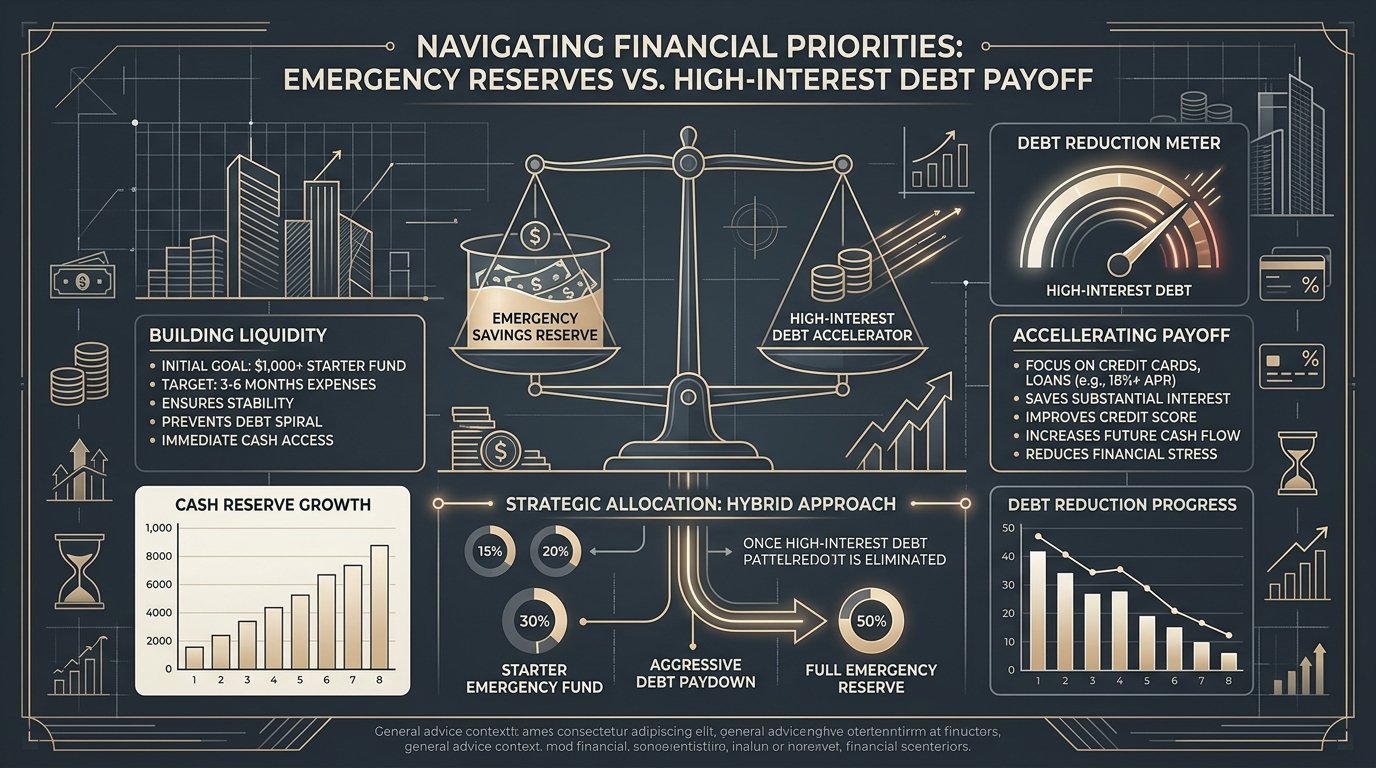
Few financial debates generate as much dogmatic polarization as the choice between building an emergency savings buffer and paying down debt. The personal finance universe is fractured into two rigid camps:
- The Ultra-Conservative Savers: They insist on holding 3 to 6 months of living expenses in cash before paying an extra dime toward debt, even as credit card balances compound at catastrophic 24% to 29% APRs.
- The Pure Math Purists: They argue that carrying any liquid savings beyond next week’s grocery money is irrational when revolving debt costs $20+ a day in pure interest. “Put every cent into debt,” they declare, “and if an emergency happens, just put it on the card.”
Both philosophies are fundamentally broken in the modern economy.
The first approach bleeds thousands of dollars every year in guaranteed interest losses. The second approach ignores the psychological physics of debt: when an uninsured emergency strikes an individual with zero liquid cash, they are forced right back into the credit trap. That sudden re-leveraging shatters psychological momentum, frequently causing borrowers to abandon their payoff plans entirely.
To break free from this cycle, you need an engineered capital allocation framework—one that calculates negative arbitrage, accounts for real-world emergency costs, and establishes a dynamic sequence between liquidity and debt eradication.
The Cost of Cash Drag: Understanding Negative Arbitrage
To understand why hoarding cash while carrying debt destroys wealth, you must examine the concept of negative interest rate arbitrage.
Suppose you have $10,000 sitting in a high-yield savings account (HYSA) earning a respectable 4.5% annual yield. Simultaneously, you are carrying $10,000 in credit card balances with an average APR of 25.7%.
Result: $2,570 (Interest Paid) − $450 (Interest Earned) = −$2,120 net loss per year (or −$176.67 every single month).
By keeping that $10,000 in savings while maintaining revolving debt, you are paying a private financial tax of over $2,100 each year for the illusion of security. Cash sitting in a bank account while credit card interest compounds is not a safety net; it is an active financial hemorrhage.
The $1,000 Emergency Fund Myth in 2026
On the flip side lies the famous rule popularized in the 1990s: “Save a flat $1,000 starter emergency fund, then put everything else toward debt.”
While this rule provided simple, actionable advice three decades ago, inflation has rendered a flat $1,000 emergency fund dangerously obsolete. In 2026, very few genuine household emergencies cost less than $1,000:
- The average auto repair in the U.S. now exceeds $1,350.
- A dental crown or emergency root canal typically costs between $1,200 and $2,000 after insurance deductibles.
- An emergency veterinary visit easily crosses $1,500 to $3,000.
- Replacing a failed hot water heater or central A/C compressor ranges from $1,800 to $4,500.
When someone with an arbitrary $1,000 buffer encounters a $2,200 transmission failure, their emergency fund is wiped out instantly, and the remaining $1,200 lands directly back on high-APR credit cards. The psychological toll of watching a card balance surge after months of disciplined sacrifice causes 74% of borrowers to fall back into passive minimum payments.
The Re-Leveraging Trap
An emergency fund’s true job is not to maximize mathematical yield—its job is to serve as an impenetrable psychological firewall between your life and your credit cards. If your safety buffer is too small, the first unexpected variance in life derails your debt-free trajectory.
The 3-Tier Capital Allocation Framework
Rather than treating savings and debt payoff as an either/or choice, sophisticated debt architects implement a three-tier sequential capital allocation system:
The Core Operational Buffer (1 Month of Baseline Expenses)
Before throwing a single extra dollar above minimum payments at debt, build a liquid cash reserve equal to one month of bare-bones non-discretionary survival expenses.
This is not your full pre-debt spending budget. It covers only the absolute necessities: rent/mortgage, basic groceries, utilities, transportation to work, prescription medicines, and minimum debt payments. For most individuals and families, this sits between $2,000 and $4,500.
Goal: Fully insulate your household against 95% of common minor emergencies (car repairs, medical copays, home maintenance) without touching a credit card.
The High-Interest Blitz (Aggressive Debt Elimination)
Once your 1-month operational buffer is locked in a separate, dedicated high-yield account, halt all additional cash savings accumulation.
Channel 100% of your discretionary surplus cash flow directly into your high-APR debt (any debt carrying interest rates above 8% to 10%). Whether utilizing the Debt Avalanche or Debt Snowball strategy, this stops the daily compounding interest bleed as fast as mathematically possible.
As documented in our guide on how paying off debt impacts credit scores and our analysis of the credit utilization ratio, aggressive payoff in Tier 2 delivers massive credit score surges alongside guaranteed return on capital.
The Full Emergency Reserve (3 to 6 Months)
The instant your final revolving high-APR debt hits $0.00, do not immediately inflate your lifestyle. Instead, redirect the exact monthly cash flow you were sending to credit card banks directly into your emergency reserve.
Scale your 1-month operational buffer up to a comprehensive 3 to 6 months of living expenses. Without monthly debt payments eating up your cash flow, building this fortress takes a fraction of the time it would have previously required.
Why You Cannot Rely on “Available Credit” as an Emergency Fund
A common argument among math-first commentators is: “Why keep even 1 month of cash? If an emergency happens, I still have $15,000 of available credit on my cards.”
Relying on bank credit lines as your emergency buffer is dangerous because credit card limits are revocable at the lender’s sole discretion.
During macroeconomic downturns or periods of personal financial stress (e.g., losing a job or experiencing a sudden credit score fluctuation), credit card issuers routinely run automated account reviews. Banks engage in aggressive balance chasing: if you pay down a card from $8,000 to $4,000, the bank immediately lowers your credit limit to $4,000. If you lose your job, the bank may slash your lines across the board right when you need liquidity most.
Cash held in an FDIC-insured account is sovereign capital. Credit lines are rented capital that can be revoked without warning.
Evaluating the Debt Profile: Not All Debt is Created Equal
The urgency of choosing between emergency savings and debt payoff depends entirely on the interest rate and structure of your obligations:
| Debt Category | Typical APR Range | Priority vs. Savings | Strategic Recommendation |
|---|---|---|---|
| Credit Cards & Payday Loans | 22.0% – 36.0%+ | Critical Priority | Build 1 month buffer, then halt all savings to blitz debt. |
| Personal Unsecured Loans | 11.0% – 18.0% | High Priority | Aggressively eliminate after Tier 1 buffer is secured. |
| Automobile Financing | 5.0% – 9.0% | Moderate Priority | Can split surplus 50/50 between payoff and savings expansion. |
| Federal Student Loans | 3.5% – 6.5% | Low Priority | Build full 3-6 month reserve before making extra principal payments. |
| Fixed Residential Mortgages | 3.0% – 6.5% | Low Priority | Full emergency fund and retirement match take complete precedence. |
The Decision Matrix: Where Should Your Next Dollar Go?
To determine where your next surplus dollar belongs today, follow this simple diagnostic flow:
- Do you get an employer 401(k) match? If yes, capture the match first (an instant 50% to 100% guaranteed return). Never leave free compensation behind.
- Do you have at least 1 full month of essential living expenses in cash? If no, all surplus goes here until the buffer is complete.
- Do you carry revolving credit card balances or debt with an APR above 10%? If yes, 100% of remaining surplus attacks this debt. You are in Tier 2.
- Is all high-interest debt eliminated? If yes, expand your cash buffer to 3–6 months (Tier 3), then accelerate low-interest debt or long-term investments.
Engineered Debt Elimination Without Guesswork
Stop agonizing over conflicting rules of thumb. Model your exact interest burn rate, project your debt-free milestone dates, and architect a financial strategy based on pure mathematical certainty.
Architect Your Payoff Engine