
Should You Invest or Pay Off Debt First? The Mathematical Hurdle Rate, Guaranteed vs. Expected Returns & The Exact Flowchart
Compound interest is the most powerful wealth-building force in financial history—and the most devastating wealth-destroying force when it works against you. When deciding whether to put extra dollars into the stock market or toward debt, the choice is not a matter of gut feeling or lifestyle philosophy. It is governed by one strict mathematical benchmark: the hurdle rate.
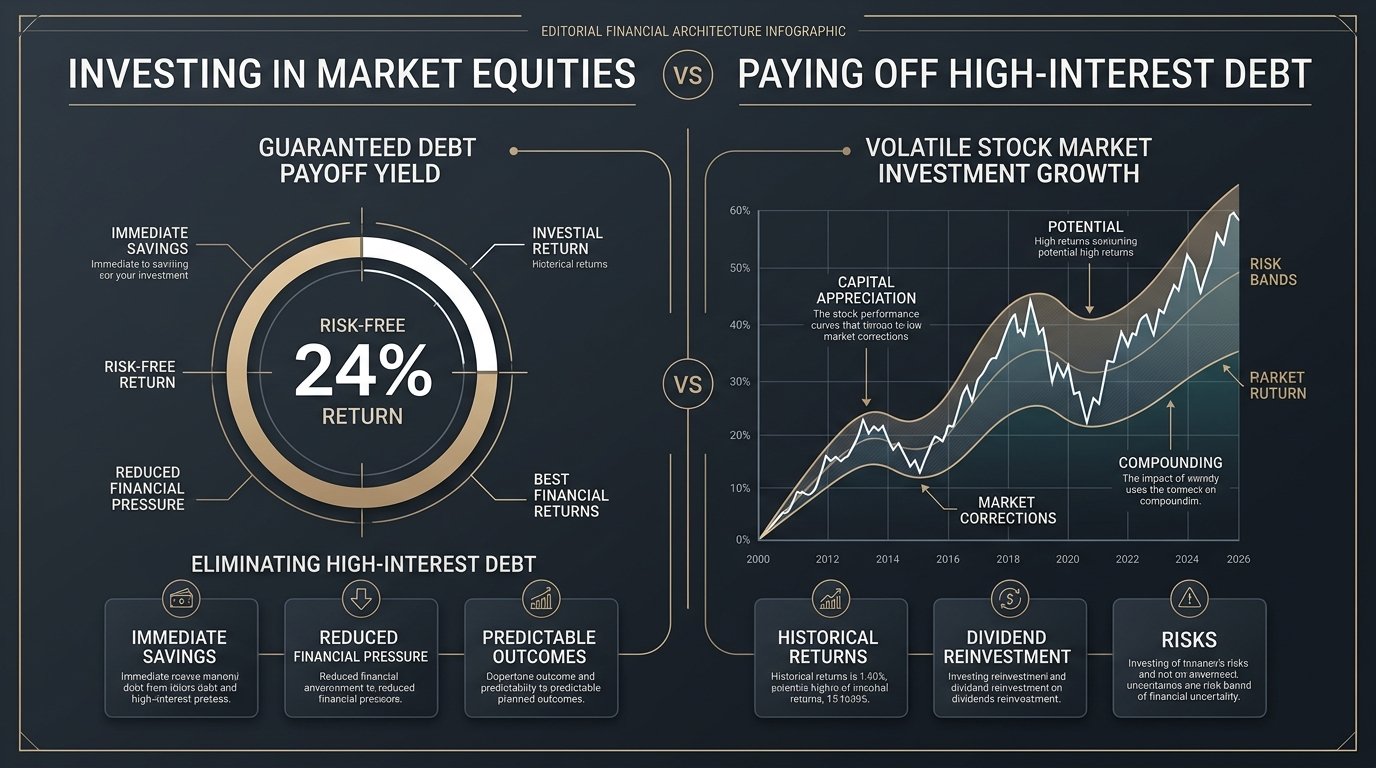
Every month, millions of ambitious earners face the same dilemma: “I have an extra $500. Should I buy index funds in my brokerage account to capture compound interest, or send it to my debt?”
The financial media often complicates this decision with sentimental debates about “peace of mind” versus “optimizing for wealth.” But at its core, this is a clean mathematical comparison between two competing assets: a guaranteed, post-tax return (paying down debt) and an uncertain, pre-tax expected return (investing in equities).
When you invest $500 in an S&P 500 index fund while carrying credit card debt at 24% APR, you are essentially borrowing money at 24% interest to gamble on a market that averages 10% nominal returns over multi-decade horizons. In any professional treasury or corporate finance department, that trade would be rejected immediately as reckless negative arbitrage.
Below is the objective mathematical framework to determine your exact hurdle rate, identify the one universal investment exception that overrides high interest, and follow the exact sequential flowchart for every dollar you earn.
The Concept of the Hurdle Rate: Guaranteed vs. Expected Returns
In corporate capital allocation, a hurdle rate is the minimum rate of return a project must generate before an organization commits capital to it. For individual finances, your hurdle rate is established by the interest rate on your outstanding debt.
There is a fundamental difference between paying off debt and buying stocks:
- Paying Off Debt = 100% Guaranteed & Completely Post-Tax: When you pay off a credit card charging 24.8% APR, you earn an immediate, risk-free 24.8% return on investment. No market crash, recession, or geopolitical event can take that return away from you. Furthermore, because you don’t pay income tax on interest you avoided paying, a 24.8% debt payoff is equivalent to earning over 30% pre-tax in an investment portfolio.
- Investing in Equities = Volatile & Pre-Tax: While the S&P 500 has averaged roughly 10% annual nominal returns over the last century, that return comes with massive volatility. In any given single year, equities can plummet -20%, -35%, or flatline for multiple years. Once you account for capital gains taxes and inflation, the real expected return is closer to 6.5% to 7.0%.
Example: If you are in the 24% federal tax bracket and carrying a 22% credit card APR: $22\% ÷ (1 – 0.24) = 28.95%. To match the wealth-building effect of paying off your credit card, you would need an investment that delivers a guaranteed 29% pre-tax gain every year. No conventional index fund can offer this.
The Three Interest Rate Zones: The Allocation Spectrum
Not all debt is equal. While carrying high-interest revolving debt is a financial emergency, carrying low-interest fixed debt can be a mathematically rational wealth accelerator. We divide all consumer obligations into three distinct zones:
| Zone | Interest Rate (APR) | Typical Obligations | Priority Rule |
|---|---|---|---|
| Zone 1: Toxic Debt | > 8.0% – 10.0% APR | Credit cards, payday loans, high-rate personal loans, store financing | Pay Off Debt 100% (Halt all non-matched investing) |
| Zone 2: The Moderate Gray Zone | 5.0% – 8.0% APR | Auto loans, private student loans, newer mortgage notes | Hybrid / Discretionary (Split surplus 50/50) |
| Zone 3: Low-Cost Leverage | < 5.0% APR | Older fixed mortgages, low-interest federal student loans | Invest in Equities (Pay only minimum scheduled payments) |
Zone 1: Toxic Debt (>8% to 10% APR) — Pay Off Debt First
Any debt carrying an interest rate above 8% to 10% mathematically crushes long-term stock market returns. Attempting to build an investment portfolio while carrying $15,000 in credit card balances is like running an air conditioner with all your windows smashed open—the cool air generated by your investments is instantly sucked out by compounding finance charges.
In this zone, every single discretionary dollar belongs in your debt payoff engine. As we detailed in our guide on the credit utilization ratio and our analysis of how your credit score changes during debt payoff, aggressive payoff here also triggers huge credit score increases that lower all future borrowing costs.
Zone 2: The Moderate Gray Zone (5% to 8% APR) — The Hybrid Strategy
In this intermediate range, expected stock market returns (7% to 10%) are roughly neck-and-neck with the guaranteed cost of the debt. Here, math gives way to risk tolerance:
- Risk-Averse Individuals: Choose the guaranteed 6.5% return of debt payoff, locking in mental clarity and eliminating fixed monthly overhead.
- Mathematically Aggressive Investors: Split the difference—putting 50% of surplus cash toward principal reduction and 50% into low-cost index funds to capture multi-decade compound growth.
Zone 3: Low-Cost Leverage (<5% APR) — Invest First
If you hold a 3.2% fixed 30-year mortgage or a 4.0% federal student loan, rushing to pay it off early usually costs you significant long-term wealth. Historically, broad market equities outperform a 3.5% hurdle rate over 15- to 30-year time horizons by an overwhelming margin. Making only minimum payments on sub-5% debt and investing surplus capital into tax-advantaged accounts (Roth IRAs, 401ks) is the optimal mathematical path.
The One Universal Exception: The Employer 401(k) Match
There is exactly one investment opportunity that mathematically overrides even the most predatory credit card debt: your employer’s 401(k) match.
If your employer offers a dollar-for-dollar match on up to 4% of your salary, contributing that 4% earns an immediate 100% risk-free return on day one. Even a 50% match represents an instant, risk-free 50% gain.
The Non-Negotiable Match Rule
Always contribute enough to your company retirement plan to capture the full employer match, regardless of how much high-interest credit card debt you carry. Leaving an employer match unclaimed is literally turning down free compensation. Once the match is secured, immediately redirect every remaining dollar to Zone 1 debt.
The Sequential Capital Flowchart: What to Do With Your Next Dollar
Rather than guessing each month, follow this engineered order of operations for every dollar that enters your household:
Build a 1-Month Core Operational Buffer
As established in our framework on emergency funds vs. debt payoff, establish a liquid cash reserve equal to one month of survival essentials ($2,000–$4,000) to prevent the demoralizing “re-leveraging trap.”
Capture the Full Employer 401(k) Match
Contribute the exact percentage required to harvest 100% of your company’s matching dollars. Do not contribute a single dollar beyond the match limit yet.
Eliminate All Toxic Debt (>8% APR)
Channel 100% of remaining surplus cash flow into credit cards, personal loans, and high-interest debt using either the Avalanche or Snowball method. Zero investing beyond Step 2 until this zone reaches $0.00.
Scale Emergency Reserves to 3–6 Months
With high-interest debt eradicated, expand your cash reserve in a high-yield savings account to 3 to 6 months of living expenses.
Max Out Roth IRA, HSA & Remaining 401(k) Capacity
Deploy surplus capital into tax-advantaged investment vehicles, compounding wealth in broad-market index funds while letting low-interest (<5%) debt ride on scheduled minimums.
Stop Wondering Where Your Cash Flow Goes
High-APR debt bleeds money every single day that you hesitate. Model your exact interest burn rate, uncover your optimal debt payoff sequence, and calculate your true finish line with mathematical precision.
Model Your Debt-Free Architecture