
Software Architecture / Payoff Analytics
Loan Payoff Calculator: How Extra Payments Shave Years & Thousands in Interest
Most online payment calculators are designed by lenders to answer one passive question: “What is your monthly payment?” They rarely reveal the active question that matters to borrowers: “How much time and money do you save when you add an extra $100 toward principal?”
When borrowers search for a loan payoff calculator or payment calculator, they often want to calculate more than just their static installment. Whether you are managing an auto loan, personal debt, student loans, or credit card balances, understanding how early principal reduction compresses your repayment timeline is the key to escaping debt years ahead of schedule.
To take control of your financial architecture, you need to understand the mechanics of loan amortization, the compounding impact of extra payments, and how a modern debt payoff planner coordinates multiple loans into one cohesive finish line.
How a Loan Payoff Calculator Works: The Math Behind Amortization
Standard installment loans follow an amortization schedule where every fixed monthly payment is calculated using the standard annuity formula:
Where: P = Principal Loan Balance, r = Monthly Interest Rate (APR ÷ 12), n = Total Months
Because the interest charge each month is calculated against your remaining principal balance, your early payments are heavily weighted toward interest. On a 5-year, $30,000 loan at 9% APR, over 37% of your initial $622 monthly installment is lost to bank profit rather than reducing your debt.
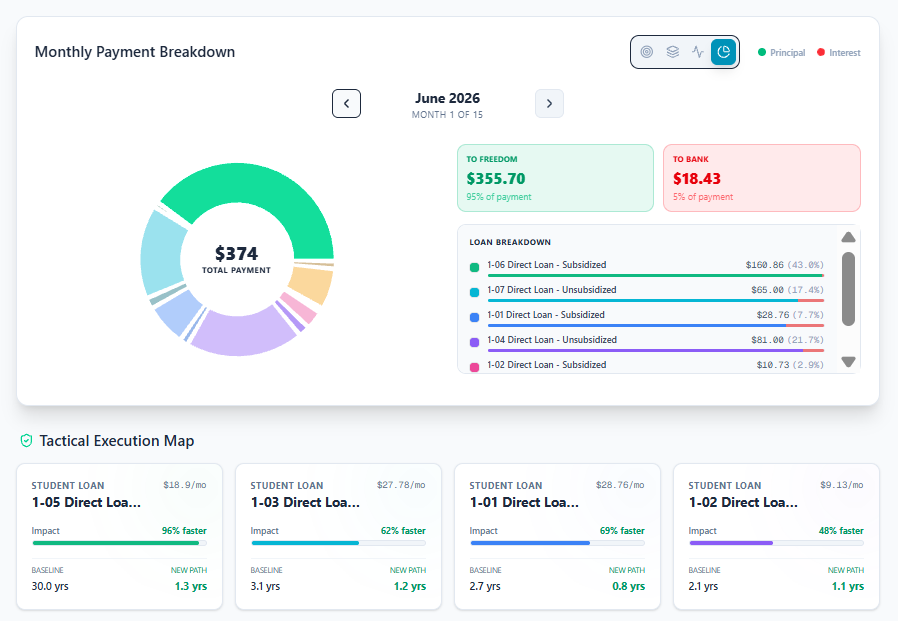
Figure 1: How standard amortizing payments are front-loaded with interest bleed compared to late-stage principal reduction.
The Compounding Impact of Extra Principal Payments
When you make an extra payment—whether $50 a month or a $1,000 lump sum from a tax refund—that money does not follow the standard amortization split. As long as you specify that the funds apply to principal reduction, 100% of that extra cash attacks your loan balance directly.
This creates a triple-compounding benefit:
Benefit 01
Zero Interest Leakage
Every extra dollar goes dollar-for-dollar into equity and balance reduction, bypassing the lender’s interest calculation entirely.
Benefit 02
Lower Daily Interest Accrual
By permanently lowering your principal baseline today, every single future month’s interest charge is calculated on a smaller number (see daily interest bleed).
Benefit 03
Timeline Compression
Extra payments shave months off the backend of your loan—the exact months where payments would have been 95%+ principal anyway.
Benefit 04
Permanent Cash Flow Freedom
Eliminating a loan 18 months early frees up your full monthly installment (e.g. $450/mo) a year and a half sooner for wealth building.
Payoff Modeling: $30,000 Loan at 9% APR (5-Year Term)
To see how extra payments mathematically collapse an amortization schedule, examine the numbers below for a borrower testing different surplus allocations on a $30,000 baseline:
| Extra Payment / Month | Total Monthly Outflow | Repayment Term | Total Interest Paid | Total Money Saved | Time Shaved Off |
|---|---|---|---|---|---|
| $0 / mo (Baseline) | $622.75 / mo | 60 Months (5.0 yrs) | $7,365 | $0 (Baseline) | 0 Months |
| +$100 / mo | $722.75 / mo | 50 Months (4.2 yrs) | $5,984 | $1,381 Saved | 10 Months Early |
| +$250 / mo | $872.75 / mo | 40 Months (3.3 yrs) | $4,652 | $2,713 Saved | 20 Months Early |
| +$500 / mo | $1,122.75 / mo | 31 Months (2.6 yrs) | $3,524 | $3,841 Saved | 29 Months Early |
Adding $250 a month doesn’t just save $2,713 in cold hard interest—it gives you back **nearly two full years of your life** without a monthly loan payment hanging over your head.
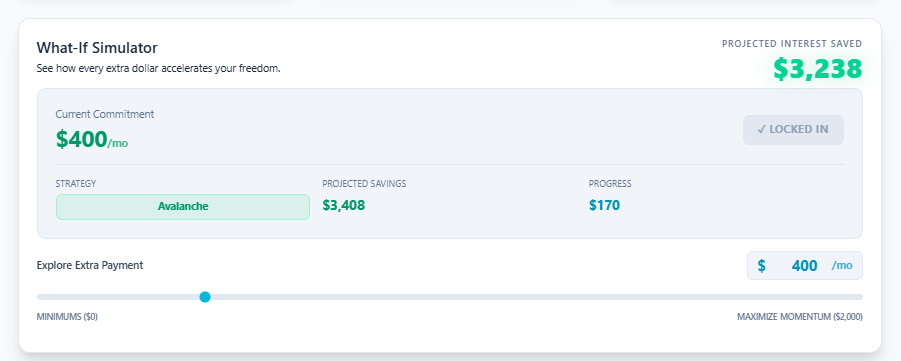
Figure 2: Testing extra payment scenarios in the LEVEL What-If simulator to visualize timeline compression in real time.
Single-Loan vs. Portfolio-Wide Cascading Loan Repayment
Basic payment calculators only evaluate one loan in isolation. If you have an auto loan, student debt, and two credit cards, a static calculator has no idea what to do when your auto loan hits zero.
In contrast, an architectural loan repayment engine models payment cascading: 1. Once Loan 1 is paid off, its entire required installment ($420/mo) is automatically rolled into your next target. 2. The algorithm evaluates your accounts side by side—comparing the Debt Snowball (psychological momentum), Debt Avalanche (pure APR), and the proprietary Dynamic Blitz protocol (targeting daily interest dollar bleed). 3. Your overall debt-free date pulls forward exponentially as freed-up cash flows compound from one liability to the next.

Figure 3: Comparing multi-strategy repayment engines to find the exact mathematical balance between motivation and interest savings.
Frequently Asked Questions
Does making extra payments hurt my credit score?
How do I make sure extra payments go to principal and not next month’s bill?
Is it better to pay extra monthly or as a lump sum?
Does this loan payoff calculator require connecting my bank accounts?
Interactive Loan Payoff Engine
Your debt calculator isn’t broken. Your finish line is invisible.
Calculate your exact loan payoff date and interest savings today on LEVEL Debt-Free Architect. Run What-If extra payment simulations, compare Snowball, Avalanche, and Blitz side by side, and engineer your path to zero—100% free to start, with zero bank sync required.