
Student Loans or Credit Cards First? The Sequencing Rule
When money is limited, the order you pay things matters as much as the amount. Here is the rule that settles the student loan vs. credit card question, the few exceptions, and what to do if a student loan has already gone late.
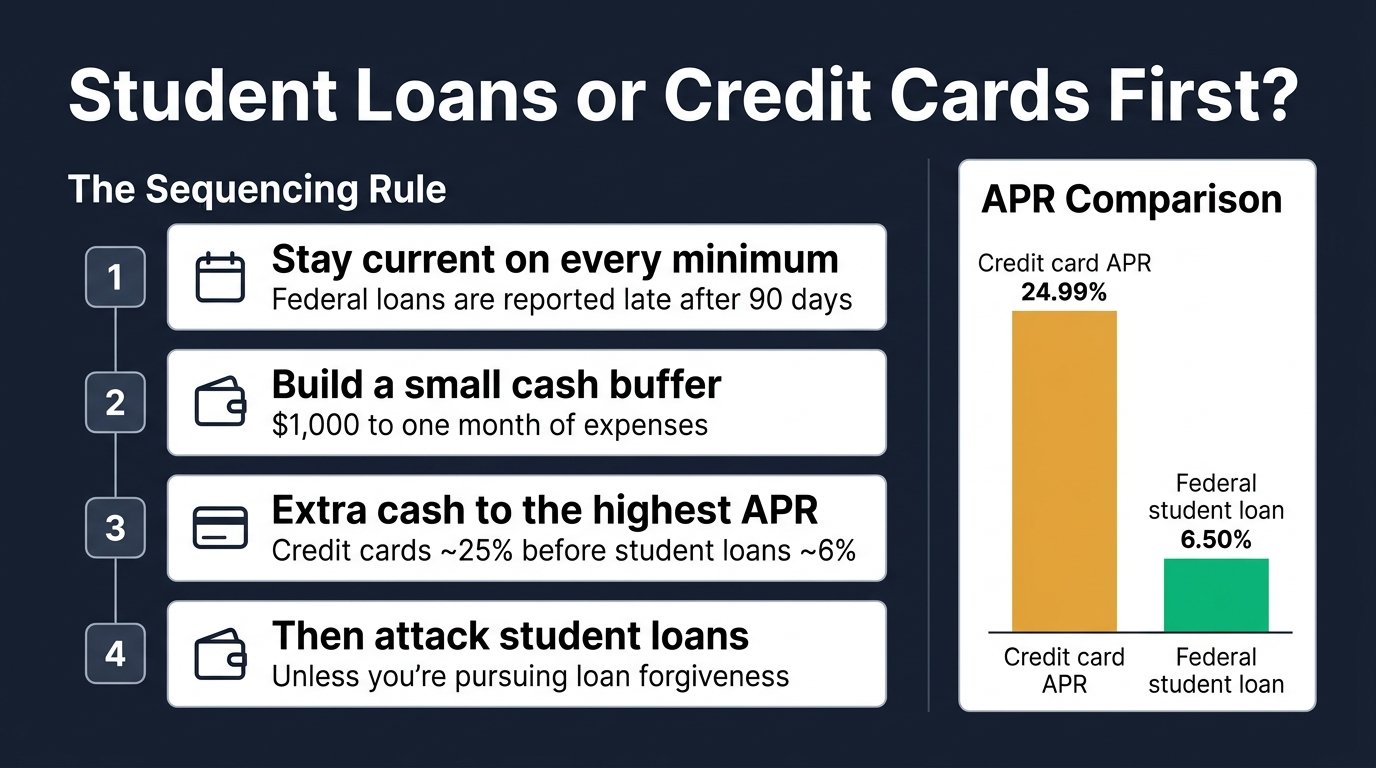
The short answer: pay every minimum on time first, keep a small cash buffer, and then send all extra money to the debt with the highest interest rate. For most people that means credit cards (often 20% to 30% APR) before federal student loans (often 4% to 8%). The two big exceptions are a student loan that is already behind, which you fix before anything else, and federal loans you plan to have forgiven, which you should not pay early.
Situation 1: A borrower earning a six-figure salary has about $14,000 on credit cards at 24.99% APR and $38,000 in federal student loans at 6.5%. They have $800 a month beyond their minimums and keep sending it to the student loans because that balance looks bigger and scarier.
Situation 2: Another borrower fell behind on a student loan during a job change. By the time they noticed, the payment was 90 days late and their credit score had dropped by roughly 100 points. They want to know whether to keep paying the credit cards or put everything into catching up.
Both questions are answered by the same four-step order.
Working with a tight monthly income? See our full worked example on paying off $20,000 in debt on a $50,000 salary.
The Sequencing Rule in Four Steps
- Stay current on every minimum payment. Every account, every month. A missed payment costs more in fees, penalty rates and credit damage than any extra payment can save.
- Keep a small cash buffer. Somewhere between $1,000 and one month of expenses. Without it, the next car repair goes straight back on a credit card.
- Send extra money to the highest interest rate. This is the avalanche method, and it almost always points at credit cards first.
- Then move to the student loans. Once the cards are gone, add everything you were paying on them to the student loan payment.
The Math: Why Credit Cards Usually Come First
Take Situation 1. Both plans use the same total budget each month: $350 card minimum, $430 student loan minimum, and $800 extra, for $1,580 a month. The only difference is where the $800 goes.
| Where the extra $800 goes | Credit cards paid off | Student loans paid off | Debt-free in | Total interest |
|---|---|---|---|---|
| Student loans first | Month 42 | Month 34 | 42 months | $13,765 |
| Credit cards first | Month 15 | Month 38 | 38 months | $7,465 |
Sending the extra money to the cards first saves about $6,300 in interest and finishes four months sooner, with exactly the same monthly spending. The reason is simple: each $800 put toward the card avoids about $16.66 in interest the next month, while the same $800 on the student loan avoids about $4.33. On day one, the card balance costs about $9.59 a day in interest even though it is less than half the size of the student loan, which costs about $6.77 a day.
A big student loan balance feels more urgent, but the interest rate decides what each dollar saves. Our guide on why splitting extra money across every debt backfires shows the same effect across several credit cards.
When Student Loans Should Come First
1. The student loan is already behind
This overrides everything else. Federal student loan servicers generally report a payment as late to the credit bureaus once it is 90 days past due. Private student loans and credit cards can be reported after 30 days. If you are close to either line, put the extra money into catching up first, even if the card has a higher rate. A first serious late mark can take a good score down by 100 points or more and stays on the report for up to seven years.
Federal loans that go about 270 days without a payment generally go into default. At that point the government can take part of your paycheck without a court order, keep your tax refund, and add collection costs to the balance. Avoiding that is worth far more than a few months of credit card interest.
2. A private student loan with a high rate
Some private student loans, especially variable-rate ones, charge 12% to 16% or more. Compare the actual rates. If a private loan charges more than a card, it moves ahead in line. The rule is about the rate, not the type of debt.
3. You are pursuing federal loan forgiveness
If you work toward a federal forgiveness program, any federal balance you pay off early is money you would not have had to pay. In that case, pay only the required federal amount and send everything else to the cards.
4. The credit card is at 0% for many more months
A card on a 0% balance transfer promotion with a year or more left is temporarily cheaper than a 6% student loan. Just make sure the card balance is gone, or the plan switches back to it, well before the promotion ends.
If a Student Loan Has Already Gone Late: The Catch-Up Plan
- Call the servicer before you send anything. Ask exactly how much it takes to bring the account current and whether a short deferment or forbearance can cover the missed months.
- Pause extra payments on the cards. Keep paying the card minimums so they stay current, but move all extra money to the student loan until it is caught up.
- Ask about a lower required payment. Federal borrowers can apply for an income-driven repayment plan, which sets the payment based on income and family size. A lower required payment makes it much harder to fall behind again.
- If the loan is in default, ask about rehabilitation. Rehabilitating a defaulted federal loan, usually through a series of agreed on-time payments, can remove the default record from your credit report. The earlier late payments stay.
- Once current, go back to the rule. Card minimums plus extra to the highest rate; student loan minimum on autopay so it can never slip again.
Lowering the Student Loan Payment to Pay Cards Faster
If the federal payment is squeezing your budget, an income-driven plan can lower it. You can then send the difference to the credit cards and clear the expensive debt sooner. Two cautions: interest that the lower payment doesn’t cover may be added to the student loan balance, and a longer repayment term means more interest overall. Treat it as a temporary bridge, and switch the money back to the student loans once the cards are paid off.
Student loan interest may also be tax-deductible, up to $2,500 a year depending on your income, which makes the student loan’s real rate slightly lower still. That strengthens the case for paying the cards first. If your situation is severe enough that no plan works, talk to a licensed attorney or a nonprofit credit counselor before making a decision.
See your own order in seconds
Enter your cards and student loans into LEVEL and it will rank them by rate, show your debt-free date, and roll each paid-off payment into the next debt automatically. No bank logins required.
Build your payoff plan free →