
Software Architecture / Payoff Analytics
Loan Repayment Calculator: How to Calculate Payoff Dates & Interest Saved
Most online payment calculators only tell you what you owe this month. They rarely tell you what happens when you inject an extra $150, or how rolling over a paid-off auto loan payment into a credit card balance can collapse four years of interest into 14 months.
When borrowers look for a loan repayment calculator or loan payoff calculator, they usually start with static single-loan tools offered by retail banks. These tools perform simple linear arithmetic: loan balance, nominal interest rate, and term length (as detailed in our guide to reading an amortization schedule).
However, modern households rarely carry just one isolated liability. A typical balance sheet holds an auto loan, student debt, and multiple revolving credit card balances (see why high earners get trapped in debt). To calculate your true debt-free timeline, you need a dynamic multi-account loan repayment engine that models cascading cash flow, interest bleed reduction, and what-if scenarios.
The Mathematics of Loan Repayment: The Amortization Split
Every installment payment you make on an amortizing loan is divided into two distinct components: accrued interest and principal reduction. The monthly interest charge is governed by a simple formula:
Principal Paid = Total Monthly Payment − Monthly Interest
In the early stages of any loan repayment schedule, the principal balance is at its maximum, meaning interest consumes the vast majority of your monthly installment. On a 5-year, $25,000 auto loan at 9% APR, over $187 of your very first $518 payment is burned immediately as bank profit—not debt reduction.
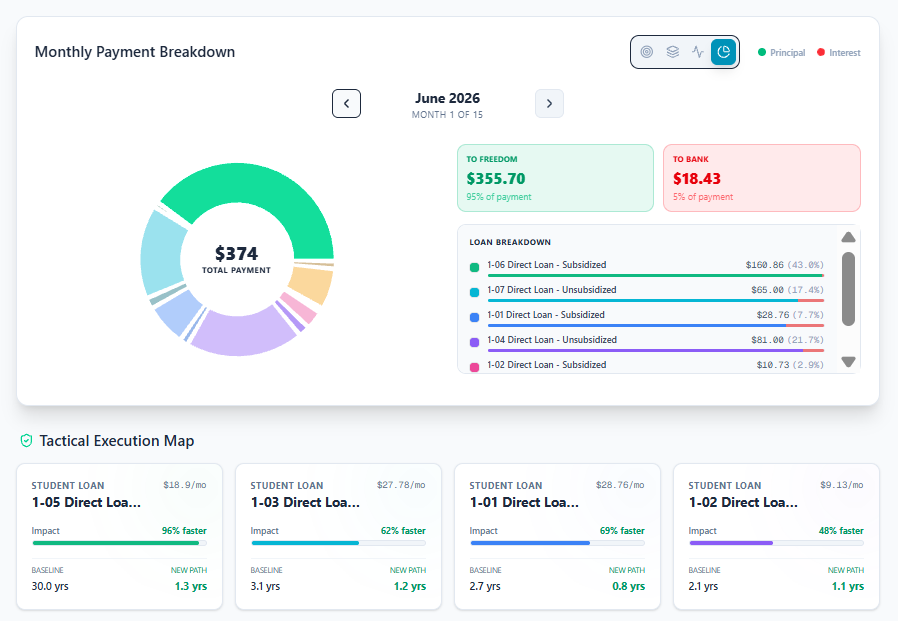
Figure 1: How early loan payments are front-loaded with interest bleed compared to late-stage principal elimination.
When you make an extra principal payment, 100% of that surplus bypasses the interest equation entirely. It attacks the principal baseline, permanently reducing the balance upon which every future month’s interest will be calculated.
Single-Loan vs. Portfolio-Wide Cascading Loan Repayment
The fatal flaw of basic loan repayment calculators is that they operate in a vacuum. If you pay off a $340/month car loan, a standard calculator assumes you simply stop spending that $340. In reality, financial architects practice payment cascading.
When your car loan reaches zero, that $340 monthly cash flow is not absorbed back into general spending. It is immediately routed into your next target balance—whether that is an 18% APR personal loan or a 24% APR credit card. This compounding acceleration is what transforms a 7-year slog into a rapid payoff sprint.

Figure 2: Comparing multi-strategy repayment engines to determine whether Snowball, Avalanche, or Dynamic Blitz pays off debt fastest.
Comparing the 3 Primary Loan Payoff Strategies
How you sequence your payments across multiple accounts dictates both your emotional stamina and total interest paid. Modern repayment calculators model three core methodologies:
Psychological Engine
Debt Snowball Calculator
Sorts balances strictly by size from lowest to highest, ignoring interest rates. Surplus funds eliminate small balances quickly, providing rapid psychological wins and closing open mental tabs.
Mathematical Engine
Debt Avalanche Calculator
Sorts balances strictly by APR from highest to lowest. Saves the most mathematical interest in theory, but can cause fatigue if your highest APR balance is also your largest balance ($30k at 26%).
Proprietary Hybrid
The Dynamic Blitz Protocol
Recalculates monthly to attack the exact account causing the highest daily dollar interest bleed (Balance × APR ÷ 365). Dynamically pivots as balances decrease, outperforming static methods (see the hybrid Blitz method).
Execution Blueprint
Visual Roadmap Milestone Tracking
Transforms dry calculator rows into a 12-month visual brick construction map, giving borrowers an undeniable, visible finish line without spreadsheet clutter.
Payoff Comparison: $35,000 Portfolio Across 4 Methods
Below is a modeled comparison for a borrower managing a $6,000 credit card (24% APR), a $14,000 car loan (8.5% APR), and a $15,000 student loan (6.2% APR) with $250/month in extra payment capacity:
| Payoff Method | Months to Zero | Total Interest Paid | Total Interest Saved | Key Advantage |
|---|---|---|---|---|
| Minimum Payments Only | 94 Months (7.8 yrs) | $11,840 | $0 (Baseline) | None (Maximum Bank Profit) |
| Debt Snowball | 46 Months (3.8 yrs) | $6,120 | $5,720 Saved | First payoff in Month 7 (Motivation) |
| Debt Avalanche | 41 Months (3.4 yrs) | $5,310 | $6,530 Saved | Optimal APR interest efficiency |
| LEVEL Dynamic Blitz | 39 Months (3.2 yrs) | $5,180 | $6,660 Saved | Fastest zero date + max cash savings |
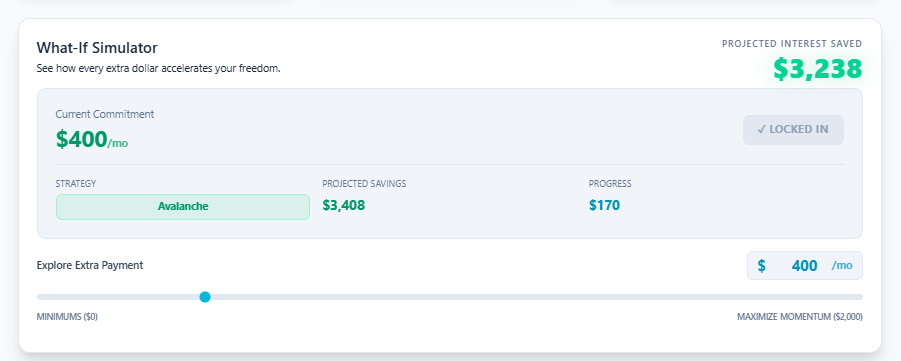
Figure 3: Simulating how extra payments and lump-sum injections collapse loan repayment schedules in real time.
Why Privacy & Zero Bank Sync Matter in a Payoff Planner
Most modern budgeting applications (like YNAB or Copilot) demand full OAuth or Plaid access to your checking, savings, and loan credentials before they render a single forecast. They harvest transaction data, scrape merchant records, and subject users to frequent token disconnections.
A true debt payoff engine does not need your bank password or your transaction history. It only requires three numbers per liability: balance, APR, and minimum payment. Running calculations locally through manual entry is not a limitation—it is a deliberate privacy feature that ensures your financial architecture remains completely confidential.
Frequently Asked Questions
How does a loan repayment calculator differ from an amortization schedule?
Can this loan payoff calculator handle different interest types?
How much time does an extra $100 per month shave off a loan?
Does LEVEL require connecting my bank accounts?
Interactive Loan Payoff Engine
Your debt calculator isn’t broken. Your finish line is invisible.
Calculate your fastest path to zero with LEVEL Debt-Free Architect. Compare Snowball, Avalanche, and Dynamic Blitz side by side, test what-if extra payment simulations, and engineer your exact debt-free date—100% free to start, with zero bank sync required.