
How Your Credit Score Changes During Debt Payoff: A Month-by-Month Look
Most borrowers expect credit score recovery to look like a smooth, upward 45-degree angle. In reality, credit scores behave like an erratic staircase: sudden surges, frustrating 90-day plateaus, and counter-intuitive dips right after paying off a balance. Here is the realistic month-by-month trajectory of what happens to your credit score as you eliminate debt.
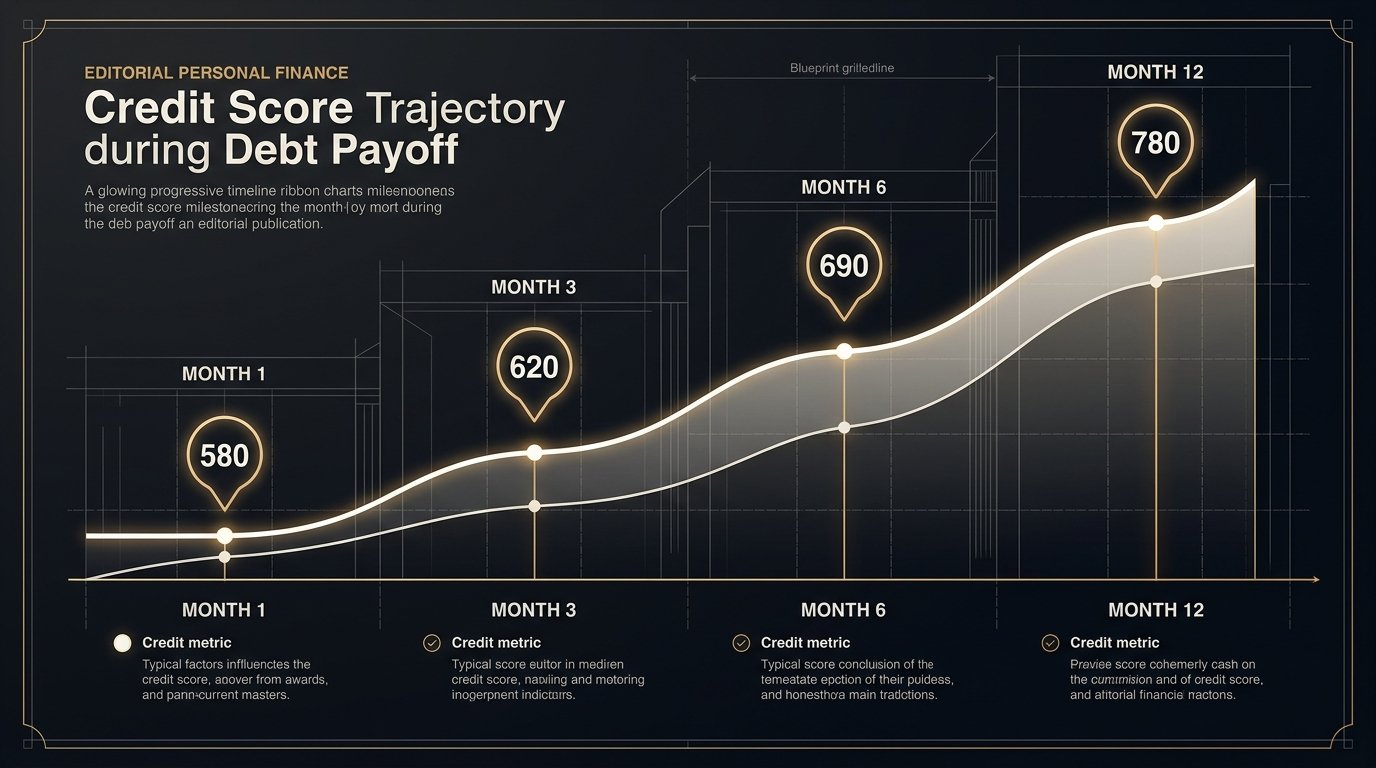
There is an acute psychological frustration familiar to anyone aggressively paying down debt: you scrape together an extra $1,200, throw it at a maxed-out credit card, log into your credit monitoring app the next morning—and your score has either refused to budge or actually dropped four points.
The human brain expects immediate, linear reinforcement: “I sacrificed capital, so the metric should instantly rise.” But credit scoring algorithms (specifically FICO Score 8, FICO 9, and VantageScore 3.0/4.0) do not measure effort or moral virtue. They measure mathematical risk based on lagging reporting snapshots, debt categories, and credit-mix ratios.
When you understand the algorithmic mechanics governing the timeline, the journey transforms from an emotional rollercoaster into an engineered blueprint. Below is the realistic month-by-month breakdown of how your credit score evolves as you dismantle debt, why mid-payoff plateaus occur, and how to avoid the catastrophic mistakes that cause scores to crash right at the finish line.
The 5 Credit Scoring Engines and How Debt Payoff Impacts Them
To understand why scores fluctuate during a payoff campaign, you must look at how debt payoff touches each component of your credit profile:
- Amounts Owed (30% of FICO): This is the dynamic rocket fuel of your score. As discussed in our deep dive on credit utilization ratio explained, reducing revolving balances produces the fastest, highest-magnitude point swings in credit scoring.
- Payment History (35% of FICO): On-time payments during payoff do not instantly erase past late marks, but they begin a 24-month dilution process. Recent on-time data progressively suppresses the scoring weight of historical delinquencies.
- Length of Credit History (15% of FICO): Paying off accounts helps preserve this metric—provided you don’t make the mistake of closing old credit cards.
- Credit Mix (10% of FICO): Lenders want to see a balanced mix of revolving credit and installment loans. Paying off installment loans in full often causes a temporary point dip because it narrows your active credit diversity.
- New Credit Inquiries (10% of FICO): Halting credit card applications while paying off debt allows older hard inquiries (which expire after 12 months for scoring purposes) to drop off, quietly adding 5 to 15 points back to your score.
The Realistic Month-by-Month Credit Score Progression
The Stagnation & Reporting Lag
In your first 30 days of debt payoff, expectations almost always outpace reality. You make your first aggressive lump-sum payment, but your credit score barely moves.
This is caused by the bureau transmission delay. Card issuers do not ping the three major credit bureaus (Experian, TransUnion, Equifax) the moment your ACH transfer clears. Instead, they batch-report your account balance once per month when your billing statement closes. If your payment cleared on Day 3 of your billing cycle, the bureaus won’t see that reduced balance until Day 30 or 35.
Furthermore, if you opened a debt consolidation loan to kick off your debt payoff sprint, you will absorb a small hard inquiry dip (3 to 7 points) and a temporary decrease in your average account age. In Month 1, patience is the only requirement.
The First Utilization Breakout
Between Day 45 and Day 90, the first wave of reported statements lands on your credit file. If your debt payoff strategy prioritizes maxed-out cards, this is where you experience your first dramatic scoring jump.
As we analyzed in whether paying off debt raises your credit score, FICO algorithms apply severe non-linear penalties when individual cards sit above 89% utilization. Knocking even one card from 92% down to 48% eliminates the “maxed-out account” penalty, injecting 20 to 35 points into your profile almost overnight.
Simultaneously, you establish 60 to 90 consecutive days of 100% on-time payment records, laying a solid foundation under your payment history category.
The Mid-Payoff Plateau
Months 4 through 6 represent the most mentally testing stretch of any debt payoff campaign. Your initial excitement fades, your payments remain large and consistent, but your score seemingly flatlines.
Why does the plateau happen? Because once your accounts drop below 50% utilization, the next major algorithmic threshold does not trigger until you cross below 29.5% and 9.5% aggregate utilization. Moving from 48% utilization to 38% utilization is mathematically commendable, but it operates within the same general FICO risk band.
Warning: The “Closure Trap” That Derails Month 5
During this phase, borrowers often pay their first credit card down to a zero balance. In a burst of emotional catharsis, they immediately close the card. Do not do this. Closing a credit card erases its credit limit from your available credit pool. If you have $6,000 in debt across two $5,000 limit cards (60% utilization) and you pay off one card and close it, your available limit drops to $5,000—catapulting your remaining $1,000 balance to 100% utilization on your credit report! Keep paid-off accounts open with a small automated bill to protect your credit ceiling.
The Tier-1 Inflection Point
As your sustained payments push your total aggregate credit card utilization below 30%, and eventually into the single digits (under 10%), your credit score accelerates into the “Good” and “Very Good” tiers (700+).
At this stage, you also qualify for the AZEO (All Zero Except One) optimization method: all revolving credit lines report a $0 statement balance, except for a single primary card that reports a nominal 1% balance ($15 to $30). This setup avoids the “all-zero” inactivity penalty while showcasing near-zero revolving risk.
Any hard credit inquiries generated over a year ago lose their scoring impact entirely, and older derogatory marks continue to lose statistical potency.
Debt Zero & The Installment Loan Paradox
You hit zero revolving debt. Your revolving utilization is permanently under 5%, and your credit cards are paid in full every month. You have ascended to prime borrower status.
However, many borrowers experience a bizarre shock when they make the final payment on their auto loan, student loan, or personal consolidation loan: their score drops 15 to 25 points the following month.
This is known as the Installment Loan Closure Paradox. When a term loan is active and paid down to 5% of its original balance, scoring models award maximum points for “responsible installment loan management.” The moment the loan closes, the account becomes inactive. Your credit mix narrows, and the bonus points evaporate. This drop is temporary and benign—lenders looking at a 780 score with zero debt will view you as an elite underwriting candidate regardless of a 15-point blip.
Trajectory by Strategy: Avalanche vs. Snowball vs. Consolidation
The specific mathematical strategy you use to attack debt dictates how your credit score evolves over time:
| Payoff Strategy | Score Behavior in Months 1-3 | Score Behavior in Months 6-12 | Total Interest Saved | Best For |
|---|---|---|---|---|
| Debt Snowball (Lowest Balance First) | Fastest Initial Rise (+30 to +50 pts) | Steady, progressive climb | Moderate (pays higher APR longer) | Borrowers needing rapid psychological wins and immediate per-card score relief |
| Debt Avalanche (Highest APR First) | Delayed Score Surge (+15 to +30 pts) | Steep Exponential Rebound | Maximum Savings | Deliberate planners focused on pure mathematical wealth preservation |
| Consolidation Loan (Revolving to Term) | Instant Massive Spike (+50 to +80 pts in Month 1) | Plateau while paying down loan principal | High (if APR is significantly lower) | Borrowers who immediately stop using cards and avoid running up new balances |
3 Non-Negotiable Rules to Protect Your Score While Paying Off Debt
- Never Close Your Oldest Credit Accounts: When an account is paid off, cut up the physical card if spending temptation exists, but leave the tradeline open. This anchors your average age of accounts and provides a permanent buffer for your aggregate credit limit.
- Pay 3 Days Before the Statement Closing Date, Not the Due Date: As detailed in our breakdown of credit utilization mechanics, the balance on your statement closing date is what gets transmitted to the credit bureaus. Paying early ensures that the bureaus see your true, reduced balance.
- Keep One Small Recurring Charge Active: If a credit card sits with a zero balance and zero transactions for 6 to 12 consecutive months, issuers may automatically close the account for inactivity. Set a small $10 recurring subscription (such as Spotify or iCloud) on autopay to keep the tradeline alive and reporting positive data every month.
Stop Guessing Your Score and Engineer Your Finish Line
Credit scores are simply a downstream reflection of your debt structure. When you eliminate the daily interest bleed and execute an exact payoff roadmap, top-tier credit happens automatically.
Calculate Your Debt-Free Date