
Using Your 401(k) to Pay Off Debt: What to Weigh First (401k Loan vs. Early Withdrawal vs. Accelerated Payoff)
Watching $50,000 sit in a retirement account while suffocating under $20,000 of high-interest credit card debt feels absurd. Tapping your 401(k) appears like an instant, painless escape hatch. But raiding retirement capital to solve debt is one of the highest-friction, highest-risk moves in personal finance. Here is the objective mathematical reality of 401(k) loans, cash-out penalties, and the hidden traps that catch 68% of borrowers.
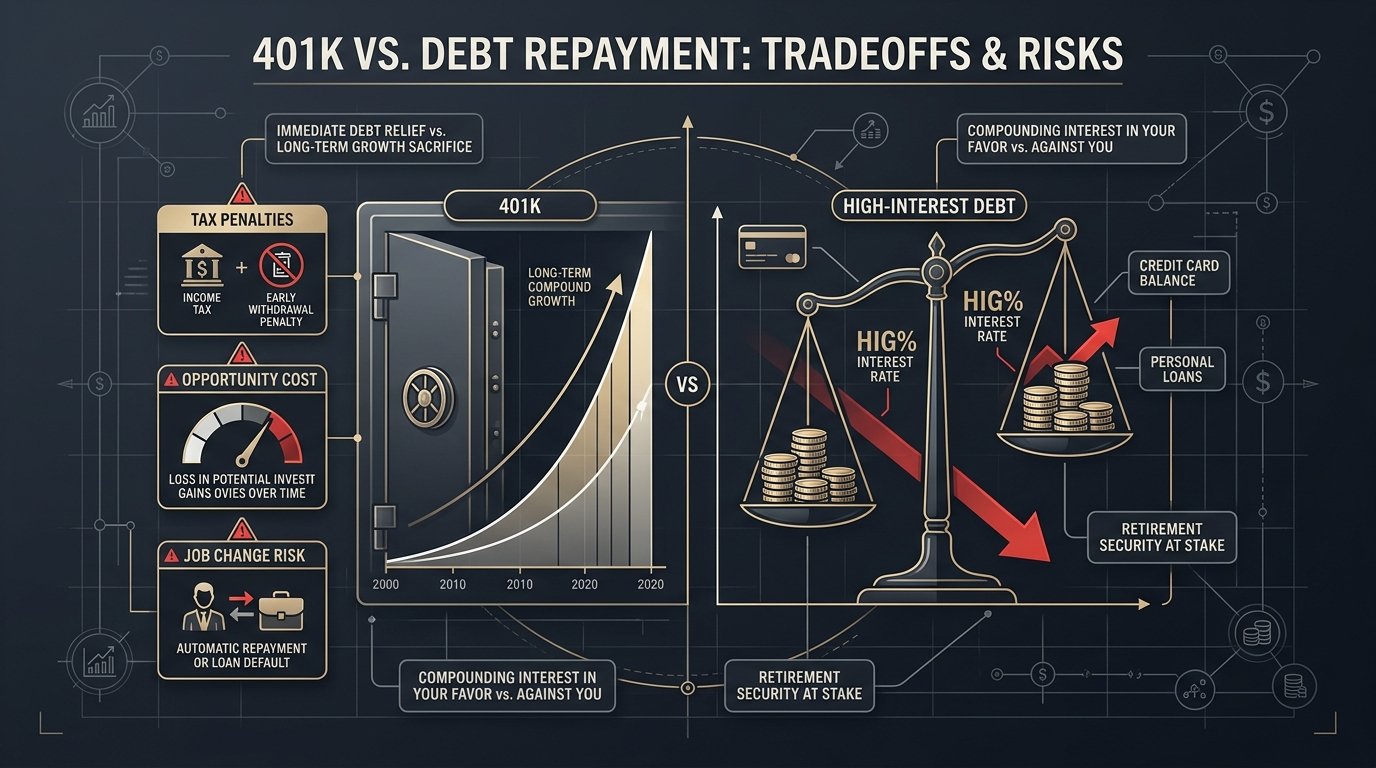
When you are bleeding $15 to $25 every single day in credit card interest, your 401(k) balance looks like an irresistible life raft. It sits right there on your employee portal—fully vested money that could wipe out your debt with a single electronic signature.
The marketing pitch for a 401(k) loan sounds almost miraculous: “No credit check! Low interest rates! And the best part? You pay the interest back to yourself!”
Or worse, some borrowers consider a direct early withdrawal (hardship distribution), believing that sacrificing a portion of their retirement is a fair trade to escape collection calls and monthly minimum payments.
However, tapping retirement assets to clear consumer debt carries severe systemic hazards. It transforms unsecured debt (which carries no claim on your future retirement or primary assets) into debt backed by your future financial survival. Before you pull the trigger on a 401(k) loan or cash-out, here is the exact financial physics you must weigh.
The Critical Distinction: 401(k) Loan vs. Early Withdrawal
Borrowers often conflate “tapping a 401(k)” into a single concept. In reality, plan administrators offer two completely distinct mechanisms, each with radically different consequences:
Option A: 401(k) Early Withdrawal (Cash-Out)
Verdict: An Algorithmic Disaster. If you take a direct distribution before age 59½, the IRS treats the money as ordinary taxable income in the current year, plus assesses an immediate 10% early withdrawal penalty.
Between federal income tax brackets (22%–24%), mandatory 20% tax withholding, state income taxes (5%–9%), and the 10% penalty, you sacrifice 35% to 45% of your withdrawal to government friction before a single cent reaches your credit card bank.
Option B: 401(k) Loan
Verdict: High Friction & Contingency Risk. You borrow up to 50% of your vested balance (up to a legal ceiling of $50,000) and repay it through automatic payroll deductions over a standard 5-year term.
There are no credit checks, and the interest rate (usually Prime + 1% or 2%) goes back into your account. However, it introduces significant opportunity costs, double taxation on interest, and career vulnerability.
The True Cost of a 401(k) Early Withdrawal: Worked Example
To see why cashing out a 401(k) is almost never justifiable, consider a borrower carrying $20,000 in credit card debt:
Tax & Penalty Deductions:
• 10% IRS Early Withdrawal Penalty: −$3,150
• 22% Federal Income Tax: −$6,930
• 5% State Income Tax: −$1,575
• Total Government Destruction: $11,655 (37.0%)
To eliminate $20,000 of credit card balances, you must surrender $31,500 from your retirement account. You are willingly destroying $11,655 in cold hard capital just to avoid paying credit card interest. Furthermore, in bankruptcy or legal restructuring, 401(k) balances are 100% protected under federal ERISA laws; credit card debt is unsecured. By cashing out, you trade legally shielded retirement wealth to settle unsecured consumer debt.
The 4 Hidden Traps of a 401(k) Loan
If an early withdrawal is out of the question, what about a 401(k) loan? While far safer than a cash-out, 401(k) loans conceal four structural traps that financial institutions rarely highlight:
Trap 1: The Job Separation Acceleration Clause
When you take a 401(k) loan, your repayment terms are tied directly to your active employment with that specific company. If you get laid off, fired, or voluntarily accept a better job elsewhere, the loan terms change abruptly.
Under the Tax Cuts and Jobs Act (TCJA), you have until the due date of your federal tax return (including extensions) for the year of departure to repay the remaining loan balance in full or roll it over into an IRA. If you cannot produce thousands of dollars in cash while unemployed or transitioning, the outstanding balance defaults. It is immediately reclassified as an early distribution—triggering income taxes and the 10% IRS penalty on the remaining principal.
Trap 2: The Staggering Opportunity Cost
When you borrow $25,000 from your 401(k), those funds are physically liquidated from your underlying mutual funds or index funds. They are no longer compounding in the market.
If you borrow $25,000 during a 5-year bull market where equities return an average of 10% annually, you miss out on over $15,000 in compounding growth. Over a 25-year timeline until retirement, that $25,000 compounding at a standard 8% annual return would have grown into over $171,000. You did not just borrow $25,000; you sacrificed a six-figure sum of your future retirement wealth.
Trap 3: Double Taxation on Loan Interest
Plan advocates celebrate that “you pay interest back to yourself.” But few realize that the interest you pay back into your 401(k) is subject to double taxation:
- You repay the loan interest using after-tax dollars deducted from your take-home paycheck.
- Decades later, when you withdraw those funds in retirement, that same interest is taxed again as ordinary income.
Trap 4: Frozen Contributions and Lost Employer Matches
Many employer plan sponsors prohibit active contributions while a 401(k) loan is outstanding. Even if permitted, many borrowers find that the monthly payroll loan deduction drains so much cash flow that they can no longer afford to contribute. As analyzed in our guide on should you invest or pay off debt first, forfeiting your employer match means turning down an instant 50% to 100% risk-free return.
The Root Cause Problem: The “Reset” Mirage
The single greatest hazard of using retirement funds to pay off consumer debt is psychological: it treats a behavioral cash-flow problem as a balance-sheet problem.
When you wipe out $25,000 of credit card debt with a 401(k) loan, your credit card balances suddenly read $0. Your credit utilization ratio drops, your credit score surges (as outlined in our research on credit score changes during payoff), and your stress temporarily evaporates.
However, your underlying daily cash flow is now more restricted than before, because your paycheck is burdened by an automated 401(k) loan repayment deduction for the next 60 months. When an unexpected expense hits—a car breakdown or medical bill—you no longer have savings or spare cash flow. The credit cards sit there with empty limits.
Industry data reveals that 68% of borrowers who use a 401(k) loan to pay off credit cards accumulate equal or greater debt within 36 months. When that happens, they now carry maximum credit card balances plus an unyielding 401(k) loan payroll deduction, placing them in far greater financial jeopardy than before.
Better, Safer Alternatives to Tapping Your 401(k)
Before putting your retirement security on the line, exhaust these proven debt acceleration strategies:
| Alternative Strategy | Retirement Risk | Cost / Friction | Optimal Use Case |
|---|---|---|---|
| 0% APR Balance Transfer Card | Zero Risk | 3% – 5% one-time fee | Good credit (680+); can pay balance within 12–21 months |
| Unsecured Consolidation Loan | Zero Risk | Fixed 8% – 14% APR | Fair-to-good credit; swaps high 26% APR for structured term |
| Algorithmic Avalanche Acceleration | Zero Risk | $0 fees (pure math) | Focuses surplus cash on highest daily interest bleed |
| 401(k) Loan | High Risk | Lost market gains + job tie | Extreme last resort; stable job; strict zero-borrowing discipline |
| 401(k) Early Cash-Out | Catastrophic | 35% – 45% tax/penalty loss | Avoid completely except to prevent active foreclosure/bankruptcy |
Protect Your Retirement. Engineer Your Debt Payoff.
You don’t need to sacrifice your future retirement wealth to eliminate debt today. Model your exact interest burn rate, project your debt-free milestone dates, and architect an accelerated payoff plan using pure mathematical certainty.
Architect Your Payoff Engine