
Buy Now, Pay Later Debt: How It Sneaks Up and How to Pay It Off
Buy Now, Pay Later (BNPL) was marketed as the modern, ethical antidote to predatory credit cards: zero interest, no credit check, just four easy payments. In reality, BNPL has engineered an epidemic of “phantom debt.” Fragmented micro-loans stack quietly across multiple apps, cannibalizing paycheck cash flow and triggering overdraft spirals. Here is the mechanics of the BNPL trap and an exact 4-step sequence to eliminate it.
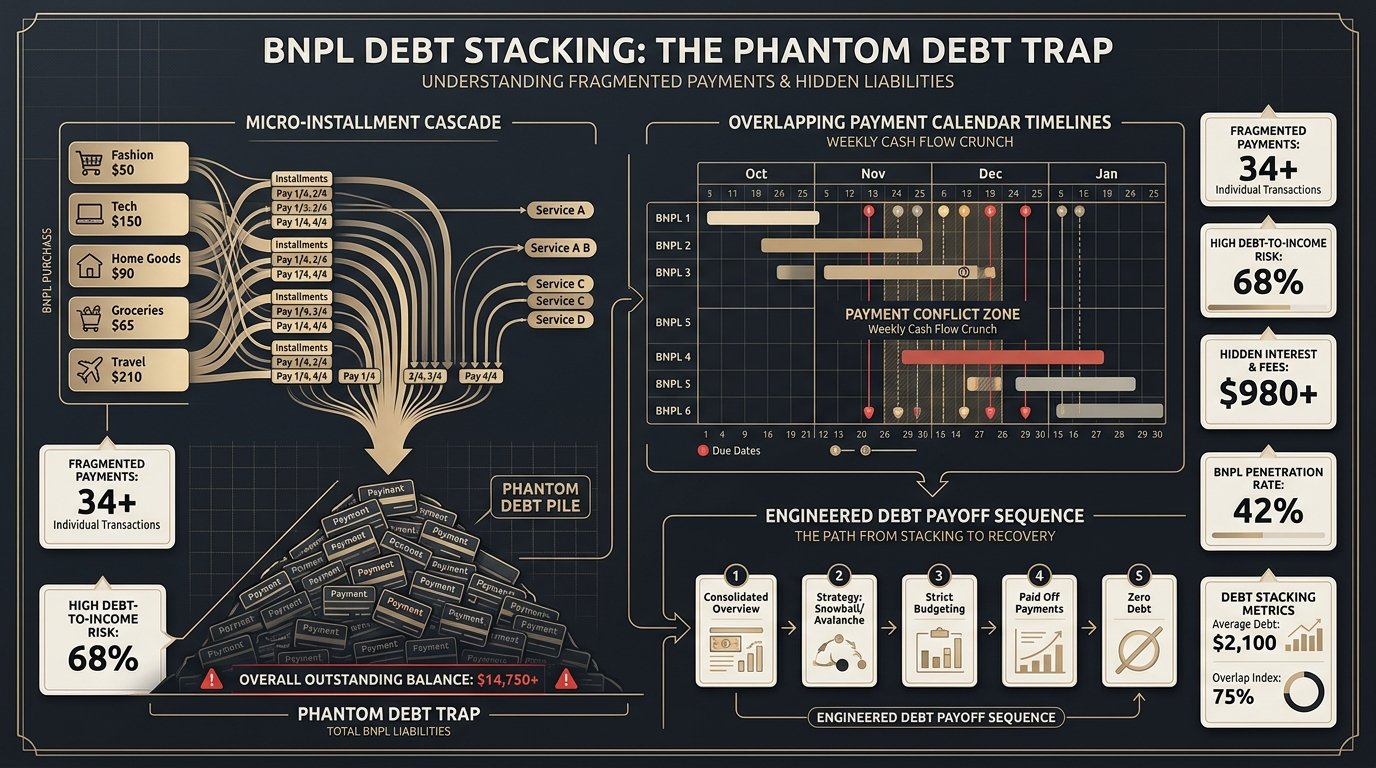
If you have ever felt broke two days after payday despite earning a solid income, checked your credit cards, noticed low balances, and wondered where hundreds of dollars vanished—you are likely living with Phantom Debt.
The term “phantom debt” refers to Buy Now, Pay Later (BNPL) loans from fintech services like Klarna, Afterpay, Affirm, Zip, and PayPal Pay in 4. They are called phantom liabilities because, historically, they existed entirely outside the traditional credit reporting ecosystem. They do not appear on your monthly credit card statements, and in many cases, credit bureaus do not yet track them in standard FICO calculations.
Instead, BNPL debt lives in the shadows of modern commerce: a frictionless string of automated debit card withdrawals scheduled on bi-weekly cycles, quietly extracting $35 on a Tuesday, $52 on a Friday, and $88 the following Monday.
What starts as a seemingly harmless way to spread a $150 purchase across six weeks rapidly metastasizes into an uncontrollable web of overlapping installment contracts. Here is how BNPL sneaks up on even disciplined spenders, why it wrecks household liquidity, and how to systematically engineer your exit.
The Behavioral Trap: Why BNPL Is More Addictive Than Credit Cards
Traditional credit card spending contains natural behavioral friction: you see an escalating total balance, a high credit limit utilization percentage, and a daunting minimum payment. BNPL is deliberately designed by e-commerce behavioural psychologists to eradicate that friction.
1. The “Micro-Commitment Mirage”
When you view a $200 jacket online, your brain registers the loss of $200. But when the checkout button splits that into “4 interest-free payments of $50,” the pain center of your brain discounts the true purchase cost by 75%. You mentally categorize the purchase as a $50 expense, freeing you to make another $40 purchase elsewhere.
2. Loan Stacking Across Multiple Apps
Because BNPL services operate as independent closed-loop platforms, they do not cross-reference active loans across competitors. A consumer can easily take out:
- Two active payment plans on Klarna ($85/month total)
- Three active payment plans on Afterpay ($140/month total)
- One large purchase on Affirm ($110/month)
- Two split orders on PayPal Pay in 4 ($95/month)
Individually, each loan feels negligible. Combined, this borrower has quietly committed $430 per month in non-negotiable debt payments—often for apparel, cosmetics, takeout, and disposable consumer goods purchased months prior.
The Real-World Shock: Carrying just six simultaneous $35 bi-weekly plans across three apps generates $420 every single 14 days ($910/month in three-paycheck months) pulled directly from your checking account.
The Overdraft Cascade & Credit Bureau Reality
The greatest structural danger of BNPL is its repayment timeline mismatch.
Credit cards give you a predictable monthly due date. BNPL plans, however, charge your linked debit card or bank account exactly every 14 days from the date of each individual purchase. If you made purchases on September 4th, September 9th, and September 18th, you have debits hitting on irregular calendar days completely untethered to your employer’s bi-weekly paycheck schedule.
The Overdraft Cascade Effect
According to Consumer Financial Protection Bureau (CFPB) data, over 40% of frequent BNPL users experience bank overdraft or NSF (non-sufficient funds) fees. When an unexpected $45 BNPL debit clears your checking account 24 hours before your paycheck deposits, it triggers a $35 bank overdraft fee. If another small installment hits right behind it, a $20 purchase ends up costing $90 in penalty fees.
Does Buy Now, Pay Later Hurt Your Credit Score?
The common marketing myth is that BNPL has “zero effect on your credit score.” This is a dangerous half-truth:
- When You Pay on Time: Historically, most “Pay-in-4” platforms did not report positive payment histories to Experian, TransUnion, or Equifax. You bore the debt risk with zero credit-building upside. (While credit bureaus are rolling out BNPL reporting models, positive reporting remains inconsistent).
- When You Default or Miss Payments: If an installment fails and your account remains past due, BNPL providers waste no time transferring your balance to third-party collection agencies. The moment a collections record hits your credit file, your credit score can violently crash 50 to 100+ points overnight.
As we analyzed in our breakdown of whether paying off debt raises your credit score and our guide on credit score changes during payoff, collection tradelines inflict severe damage that lingers for up to 7 years.
BNPL vs. Credit Cards vs. Personal Loans: The Feature Matrix
| Attribute | Buy Now, Pay Later (Pay-in-4) | Traditional Credit Card | Personal Debt Loan |
|---|---|---|---|
| Advertised APR | 0.0% (Introductory) | 22.0% – 29.9% | 8.0% – 15.0% Fixed |
| Payment Schedule | Every 14 Days (Fragmented) | Monthly Fixed Date | Monthly Fixed Date |
| Overdraft Risk | Extremely High | Low (Manual/Monthly Autopay) | Low (Single Monthly Debit) |
| Credit Report Benefit | Minimal / None | High (Payment history & limits) | High (Credit mix diversity) |
| Late Fees / Penalties | $7 – $15 per missed installment | $30 – $40 late fee + APR hike | Late fees + credit mark |
| Consumer Protection | Weak dispute rights | Strong (FCBA Fair Credit Act) | Fixed legal contract |
The 4-Step Blueprint to Eliminate BNPL Debt Permanently
Because BNPL plans have short durations (usually 6 to 8 weeks), they can be systematically dismantled faster than multi-thousand-dollar credit card balances. Here is the architectural recovery sequence:
Centralize and List Every Active Plan
Log into every shopping app on your phone: Klarna, Afterpay, Affirm, Zip, PayPal, Apple Pay Later, and Sezzle. For each account, write down: (1) Remaining balance, (2) Bi-weekly installment amount, and (3) Next scheduled withdrawal date.
Do not rely on memory. Most borrowers discover they owe 40% to 60% more in phantom obligations than they initially estimated.
Establish a Dedicated Buffer or Reroute Payments
To eliminate the risk of bank overdraft fees, transfer a one-time cash buffer (referencing our guide on emergency funds and starter cash buffers) into your checking account to cushion against mid-cycle debits.
Alternatively, switch the linked payment method inside each BNPL app to a credit card (if permitted and if you have the discipline not to carry revolving balances) to aggregate all micro-debits into a single monthly due date.
Knock Out Small Plans Immediately
Unlike credit cards where hurdle rate interest rates dictate the Avalanche method, 0% BNPL plans should be attacked with the Debt Snowball.
Find the plan with the smallest remaining balance—say, an Afterpay order with two $25 payments left ($50 total). Pay it off today. That immediately deletes a recurring 14-day debit from your life, injecting $50 of fresh liquidity back into your checking account every month.
Remove One-Click Frictionless Checkout
Once all active BNPL plans read zero, delete the apps from your phone. Remove BNPL browser extensions and unlink saved fintech accounts from Safari, Chrome, and Shopify Shop Pay.
Re-introduce intentional friction: if you cannot pay for a discretionary retail item with cash or a single credit card payment cleared at the end of the month, you cannot afford it today.
Tired of Fragmented Micro-Debits Draining Your Income?
Bring every liability—credit cards, BNPL, personal loans, and auto notes—into a single engineered architectural blueprint. Model your exact debt-free date and eliminate interest bleed with mathematical precision.
Architect Your Debt Payoff Blueprint