
Debt-to-Income Ratio Calculator: What Lenders Actually Look At
You can walk into a bank with an 800 credit score and still get flatly rejected for a mortgage or consolidation loan if your Debt-to-Income (DTI) ratio crosses an invisible underwriting threshold. Here is our interactive DTI calculator—plus the exact mathematical rules underwriters use to judge your cash flow and how to compress your ratio in weeks instead of years.
Interactive Debt-to-Income (DTI) Ratio Calculator
Before diving into underwriting rules, calculate your exact Front-End and Back-End DTI ratios below. Enter your gross (pre-tax) monthly income and the required minimum monthly payments that appear on your credit report:
Why Credit Scores Don’t Tell the Whole Story
Your credit score measures historical repayment behavior and revolving capacity (such as your credit utilization ratio). Your Debt-to-Income (DTI) ratio measures something entirely different: how much of your monthly gross cash flow is already spoken for by legally binding debt contracts.
Even if you have never missed a payment in 15 years, an underwriter looking at a 48% DTI sees a household where nearly half of every pre-tax dollar goes to existing lenders before income taxes, groceries, utilities, or healthcare are paid. One unexpected medical bill or temporary income dip would trigger immediate default.
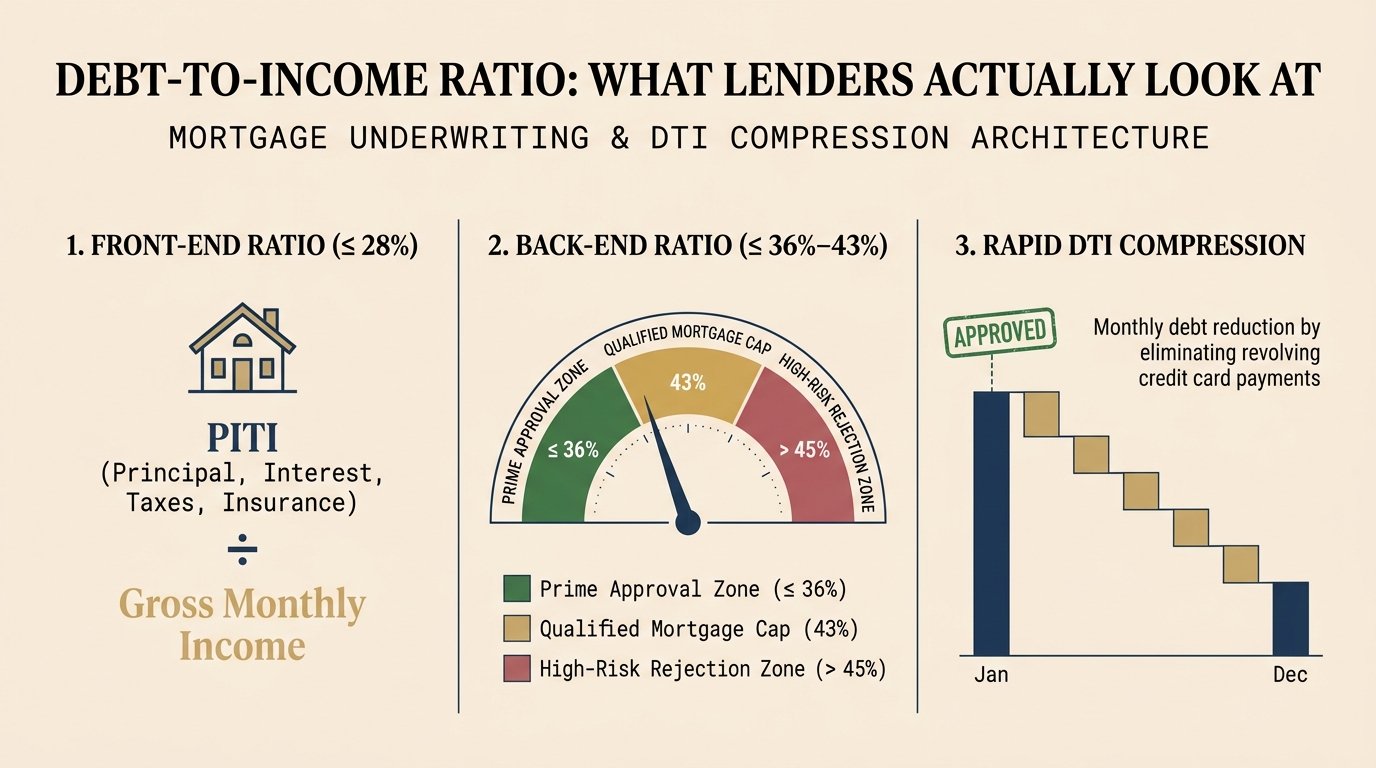
Lenders split your DTI into two distinct calculations—commonly known as the 28/36 Rule:
1. Front-End DTI = (Proposed Monthly Housing Payment [PITI + HOA]) ÷ Gross Monthly Income
2. Back-End DTI = (Housing Payment + All Monthly Minimum Debt Obligations) ÷ Gross Monthly Income
Note that PITI stands for Principal, Interest, Property Taxes, Homeowners Insurance, and any mandatory Mortgage Insurance (PMI/MIP) or Homeowners Association (HOA) dues.
What Counts (and What Doesn’t) in an Official DTI Calculation
One of the most common mistakes borrowers make when calculating DTI on a napkin is using net take-home pay and including monthly living expenses like utilities or car insurance. Underwriters follow strict institutional definitions:
Included in Back-End Debt Obligations:
- Housing Payment: Either your current rent or your proposed full mortgage payment (PITI + HOA).
- Revolving Credit Card Minimums: The exact minimum monthly payment printed on your most recent credit report statement—not what you voluntarily choose to pay each month.
- Auto, Boat, & RV Loans: The fixed contractual monthly installment payment.
- Student Loans (Even in Deferment!): If your student loans are in active repayment, lenders use the reported monthly payment. However, if your loans are in deferment, forbearance, or show a $0 Income-Driven Repayment (IDR) amount, FHA and conventional underwriters often apply an imputed payment rule—counting 0.5% to 1.0% of your total student loan balance as a monthly debt obligation ($250 to $500/month on a $50,000 loan).
- Personal & Consolidation Loans: Any fixed installment loan reported to Equifax, Experian, or TransUnion.
- Court-Ordered Obligations & Co-Signed Debt: Alimony, child support, and any loan you co-signed for a family member (unless you can provide 12 consecutive months of canceled checks proving the primary borrower pays it unassisted).
Excluded from DTI Calculations:
- Federal, state, and local income taxes (DTI always uses gross pre-tax income).
- Health insurance premiums, 401(k) contributions, and HSA deductions.
- Utilities (electricity, water, gas, internet, cell phone plans).
- Auto insurance, gas, groceries, childcare, and streaming subscriptions.
- Most 4-payment Buy Now, Pay Later (BNPL) plans—unless they have defaulted or been converted into formal installment loans reported to credit bureaus.
What Lenders Actually Look At: Underwriting Thresholds by Loan Type
Different loan programs enforce vastly different ceilings on your Back-End DTI. If you are applying for a mortgage or shopping for a debt consolidation loan, here is where the real approval lines are drawn:
| Loan Category | Ideal Front-End DTI | Max Back-End DTI | Underwriting Nuance & Exceptions |
|---|---|---|---|
| Conventional Mortgage (Fannie Mae / Freddie Mac) | ≤ 28% | 36% – 45% (Up to 50% via Desktop Underwriter) | Manual underwriting caps at 36% (or 45% with high credit scores & cash reserves). Automated underwriting can stretch to 49.9% for 740+ FICO borrowers. |
| FHA Mortgage Loan | ≤ 31% | 43% (Up to 50%–56.9% with compensating factors) | Counts 0.5% of deferred student loan balances per month unless an active IBR payment is documented. |
| VA Home Loan | No hard cap | 41% Benchmark | Focuses heavily on Residual Income (how many actual dollars remain each month for family size and region). |
| Personal / Debt Consolidation Loan | N/A | 35% – 40% | Unsecured personal lenders rarely approve applicants above 40% DTI unless the loan proceeds are sent directly to creditors to pay off existing cards. |
| Prime Auto Loan | N/A | 40% – 45% (Plus ≤ 15% Payment-to-Income) | Auto underwriters verify that the car payment itself does not exceed 12%–15% of gross monthly income. |
The Counter-intuitive Secret: How to Compress Your DTI Fast
Suppose you are preparing to buy a home or refinance in 90 days, and the calculator above shows your Back-End DTI is 44.5%—just $220/month too high to qualify for a prime conventional rate. You have $4,000 in cash available to pay down debt. Where should that $4,000 go?
This is where standard financial intuition fails—and where mathematical precision wins.
If you owe $14,000 on an auto loan with a $450/month payment and throw $4,000 at it, your balance drops to $10,000—but your required monthly payment remains $450/month. Your DTI does not budge by a singletenth of a percent until an installment loan balance hits $0.00 (or has fewer than 10 monthly payments remaining under Fannie Mae rules).
To compress your DTI rapidly before a loan application, you must target debts with the highest Minimum-Payment-to-Balance Ratio:
- Small Installment Loans Near Payoff: If you owe $1,800 on a car loan or furniture loan that carries a $320/month fixed payment, paying off that $1,800 completely eliminates the entire $320/month obligation overnight—delivering an massive 17.7% monthly cash-flow yield on your payoff dollar.
- High-Minimum Revolving Credit Cards: Because credit card minimums are calculated as a percentage of your current statement balance (typically 2% to 3% of the balance, or a $25–$40 floor), paying down revolving balances lowers your required minimum payment on the very next statement cycle—while simultaneously boosting your credit score, as detailed in our guide on whether paying off debt raises your credit score.
- Eliminating “Floor Minimum” Nuisance Cards: Three retail cards carrying $350 balances each might charge a $35 minimum monthly payment per card ($105/month total). Clearing $1,050 across those three nuisance balances wipes $105/month off your DTI denominator immediately.
Using LEVEL to Engineer Your Debt-Free & DTI Roadmap
Whether you are trying to qualify for a mortgage, unlock a low-rate refinance, or permanently eliminate your monthly obligations, guessing which balance to strike first costs thousands in unnecessary interest and lost underwriting leverage.
As we highlighted in our LEVEL vs. Tally architectural comparison, LEVEL lets you map out every liability in under two minutes with zero bank-account linking. You can test custom payoff sequences, simulate one-time lump-sum strikes, and see the exact month each minimum payment drops off your monthly obligations forever.
Compress Your DTI & Eliminate Monthly Minimums with LEVEL
Stop letting minimum payments dictate your borrowing power. Plug your balances and APRs into LEVEL to see your exact daily interest bleed, compare Avalanche vs. Snowball vs. Custom payoff sequences, and lock in your exact debt-free date—100% free and private.
Build Your Payoff Blueprint at DebtFreeArchitect.com →