
Why Paying Extra on Every Credit Card Doesn’t Work (and the Fix)
Spreading extra cash evenly across multiple credit cards feels fair, but mathematically it is one of the slowest ways to eliminate debt. Here is why the “peanut butter spread” keeps your monthly overhead trapped—and how focused rollovers accelerate your freedom date.
A borrower carrying $22,000 across four credit cards recently shared a common frustration: every month, they paid their required $580 in minimum payments, plus an additional $400 in extra cash from their side income. Wanting to make progress across the board, they split the extra money into four equal piles: $100 extra to Card A, $100 to Card B, $100 to Card C, and $100 to Card D.
Eighteen months later, they hadn’t closed a single account. They were still juggling four separate due dates, writing four checks every month, paying hundreds of dollars in compounding interest, and feeling completely burned out (see our case study on paying off $20k in debt on a $50k salary). They asked a desperate question: “Why does it feel like I’m blowing at a forest fire?”
Here is the direct answer in plain math: spreading extra cash evenly across all of your debts—known as the “peanut butter spread”—dilutes your capital, prolongs your cash-flow vulnerability, and allows high-interest compounding to bleed your budget unchecked. To get out of debt as fast as humanly possible, you must pay only the bare minimum on every account except one, attack that single focus account with 100% of your extra payment force, and cascade the freed-up cash into the next account the moment it reaches zero.
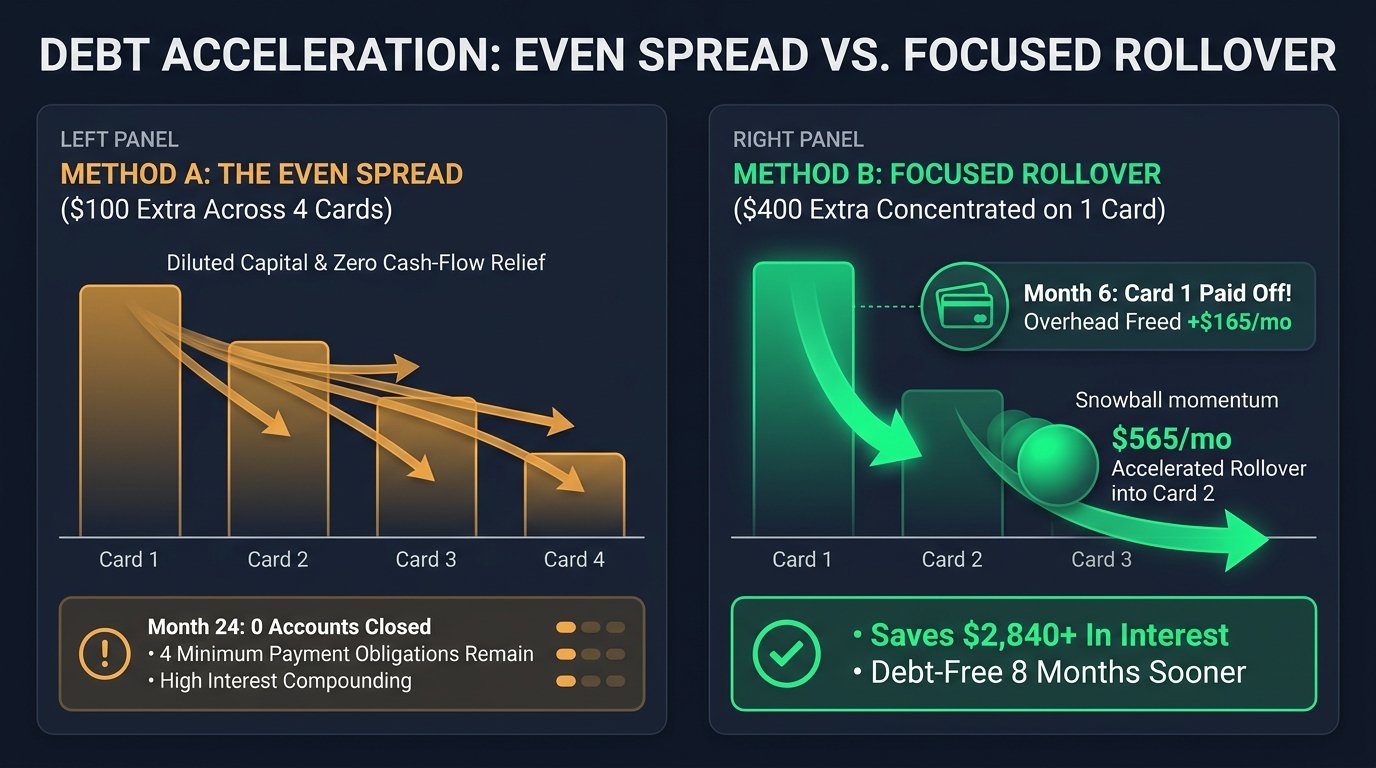
Let’s look at the exact numbers from the borrower carrying $22,000 across four credit card accounts, comparing an even $100 spread against a focused rollover strategy with the exact same $980 total monthly payment budget ($580 baseline minimums + $400 extra cash):
- Card 1 (Retail Store Card): $2,400 balance @ 29.99% APR | $75 minimum payment
- Card 2 (Major Card): $5,600 balance @ 26.99% APR | $165 minimum payment
- Card 3 (Travel Card): $6,800 balance @ 22.49% APR | $190 minimum payment
- Card 4 (Credit Union Card): $7,200 balance @ 14.99% APR | $150 minimum payment
| Payoff Strategy | Extra Payment Method | First Account Paid Off | Total Payoff Time | Total Interest Paid | Cash Savings |
|---|---|---|---|---|---|
| The Even Spread (“Peanut Butter”) | $100 extra split evenly across all 4 cards | Month 18 (Card 1) | 36 Months (3.0 Years) | $6,679.93 | $0 (Baseline) |
| Focused Payoff (Avalanche / Rollover) | $400 extra concentrated on Card 1, then rolled forward | Month 6 (Card 1) | 29 Months (2.4 Years) | $5,823.47 | +$856.46 Saved |
Notice what the table reveals. Both methods spend the exact same $980 every month. Yet the focused strategy finishes 7 months earlier, puts $856.46 in cash back in the borrower’s pocket, and most importantly: kills the first credit card in Month 6 instead of Month 18.
If your budget is in an acute deficit and you can’t afford minimum payments on credit cards, do not make partial payments across every card. Read our triage survival protocol first.
When focused payments eliminate your first card, follow our checklist on what to do after paying off a credit card so you roll 100% of that payment into the next balance.
The 4 Hidden Traps of Spreading Your Payments Evenly
Why does spreading extra payments evenly produce such inferior results? There are four mathematical and structural reasons why the “peanut butter spread” consistently fails borrowers.
1. Compounding Interest Asymmetry (Daily Interest Bleed)
Credit card interest compounds daily based on your Annual Percentage Rate: Daily Interest = Balance × (APR / 365). When you have multiple cards with different interest rates, every dollar you allocate to a lower-interest card instead of your highest-interest card costs you money in real time.
In our case study, sending $100 extra to Card 4 (14.99% APR) saves $0.041 per day ($1.25/month) in interest charges. But sending that same $100 to Card 1 (29.99% APR) would have saved $0.082 per day ($2.50/month)—exactly double the savings. By dividing the extra cash evenly, you allow the highest-interest card to continue bleeding cash at nearly 30% APR. Our Daily Interest Bleed calculator demonstrates how this rate asymmetry quietly siphons thousands of dollars from unsuspecting borrowers over time.
2. The Cash-Flow Fragility Trap (Locked Overhead)
The biggest hidden danger of spreading payments evenly is not just interest—it is cash-flow risk. Every active credit card carries a mandatory minimum monthly payment. In our example, the borrower’s non-negotiable overhead is $580 every single month.
Under the even spread method, all four balances decline slowly in lockstep. Because no single card receives sufficient capital to reach zero, the borrower must still pay all four minimum payment bills every month for the first 17 consecutive months. If an emergency strikes in Month 12—such as a medical bill or job interruption—the borrower cannot lower their debt payments below $580 without risking a 30-day late mark on their credit reports.
Under a focused payoff plan, Card 1 is completely wiped out in Month 6. In Month 7, that $75 minimum payment disappears forever. The borrower’s mandatory baseline drops from $580 to $505. By Month 14, Card 2 is wiped out, reducing mandatory overhead to $340. Each closed account creates a structural cushion that protects you against life’s unexpected expenses.
A debt payoff plan is not just about reducing balances; it is about eliminating mandatory monthly bills. Every closed account permanently lowers your survival overhead, freeing up working cash flow and reducing financial anxiety.
3. The Minimum Payment Decay Effect
Credit card issuers calculate your required minimum payment as a percentage of your remaining balance—typically 1% to 2% of the balance plus accrued monthly interest. As your balance drops, your required minimum payment automatically decreases.
When borrowers pay an even amount across all accounts, they often notice their required minimums dropping from $75 to $68, then to $62. If they are not tracking their total debt budget strictly, they naturally relax their total outflow. By allowing minimum payments to decay across four cards simultaneously, the total payoff velocity slows down, extending the debt timeline by years. A dynamic amortization model like LEVEL fixes this by locking your total debt budget and automatically rolling decaying minimums forward.
4. Psychological Fatigue (“Blowing at a Forest Fire”)
Debt payoff is an endurance race. When you divide $400 across four cards, each account balance creeps downward by just $100 to $150 per month after interest charges. After an entire year of hard sacrifice and aggressive budgeting, you still open four statements every month and see four large balances. There is no tangible victory, no closed account, and no sense of finish line.
Behavioral economists have repeatedly found that human beings need quick, tangible milestones to maintain discipline. Closing an account in Month 6 gives you an immediate psychological victory. You shred the card, update your spreadsheet or app, and experience the visceral thrill of watching your mandatory bills disappear.
The Concentrated Payoff Protocol: How to Fix Your Plan Today
If you are currently spreading extra cash across multiple accounts, you can pivot to a concentrated payoff protocol immediately without spending a single additional dollar. Here is the step-by-step framework:
- List All Accounts: Write down your current balance, Annual Percentage Rate (APR), and minimum monthly payment for every account.
- Lock Your Total Debt Budget: Add all required minimum payments together, then add the exact dollar amount of extra cash you can afford. This is your total monthly debt budget (e.g., $580 min + $400 extra = $980 total).
- Select Your Single Focus Target:
- Debt Avalanche: Choose the card with the highest APR (e.g., Card 1 at 29.99%). This mathematically saves the most money in interest charges.
- Debt Snowball: Choose the card with the smallest balance (e.g., Card 1 at $2,400). This eliminates your first monthly bill the fastest.
- Put Non-Target Cards on Autopilot: Set automatic payments for the exact minimum amount on all secondary accounts. Never pay a penny more on these accounts until your focus card is dead.
- Direct All Firepower at the Focus Card: Send every remaining dollar of your debt budget ($400 extra) to your single focus account.
- Execute the Rollover: When your focus card reaches $0, celebrate—and then immediately take its former minimum payment ($75) and add it to your extra payment pool. Your extra payment on the next card is now $475/month!
What If You Only Have $100 or $200 Extra per Month?
Many borrowers believe focused payoff only works if you have large sums of disposable cash. In reality, the smaller your extra cash, the more dangerous an even spread becomes.
Consider the same $22,000 four-card portfolio, but imagine the borrower only has $200 in total extra cash ($50 extra per card):
| Strategy ($200 Total Extra/Mo) | Months Until First Account Closes | Total Payoff Duration | Total Interest Paid |
|---|---|---|---|
| $50 Even Spread Across 4 Cards | 27 Months (2.25 Years!) | 49 Months (4.1 Years) | $9,241.32 |
| $200 Focused Payoff (Avalanche) | 10 Months | 39 Months (3.25 Years) | $8,278.71 |
When capital is tight, spreading $50 across four cards delays your first account closure until Month 27. For more than two full years, you remain fully exposed to four monthly payment obligations. By focusing that same $200 on a single card, your first card reaches zero in Month 10—a full 17 months earlier—saving nearly $1,000 in interest and cutting 10 months off your payoff journey.
Are There Any Exceptions Where Paying Extra on Multiple Cards Makes Sense?
In almost all mathematical scenarios, concentrated payoff outperforms an even split. However, there are two specific exceptions where temporary multi-card allocation is justified:
- Credit Utilization Step-Downs: If a specific card is maxed out above 90% utilization and severely hurting your credit score before an upcoming mortgage or auto loan application, directing extra cash to bring that card below 69% or 49% utilization can yield a quick score boost. Once below the utilization cliff, return immediately to the concentrated focus method.
- 0% Balance Transfer Expiration Cliffs: If you have a balance transfer card whose 0% promotional APR expires in 90 days (jumping to 28% or triggering deferred interest), pausing your main strategy to eliminate the promo balance before the cliff date avoids catastrophic retroactive interest penalties. Our guide on 0% promotional cliffs and spreadsheet errors explains how to navigate this pivot.
Automate Your Cascading Payoff Rollovers with LEVEL
Calculating cascading rollovers, interest rate shifts, and exact debt-free dates by hand in a spreadsheet requires complex nested formulas that break easily. LEVEL builds a dynamic, high-conviction debt payoff architecture tailored to your accounts—with zero bank account linking, zero passwords, and complete privacy.