Debt Management Plan vs. a DIY Payoff Plan: When to Go It Alone
A nonprofit Debt Management Plan can slash 26% credit card rates down to 8%. However, it requires closing your enrolled cards. Here is the exact 36-month math that shows when to enroll and when to stay DIY.
First, choose a DIY payoff plan if you can clear your credit card balances in 24 months or less. On a short timeline, keeping your cards open and avoiding monthly fees wins easily.
In contrast, choose a nonprofit Debt Management Plan (DMP) if your DIY timeline stretches past 36 months at 24% to 29% APR. Similarly, a DMP makes sense if your minimums eat all your monthly cash flow or your issuers already denied lower rates.
Once you decide to eliminate high-interest credit card debt, you face a major fork in the road. Specifically, should you build a DIY plan using the Debt Avalanche or Debt Snowball? Or should you enroll in a Debt Management Plan through a nonprofit credit counseling agency?
Unfortunately, most online advice treats this choice like an ideology. For example, one camp insists you should never pay a third party for debt help. Meanwhile, another camp pushes counseling on everyone regardless of income. Instead, the right answer depends strictly on your payoff horizon and your interest drag.
A Real-World $24,000 Case Study
The Situation: Consider a household owing $24,000 across four credit cards at a 25.99% average APR. Their minimum payments total $660 per month. After covering rent, food, and utilities, they can afford $700 per month toward debt.
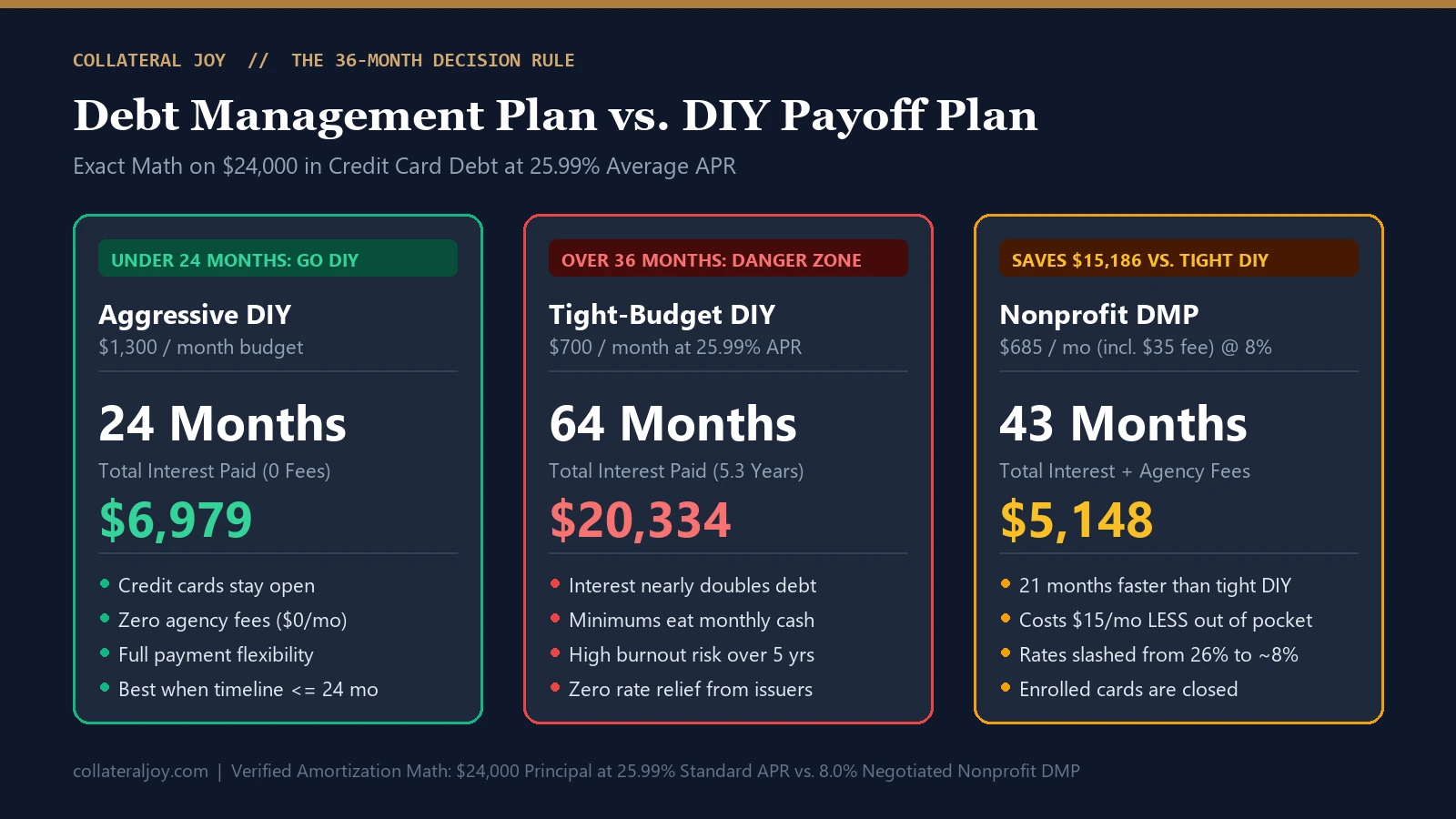
The DIY Reality: Because the interest rate is 25.99%, over $520 of their first payment goes straight to interest. Therefore, staying DIY takes 64 months (5.3 years) and costs $20,334 in total interest.
The DMP Quote: Next, an accredited nonprofit agency quotes $650 per month plus a $35 fee ($685 total) at an 8.0% negotiated APR. As a result, the debt disappears in 43 months. Total interest plus fees drop to $5,148, saving $15,186 while costing $15 less each month.
Worked Math: $24,000 Debt at 25.99% Average APR
To see why your monthly budget changes the verdict, compare three paths for the exact same $24,000 stack.
| Strategy | Monthly Outlay | Effective APR | Payoff Timeline | Interest + Fees Paid | Account Status |
|---|---|---|---|---|---|
| Aggressive DIY | $1,300 / month | 25.99% | 24 Months | $6,979 ($0 fees) | All cards stay open |
| Tight-Budget DIY | $700 / month | 25.99% | 64 Months | $20,334 ($0 fees) | All cards stay open |
| Nonprofit DMP | $685 / mo ($650 + $35 fee) | 8.00% | 43 Months | $5,148 ($3,643 int + $1,505 fees) | Enrolled cards closed |
Why the 36-Month Threshold Matters
Look closely at Row 1 versus Row 2. If you can send $1,300 per month toward $24,000, you wipe out the debt in 24 months. Consequently, going DIY keeps your credit lines open and avoids agency rules. In that case, a DMP is completely unnecessary.
However, when your budget caps out at $700 per month, compound interest overwhelms your payments. Even though the DMP payment looks only $15 lower per month, the math changes dramatically. We break down this exact illusion in Is a Debt Management Plan Worth It? The Real Math Behind “Only $60 Lower”. Ultimately, cutting the rate from 25.99% to 8.0% saves over $15,100 and shaves 21 months off your timeline.
The 4 Trade-Offs People Miss Before Enrolling
Before committing to either path, weigh four practical trade-offs. Because these rules rarely appear in sales brochures, checking them upfront prevents regret.
1. Enrolled Credit Cards Must Be Closed
To grant a permanent rate cut down to 6% or 9%, issuers require closing enrolled cards to new charges. As a result, your credit utilization may rise briefly until balances drop. However, closed positive accounts still count on your credit profile for up to 10 years. For exact scoring numbers, read our guide on whether closing a card in a hardship plan hurts your credit score.
2. Payment Rigidity vs. Cash-Flow Flexibility
On a DIY plan, you control every dollar. For example, if an unexpected $400 car repair hits, you can drop to minimums for one month without penalty. In contrast, a DMP requires a fixed monthly draft. Because missing a DMP draft can void your negotiated rate cuts, never enroll unless the payment fits comfortably inside your budget.
3. The Monthly Administration Fee
Nonprofit credit counseling agencies charge a small setup fee ($0 to $50) and a monthly maintenance fee ($25 to $50). Over 43 months at $35 per month, that totals $1,505. Therefore, paying $1,505 to save $16,691 in interest is an outstanding deal. Conversely, paying $1,505 when you could finish DIY in 14 months wastes money.
4. The “Middle Path”: Direct In-House Hardship Programs
Additionally, many borrowers overlook a powerful middle option. Before hiring an agency, call your issuers directly to request an internal credit card hardship program. Often, issuers offer 12-month to 60-month internal plans at 0% to 9.99% APR with $0 monthly fees. Still, if frontline reps deny you because your accounts are current, a nonprofit DMP becomes your next best move.
A nonprofit Debt Management Plan repays 100% of your principal on time every month while lowering your APR. In contrast, for-profit debt settlement companies tell you to stop paying bills and let accounts default. Always review CFPB guidance on credit counseling and verify accreditation through the National Foundation for Credit Counseling (NFCC).
The 5-Point Decision Checklist
Finally, use these clear rules to pick your path in under five minutes.
- First, you can pay off all unsecured debt in 24 months or less using Avalanche or Snowball.
- Second, you qualify for a 0% balance transfer that lowers your rate without closing old cards.
- Third, your income fluctuates (commission or freelance), so you need month-to-month payment flexibility.
- First, your DIY payoff timeline at 24%+ APR stretches beyond 36 months.
- Second, your card issuers already denied your direct requests for an internal hardship rate cut.
- Third, you have steady income for a fixed draft and want enrolled cards closed to stop re-spending.
However, if you cannot afford even a reduced DMP payment after funding food, housing, utilities, and transport, start with our cash-flow deficit triage plan. In severe insolvency, you should also speak with a licensed consumer attorney.
Test Your Exact DIY Timeline Before Calling Anyone
Do not guess whether your payoff horizon is 22 months or 58 months. Instead, test your real balances inside our Debt Snowball vs. Avalanche Calculator or model custom rate cuts inside LEVEL with zero bank linking and 100% privacy.
Frequently Asked Questions
Does a Debt Management Plan hurt my credit score?
No, enrolling in a DMP is not a negative FICO scoring factor by itself. Initially, your score may dip 15 to 35 points because enrolled cards are closed. However, consistent on-time payments and rapidly falling balances usually push scores significantly higher within 12 to 24 months.
Can I keep one credit card open outside of a Debt Management Plan?
Yes. Most nonprofit agencies allow you to keep one zero-balance or low-balance card outside the plan for travel or emergencies. You only need to close the specific cards receiving negotiated rate cuts.
Can I pay off a Debt Management Plan early without penalty?
Yes. Nonprofit DMPs never charge prepayment penalties. Therefore, if you get a tax refund or raise, you can pay extra toward principal to finish early and stop paying the monthly fee sooner.
What is the difference between a DMP and calling my credit card company myself?
Calling your issuer directly costs $0 in agency fees. However, many issuers refuse hardship cuts while your account is still current. In contrast, NFCC nonprofit agencies hold pre-negotiated agreements that lower APRs even before you miss a payment.