
New Year Debt Payoff Plan: The 4-Quarter Blueprint to Eliminate Balances for Good
Every January, millions of people resolve to “get out of debt” through sheer willpower and extreme deprivation. By the second week of February, over 80% of these resolutions collapse into burnout, guilt, and binge spending. Sustainable debt elimination is not a test of moral character—it is a problem of seasonal cash-flow architecture. Here is the quarter-by-quarter blueprint to permanently eradicate high-interest balances over 12 structured months.
- The Deprivation Rebound: Slashing personal spending to zero in January triggers the psychological equivalent of a crash diet. Sustainable payoff plans build in a non-negotiable “Joy Line Item” to maintain stamina.
- Q1 Tax Refund Blitz: The average U.S. federal tax refund exceeds $3,000. Funneling this windfall directly into your highest-APR balance in March bypasses months of compounding interest bleed.
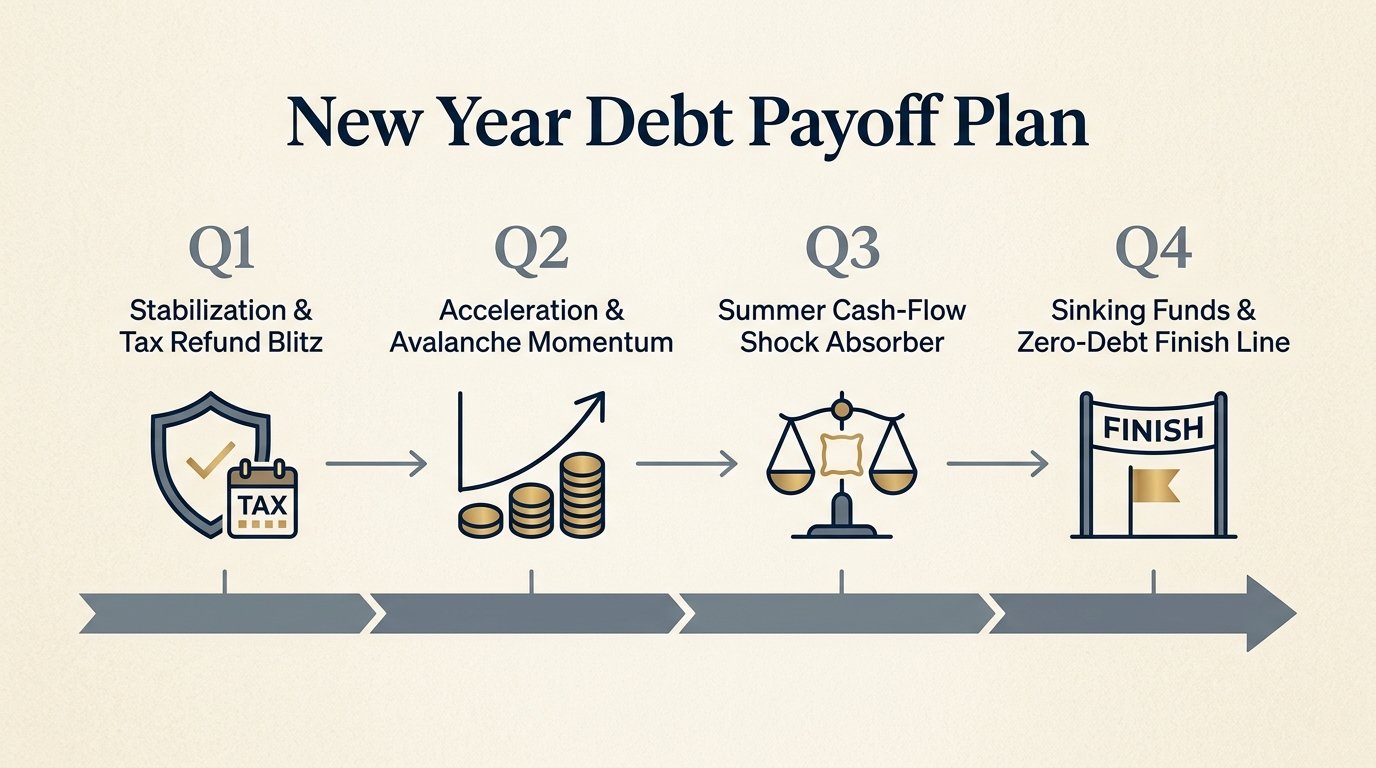
- The 4-Quarter Pacing: Divide the year into distinct phases: Q1 (Stabilization & Windfall), Q2 (Avalanche Momentum), Q3 (Summer Seasonal Defense), and Q4 (Holiday Sinking Funds & Zero-Debt Finish Line).
- Automate Minimums, Blitz Principal: Never automate extra principal payments. Automate mandatory contractual minimums to protect your credit score, and execute manual monthly principal sweeps based on cash flow.
- Sinking Funds Prevent Relapse: December holiday debt is not an “emergency”—it is an annual calendar certainty. Establishing automated monthly sinking funds by July prevents holiday borrowing from undoing your entire year’s progress.
1. Why 80% of New Year Debt Resolutions Fail by Mid-February
The standard American New Year financial ritual follows a predictable, exhausting script:
On January 1st, energized by holiday spending guilt, you open your credit card apps, total up your balances, and feel a surge of panic. You vow: “This year is different. No dining out, no new clothes, no coffees, no vacations. Every single spare penny goes toward debt.”
For three weeks, sheer adrenaline carries you through. You bring brown-bag lunches, cancel streaming services, and decline social invitations.
Then, by early February, deprivation fatigue sets in. A stressful week at work, an unexpected car repair, or a dinner invitation from friends shatters the budget. You spend $150, feel a wave of shame for “failing,” and abandon the plan entirely. By March, credit card balances are higher than when the year began.
The mistake is not a lack of willpower. The mistake is treating debt payoff like an endurance punishment rather than an engineered seasonal roadmap. Life does not operate on a static 30-day spreadsheet; it ebbs and flows across four distinct quarters of seasonal expenses, tax windfalls, and summer disruptions.
2. The 4-Quarter Annual Debt Payoff Framework
To eliminate debt over the next 12 months, structure your financial year into four sequential, specialized operational phases:
The objective of Q1 is triage, interest arrest, and liquidity stabilization:
- Perform the Forensic Inventory: List every active liability, outstanding balance, contractual minimum, and annual percentage rate (APR). Calculate your true daily dollar bleed (Balance × APR ÷ 365).
- Establish the $1,500 Starter Cushion: Before accelerating extra principal, park a minimum cash buffer in high-yield savings to absorb routine flat tires and medical co-pays without swiping cards (as detailed in our guide on emergency funds vs. debt payoff).
- File Taxes Early & Deploy the Refund: The average American tax refund exceeds $3,000. Do not let this cash sit idly in checking or leak into lifestyle upgrades. Treat your tax refund as a tactical cruise missile: deploy 80% directly into your highest-APR balance in March, and allocate 20% to reinforce your emergency cushion.
With your tax refund deployed and balances trimmed, Q2 focuses on establishing an automated monthly velocity:
- Implement the Debt Avalanche: Channel all discretionary debt payoff cash into the highest-APR card while paying contractual minimums on all lower-rate accounts.
- Execute the “Subscription & Utility Audit”: Review recurring bank statements for the past 90 days. Cancel zombie subscriptions, renegotiate auto insurance rates, and shop your home broadband plan. Reallocate the $80 to $150 in monthly savings directly toward debt principal.
- Mid-Year Credit Utilization Check: Watch your revolving credit utilization ratio drop below 30% and 10%, unlocking significant FICO score gains (as detailed in our credit score payoff timeline guide).
Summer is where traditional debt plans quietly die. Weddings, family vacations, camp fees, and patio dining create sudden cash outflows that tempt borrowers to swipe credit cards:
- Adopt Cash-Only Summer Leaks: Budget vacation and leisure activities strictly with cash or debit. If the vacation fund has $800, that is the hard ceiling. Never finance a temporary weekend getaway at 25% APR.
- Maintain Consistency over Perfection: If summer expenses compress your monthly surplus, drop back to your baseline debt payments rather than quitting. Protecting cash reserves is better than making a heroic debt payment and needing to re-borrow two weeks later (a core principle of irregular cash-flow management).
The final quarter of the year determines whether you permanently break the debt cycle or reload your balances for next year:
- Build the Holiday Sinking Fund: Starting in October, calculate your total planned holiday gift, travel, and entertaining budget. Divide by three and transfer that cash into a dedicated sub-savings account in October, November, and December. When Christmas arrives, you spend 100% debit.
- Deploy the Year-End Bonus (50/30/20 Rule): If you receive an annual bonus or employer profit-sharing check in December, apply the 50/30/20 formula: 50% to wipe out remaining debt principal, 30% to bolster liquid savings, and 20% for guilt-free holiday celebrations.
- Enter the New Year at $0: Cross the December 31st threshold with zero consumer credit card debt for the first time in your adult life.
3. The “Joy Line Item”: Why Anti-Deprivation Rules Work
The fatal flaw of traditional budgeting is the elimination of all pleasure. Personal finance is behavioral psychology disguised as arithmetic.
If your payoff plan forbids you from ordering a pizza, grabbing a weekend craft beer, or buying a new book for 12 months, your brain views debt elimination as a prison sentence. Under extreme restriction, willpower acts as a depleting battery.
To build a plan that survives until December, mandate a non-negotiable “Joy Line Item” in your monthly budget—typically $75 to $150 per adult.
This money is completely unrestricted. It carries zero guilt, zero tracking, and zero justification. When you know you have permission to enjoy a small slice of your labor every week, the urge to stage an emotional $800 retail-therapy rebellion disappears.
4. The Willpower Resolution vs. The Engineered Annual Blueprint
| Strategic Dimension | Traditional “Willpower” Resolution | Engineered 4-Quarter Architecture |
|---|---|---|
| Guiding Strategy | Vague emotional desire: “I will spend less and save more.” | Mathematical sequencing: Dynamic Avalanche targeting daily dollar bleed. |
| Windfall Treatment | Tax refund & bonuses viewed as “found money” and spent on upgrades. | Windfalls modeled as tactical principal strikes (80% debt / 20% buffer). |
| Discretionary Spending | Total deprivation (zero dining out, zero entertainment); leads to burnout. | Protected “Joy Line Item” built into cash flow to maintain psychological stamina. |
| Seasonal Expenses | Summer trips and Christmas gifts treated as unexpected emergencies. | Anticipated with automated monthly sinking funds starting 4–6 months early. |
| February Outcome | Over 80% abandon budget after first minor spending slip. | Surplus adjusts dynamically; zero panic, zero debt relapse. |
| 12-Month Result | Credit balances identical or higher by December. | Total elimination of high-interest revolving liabilities. |
5. Real-World Case Study: Eliminating $18,000 in 12 Months
Consider Michael and Elena, who entered January with $18,000 in credit card debt spread across three cards at an average 24.5% APR:
- Card 1 (High Rate): $8,500 at 26.99% APR (Min: $240/mo).
- Card 2 (Mid Rate): $6,000 at 22.99% APR (Min: $160/mo).
- Card 3 (Store Card): $3,500 at 28.99% APR (Min: $110/mo).
- Total Monthly Minimums: $510/month.
Their monthly household surplus allowed for an extra $550/month above minimums ($1,060/month total debt allocation). In addition, they anticipated a $3,200 tax refund in March and an estimated $1,800 year-end bonus in December.
How the 4 Quarters Played Out:
- Q1 (Jan–Mar): They maintained their $1,060 monthly allocation, targeting Card 3 (Store Card at 28.99% APR). In March, their $3,200 tax refund arrived. They wiped out Card 3 completely ($3,500 gone!) and directed the remaining $1,350 to Card 1. Result: Store card eliminated in 90 days.
- Q2 (Apr–Jun): With Card 3 gone, its $110 minimum was rolled into Card 1. Total monthly payment on Card 1 surged to $900/month. By June 30th, Card 1’s balance dropped from $7,150 down to $4,450.
- Q3 (Jul–Sep): Summer vacations created higher leisure spending. They reduced extra principal payments slightly to $350/mo, maintaining their cash buffer. Card 1 balance dropped to $2,350 without adding a penny of new debt.
- Q4 (Oct–Dec): In October, Card 1 was paid to $0! In November and December, all cash flow targeted Card 2 ($6,000 at 22.99%). In December, their $1,800 bonus arrived. Combined with their December monthly allocation, Card 2 was paid down to $0 on December 28th.
By structuring windfalls and seasonal pacing, Michael and Elena eliminated all $18,000 in liabilities, saved over $3,400 in compounding interest, and entered the following January completely debt-free.
6. The Annual Debt Elimination Action Checklist
- [ ] Calculate Your True Daily Bleed: Multiply each balance by its APR and divide by 365 to calculate how much interest leaves your account daily.
- [ ] Quarantine a $1,500 Cash Buffer: Establish an emergency cushion before sending extra principal to protect against minor shocks.
- [ ] Earmark Your Tax Refund Now: Commit in advance to funneling at least 70%–80% of your IRS refund directly into your highest-APR balance.
- [ ] Automate Minimums Only: Set contractual minimums on auto-debit; execute extra principal blitzes manually based on monthly cash flow.
- [ ] Protect the “Joy Line Item”: Allocate $75 to $150/month in guilt-free personal spending to eliminate deprivation burnout.
- [ ] Open Sinking Funds by July: Set up automated transfers for summer travel and winter holidays to ensure Christmas is funded with 100% cash.
Architect Your 12-Month Debt-Free Roadmap with Precision
Don’t rely on fragile resolutions. LEVEL gives you an engineered scenario engine to model dynamic avalanche payoffs, test tax refund injections, and map your visual 12-month brick roadmap to zero—100% privately, with zero bank logins.
Architect Your New Year Plan at DebtFreeArchitect.com →Available on desktop and on mobile via the newly launched LEVEL Mobile View. Zero bank credentials required.