
Payday Loan Alternatives When You Need Cash Fast (The 400% APR Trap & 7 Safer Liquidity Lifelines)
When an acute cash emergency strikes 72 hours before payday, storefront lenders offer what looks like a minor transaction: borrow $400 today for a modest $60 fee. Mathematically, that simple fee translates to a predatory 391% APR designed to trap borrowers in an endless rollover vortex. Here is how the payday lending mechanism functions and seven regulated, low-cost liquidity lifelines to access cash immediately.
There is a specific kind of panic that sets in when your car’s alternator dies on a Tuesday, your checking account balance reads $14.22, and your paycheck won’t deposit until next Friday. You need $350 immediately to get to work.
In that moment of vulnerability, the storefront neon sign or digital sponsored ad promising “Instant Cash in 15 Minutes • No Credit Check” feels like an answered prayer. The lender doesn’t quote an intimidating interest rate; they frame the transaction in casual terms: “Just $15 for every $100 borrowed.”
Paying $60 to borrow $400 for two weeks feels manageable when you’re desperate. But that framing hides the most predatory financial instrument in modern banking.
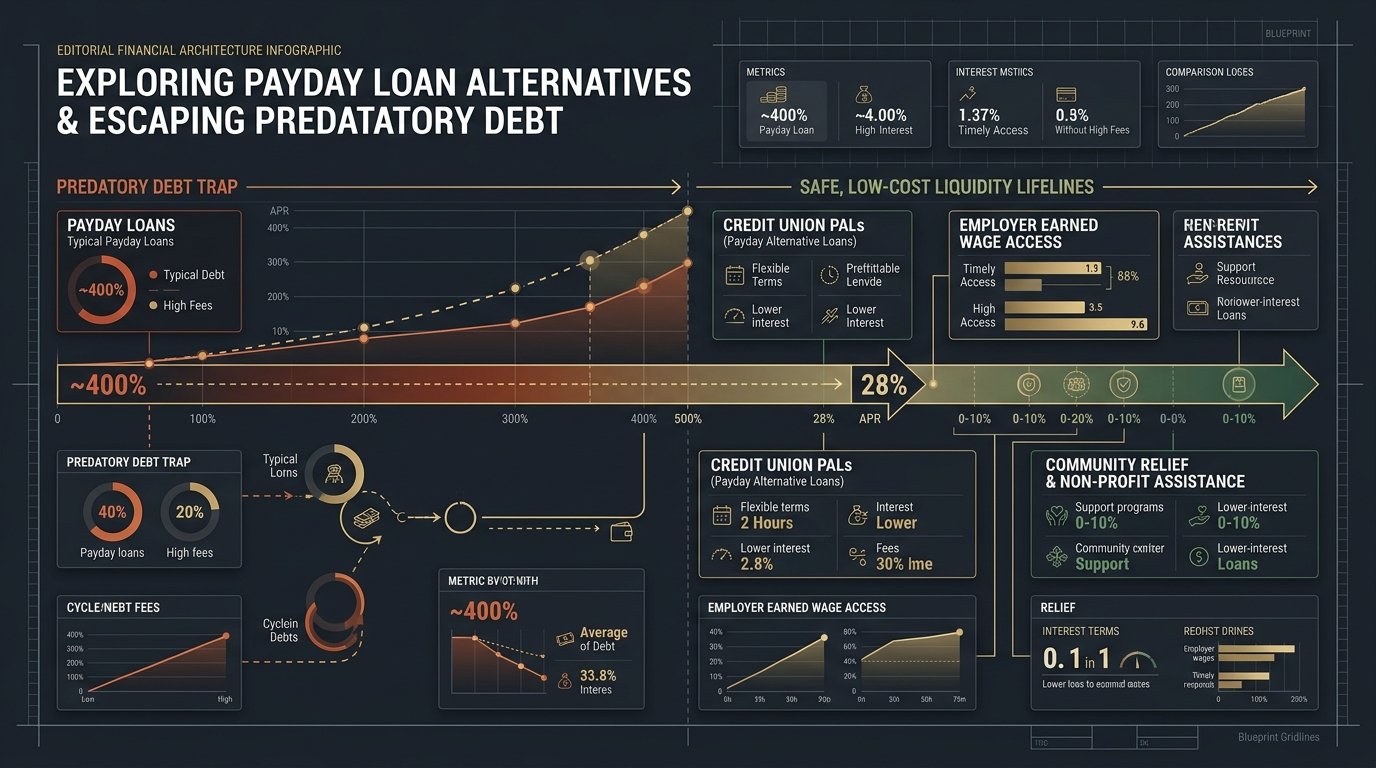
By translating short-term fees into annual percentage rates (APR) and understanding the business model of repeat rollovers, the true cost becomes undeniable: you are paying the equivalent of nearly 400% APR. Fortunately, between federal credit union mandates, non-profit hardship programs, and modern workplace tools, there are legitimate ways to bridge cash-flow shortages without mortgaging your future income.
The Mathematical Deception: How $15 Per $100 Becomes 391% APR
The payday lending industry relies entirely on the cognitive illusion of short time horizons. A 15% flat fee on a two-week loan sounds comparable to a 15% APR on a credit card. It is not.
An Annual Percentage Rate measures what money costs when borrowed across a full year (52 weeks). When a lender charges 15% for just 14 days, that fee compounds 26 times across a calendar year:
Worked Example: Borrowing $400 with a $60 fee for 14 days:
• Fee Ratio: $60 ÷ $400 = 0.15 (15%)
• Annual Multiplier: 365 ÷ 14 = 26.07 periods
• Effective APR: 0.15 × 26.07 × 100% = 391.07% APR
If you borrowed $400 at credit card rates (even a high 25% APR) for two weeks, the interest cost would be $3.84. A payday lender extracts $60.00 for the exact same capital—over 15 times the cost of the most expensive commercial credit card.
The Repeat Rollover Vortex: The Core Business Model
Payday lenders do not make their billions in profit from one-off emergency loans. Their entire economic model is engineered around loan churning and repeat rollovers.
According to data published by the Consumer Financial Protection Bureau (CFPB):
- Over 80% of payday loans are rolled over or renewed within 14 days of payoff.
- More than 75% of industry loan fees come from borrowers who take out 10 or more loans per year.
- The average borrower stays trapped in payday loan debt for five months, paying an average of $520 in finance fees just to borrow $375.
The Balloon Payment Reality
Why do rollovers happen? Because payday loans require a 100% balloon payment on your next payday. If your budget was already so strained that you needed $400 two weeks ago, having $460 deducted from your paycheck leaves you with an immediate $460 deficit for the upcoming pay period. The borrower has no choice but to immediately take out another payday loan to buy groceries, paying another $60 fee.
7 Legitimate, Low-Cost Payday Loan Alternatives
Before stepping into a predatory lending storefront or downloading a fee-heavy app, explore these seven regulated liquidity lifelines:
1. Payday Alternative Loans (PALs) from Federal Credit Unions
The National Credit Union Administration (NCUA) established the PAL I and PAL II programs specifically to protect consumers from predatory lenders. Federal credit unions offer small-dollar loans ranging from $200 to $2,000 with strict consumer safeguards:
- Statutory APR Cap: Maximum interest rate is legally capped at 28% APR (never 400%).
- Structured Terms: Repayment terms are structured between 1 and 12 months with fixed, equal monthly installments (no single-paycheck balloon debits).
- Application Fees Capped: Application processing fees cannot exceed $20.
Many credit unions allow you to apply the day you join, and approval is based primarily on employment and direct deposit history rather than traditional credit scores.
2. Employer Earned Wage Access (EWA) Programs
Many major employers now partner with Earned Wage Access providers like DailyPay, Even, and PayActiv, or offer internal payroll advances. These programs allow you to withdraw wages you have already worked for prior to scheduled payday.
Because you are accessing earned equity rather than borrowing from future paychecks, there are no 400% interest charges. Most services charge either $0 for standard ACH transfers or a nominal $1.99 to $2.99 transfer fee for instant debit card access.
3. Non-Profit Hardship Relief & Community Action Agencies
If you need cash to prevent utility shutoffs, pay rent, or cover emergency prescriptions, community assistance programs provide direct grant funding that never has to be repaid:
- Call 2-1-1 (United Way): Connects callers to local municipal emergency relief funds, food banks, and housing assistance.
- St. Vincent de Paul Society & The Salvation Army: Provide localized micro-grants directly to utility providers and landlords to resolve acute shutoff notices.
- LIHEAP (Low-Income Home Energy Assistance Program): Federal grants specifically designated to cover emergency heating and cooling bills.
4. Zero-Interest Cash Advance Apps (EarnIn, Brigit, Chime SpotMe)
Fintech cash advance apps allow verified workers to advance $50 to $250 against incoming direct deposits without APR interest. However, use them strictly under these guardrails:
- Always decline voluntary “tips”: Paying a $5 optional tip on a $50 advance for seven days converts to an effective APR of over 500%!
- Avoid express fee traps: Use free standard transfers whenever possible.
- Watch out for recurring monthly subscriptions: Some apps charge $9.99/month just for access.
5. Request Direct Utility, Medical & Creditor Hardship Plans
People often take out payday loans to pay a utility bill, doctor invoice, or credit card minimum payment. Cut out the predatory middleman by negotiating directly with the source:
Utility companies are legally restricted in many jurisdictions from disconnecting service during extreme weather, and almost all electric and gas providers offer deferred hardship payment arrangements. As analyzed in our guide on medical debt payoff strategies, hospital billing departments offer 0% interest payment plans and charity care, eliminating the need for fast cash.
6. Secured Savings-Backed or CD Loans
If you have even $300 to $500 in a savings account or certificate of deposit at a local bank or credit union, you can take out a share-secured loan. The bank freezes that collateral in your account and lends you cash at interest rates just 2% to 3% above what your deposit earns.
This allows you to access emergency cash while preserving your underlying savings (protecting against cash drag, as covered in our analysis of emergency funds vs. debt payoff) while reporting on-time installment payments to credit bureaus.
7. Credit Card Cash Advance (A Controlled Alternative)
While personal finance commentators routinely advise against credit card cash advances, the mathematics are clear: a credit card cash advance charging a 5% transaction fee and 29.9% APR is ten times cheaper than a 400% payday loan.
Borrowing $400 via credit card cash advance costs roughly $20 in initial fees and ~$10 in monthly interest. While expensive, it eliminates the immediate balloon cliff and allows you to pay down principal on a flexible schedule while maintaining your budget.
Payday Loans vs. Regulated Alternatives: The True Cost Matrix
| Financing Method | Effective APR Range | Cost to Borrow $400 for 1 Month | Repayment Structure | Credit Bureau Impact |
|---|---|---|---|---|
| Storefront Payday Loan | 391% – 521% | $120 – $150 (2 rollover fees) | 100% Balloon in 14 Days | None (until collections) |
| Credit Union PAL Loan | Max 28.0% | $9.33 + $20 app fee | Fixed 1–6 Month Payments | Builds Credit (On-time data) |
| Employer Earned Wage Access | 0.0% APR | $0.00 – $4.99 (Transfer fee) | Deducted from paycheck | Neutral / Not reported |
| Credit Card Cash Advance | 29.9% + 5% fee | $29.96 ($20 fee + interest) | Flexible monthly minimums | Reports utilization ratio |
| Community Relief Grants | 0.0% (Grant) | $0.00 (Never repaid) | Direct vendor payout | Neutral / Zero impact |
The Permanent Escape: Building the 1-Month Operational Buffer
Payday loans do not happen because of moral failure; they happen because modern households operate without an operational cash buffer. When cash flow is calibrated down to the exact dollar of incoming income, any minor $200 variance forces borrowers into predatory lending hands.
The moment you resolve an acute emergency, your primary financial priority must be establishing a 1-month core survival buffer (as detailed in our capital allocation guide on emergency reserves vs. debt). Holding just $1,500 to $2,500 in a dedicated account completely severs your vulnerability to predatory lenders, allowing you to focus on systematic debt payoff with architectural certainty.
Escape Predatory Cycles. Build an Engineered Payoff Roadmap.
Eliminate toxic debt, model your exact interest burn rate, and engineer a customized debt-free roadmap based on mathematical certainty. No bank logins required.
Architect Your Debt Payoff Blueprint