
Medical Debt Payoff Strategies That Actually Work (Itemized Audits, Charity Care & Credit Shielding)
Unlike consumer debt, medical debt is fundamentally involuntary, notoriously error-ridden, and governed by unique federal protections. Paying an initial hospital invoice at face value is the medical equivalent of paying retail on a car whose sticker price was marked up 400%. Here is the exact clinical playbook to audit itemized bills, trigger non-profit charity care, settle balances for pennies on the dollar, and protect your credit score.
Receiving an unexpected $12,000 hospital bill after an emergency surgery or ER visit triggers an immediate, visceral panic. For most people, the instinctive reaction is either total avoidance or pulling out a credit card to clear the balance and make the calls stop.
Both responses are disastrous.
Putting medical bills onto a credit card transforms 0% interest, highly negotiable medical debt into 26% compounding revolving debt with zero financial hardship protections. Meanwhile, ignoring bills entirely allows unvalidated, inflated invoices to slip into aggressive third-party debt collection.
Medical debt is not like an auto loan or a credit card balance. It is an unregulated initial billing quote generated from arbitrary hospital “chargemasters”—internal price lists that artificially inflate service costs by 300% to 1,000% above actual hospital operating costs. According to billing advocates, between 70% and 80% of hospital bills contain billing errors.
By understanding hospital compliance mandates, federal billing laws, and modern credit bureau exemptions, you can dismantle medical liabilities systematically. Here is the exact 5-step playbook.
Cardinal Rule #1: Never Put Medical Debt on a Credit Card
When an aggressive hospital billing department threatens to escalate an unpaid bill, the temptation to pay it with a credit card is overwhelming. Doing so is the single most expensive mistake in healthcare finance.
The Commercial Debt Conversion Trap
By law, hospitals and medical providers cannot charge compounding 25% interest rates, and they must comply with federal charity care laws and medical credit reporting shields. The second you charge a $6,000 medical bill to a Visa or Mastercard, you legally convert a flexible, highly negotiable 0% liability into toxic commercial debt. You forfeit all charity care rights, eliminate billing dispute defenses, spike your credit utilization ratio, and subject yourself to hundreds of dollars in monthly compounding interest.
Step 1: Demand the Itemized Bill with CPT / HCPCS Codes
Never attempt to negotiate or pay a summary bill that states vague line items like “Pharmacy: $3,450” or “Laboratory Services: $1,800.”
Call the hospital billing office immediately and state this exact phrase: “I am requesting an itemized bill containing all CPT (Current Procedural Terminology) codes, HCPCS codes, and pharmacy revenue codes for this date of service.”
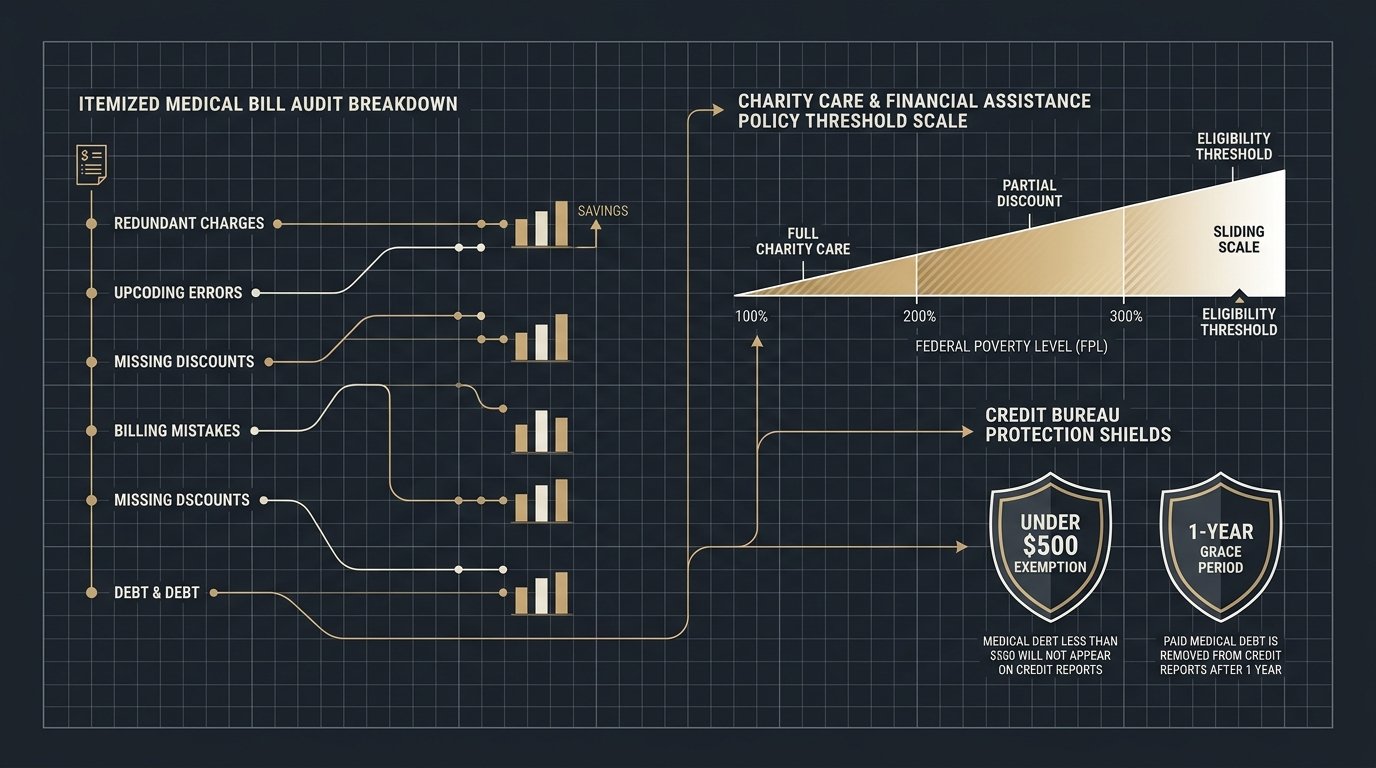
Demanding CPT codes immediately forces the billing department to run internal validation. Common billing errors that inflate medical bills include:
- Upcoding: Assigning a higher-level billing code than the care received (e.g., billing a Level 5 complex emergency room visit for a routine laceration).
- Unbundling: Separating procedures that should be billed under a single comprehensive package into multiple individual charges to extract higher fees.
- Duplicate Billing: Billing twice for the same medication, blood panel, or disposable equipment.
- Phantom Charges: Invoicing for medications prescribed but never administered, or specialist consultations that never occurred.
Simply requesting an itemized bill often reduces hospital balances by 20% to 40% because billing departments automatically remove unvalidated or redundant charges before printing the line-by-line documentation.
Step 2: Check for “No Surprises Act” Violations
Under the federal No Surprises Act, patients are legally shielded from surprise balance billing in emergency and out-of-network scenarios:
- If you visited an in-network hospital for emergency care, out-of-network emergency physicians, anesthesiologists, or radiologists cannot balance bill you beyond your normal in-network copay and deductible rates.
- For non-emergency scheduled procedures at in-network facilities, out-of-network providers cannot balance bill you without your prior informed, written consent.
If you see out-of-network physician charges from an in-network emergency room visit, file a formal dispute with the hospital patient advocate and cite federal No Surprises Act compliance.
Step 3: Trigger Non-Profit Hospital “Charity Care” (IRS 501(r))
This is the most powerful and underutilized debt-elimination tool in American healthcare. Over 58% of all hospitals in the United States operate as non-profit entities.
Under Section 501(r) of the Internal Revenue Code, non-profit hospitals are legally required to maintain a written Financial Assistance Policy (FAP) to preserve their tax-exempt status. Under these policies, hospitals must forgive or heavily discount medical bills for patients whose household income falls below specific multiples of the Federal Poverty Level (FPL).
Example: For a family of three, 400% of the Federal Poverty Level exceeds $100,000 in annual household income. Even middle-income earners routinely qualify for 50% to 80% discounts on hospital bills simply by submitting an official FAP application with recent pay stubs or tax returns.
To access this relief, search the hospital website for their “Financial Assistance Policy Application” or call the financial counseling department. By law, hospitals must pause debt collection activity while an application is under review.
Step 4: Negotiate a Cash Lump-Sum Settlement or 0% Payment Plan
If you do not qualify for charity care, you still hold immense leverage. Hospitals know that uninsured or out-of-pocket medical debt has a dismal collection rate (often collecting less than 15 cents on the dollar when sold to debt buyers).
Use tools like Healthcare Bluebook or FAIR Health Consumer to look up the Medicare reimbursement rate or fair market cash price for your specific CPT codes. Then, call the billing department with a concrete proposal:
Offer 30% to 40% in Immediate Cash
“I have reviewed fair market cash pricing for these procedures. I cannot pay the chargemaster rate of $5,000, but I have access to $1,800 today in cash. If you can accept this as payment in full and provide written confirmation of account closure, I can pay it right now.”
Hospital billing departments routinely accept cash settlements between 30% and 50% of original invoice balances to close open accounts and avoid collection agency commissions.
Lock in a Zero-Interest Internal Installment Plan
If cash is tight (referencing our guide on emergency fund priorities), request an internal hospital payment plan. Most hospital systems will establish 0% interest installment schedules over 12 to 36 months without reporting the debt or charging finance fees. Offer a realistic monthly payment (e.g., $50 to $100/month) that fits your budget.
Modern Credit Bureau Protections for Medical Debt
For decades, medical debt was a primary driver of ruined credit scores. In recent years, landmark reforms by the three major credit bureaus (Equifax, Experian, TransUnion) and the Consumer Financial Protection Bureau (CFPB) have transformed consumer protections:
| Protection Shield | Old Credit Reporting Rule | Current Legal Framework (2026) |
|---|---|---|
| Debt Under $500 | Reported to bureaus; docked score 50-100 pts | Completely Barred (Never appears on reports) |
| Reporting Grace Period | Reported after 180 days past due | Full 365-Day Window (1 year to negotiate/dispute) |
| Paid Medical Collections | Remained on credit file for 7 full years | Removed Immediately upon settlement or payment |
| Pending Insurance Disputes | Frequently referred to collections during appeals | Legally prohibited while insurance claims are pending |
As covered in our research on how paying off debt impacts credit scores and our breakdown of month-by-month score changes, these protections give you an entire 12-month runway to audit bills, apply for charity care, and negotiate settlements without damaging your credit profile.
Dismantle Medical and Consumer Debt with Mathematical Certainty
Stop stressing over scattered invoices and interest bleed. Model your exact liabilities, establish priority sequences, and calculate your debt-free milestone dates with complete privacy.
Architect Your Debt Payoff Blueprint