
Debt Payoff Plan for Self-Employed and Irregular Income
Traditional personal finance advice assumes a clockwork biweekly paycheck. When your monthly revenue swings from $3,500 to $9,000 without warning, conventional debt repayment breaks completely. Committing every spare dollar to credit cards during a feast month inevitably starves your operating reserves—forcing you to swipe credit cards to survive the next famine month. Here is the mathematical blueprint to permanently dismantle debt on variable income.
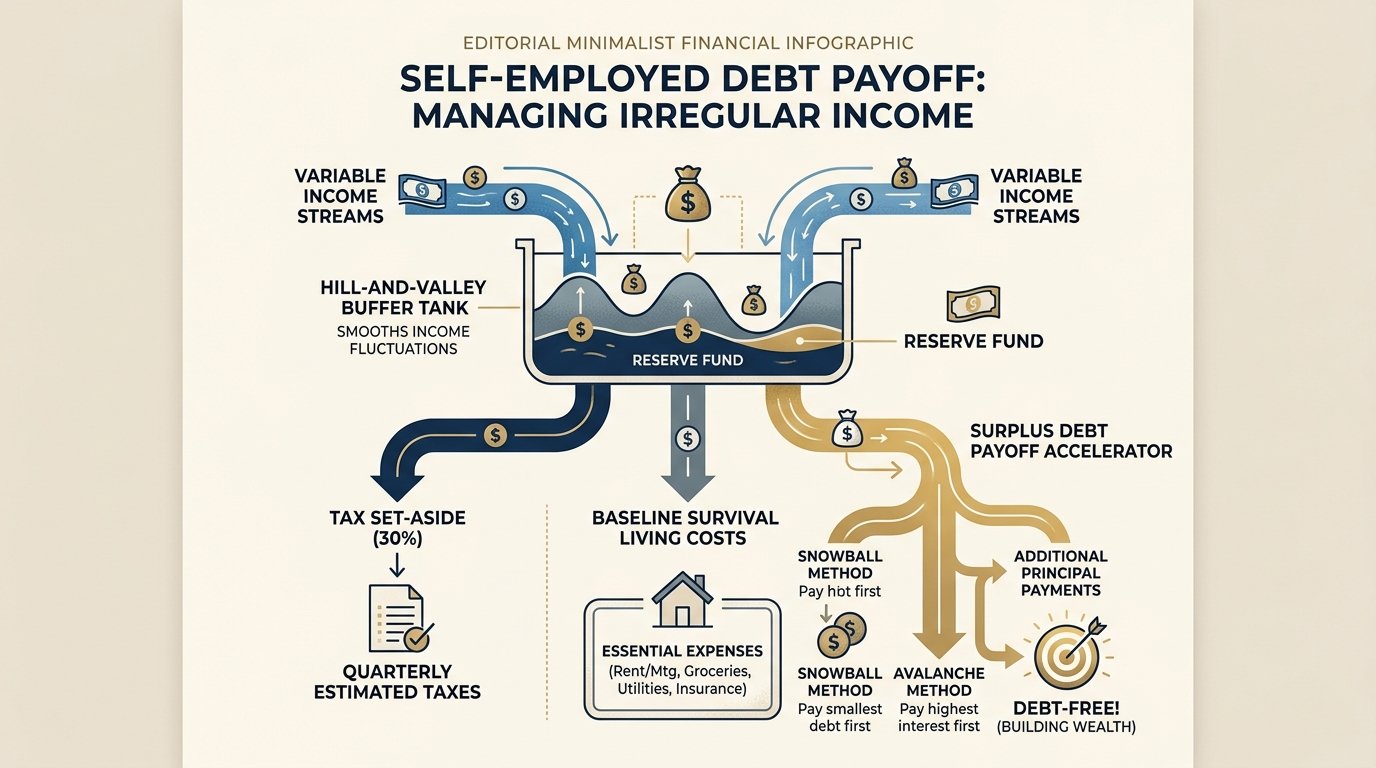
- The Feast-or-Famine Trap: Dumping 100% of lump-sum windfalls into debt creates acute liquidity starvation, forcing 1099 workers back onto credit cards during low-revenue troughs.
- Taxes Precede Principal: Never pay an extra dollar toward credit card principal until your quarterly estimated tax reserve (typically 25%–30%) is quarantined in a segregated account. An IRS lien carries far more enforcement power than an unsecured creditor.
- The Hill-and-Valley Buffer: Self-employed earners must establish a holding reservoir that normalizes erratic client deposits into an invariant baseline personal draw.
- Percentage Waterfalls Beat Rigid Autopay: Replace fixed recurring debt overpayments with a two-tier waterfall: contractual minimums in baseline months, and calibrated percentage sweeps (e.g., 50% debt, 30% buffer, 20% taxes) in surplus months.
- Cash Flow Snowball vs. Avalanche: While the mathematical avalanche saves the most interest, eliminating small, fixed monthly cash flow liabilities first dramatically lowers your monthly survival baseline.
1. Why Conventional Debt Advice Fails the Self-Employed
Nearly every mainstream debt repayment calculator assumes a linear financial reality: you earn a predictable salary on the 1st and 15th of the month, your fixed living expenses consume an invariant percentage, and whatever surplus remains can be safely locked into an automated monthly debt payoff transfer.
If you are a freelancer, independent contractor, commission-based consultant, or small business founder, that model is a recipe for chronic financial whiplash.
In self-employment, income is non-linear and asynchronous. You invoice a corporate client in January on Net-60 terms; payment arrives in late March. In April, you close three retainers simultaneously and collect $11,000. In May, client onboarding delays produce barely $3,200.
When variable earners follow rigid W-2 advice, they experience a predictable cycle:
Feast Month: You clear $10,000. Motivated to eliminate your 24% APR balance, you send $4,500 directly to credit card principal. Your balance drops, and you feel triumphant.
Famine Month: Next month receipts drop to $3,100. Rent, health insurance, software licenses, and grocery bills total $4,200. Because your surplus cash was permanently locked into debt principal (which creditors never let you borrow back without compounding interest), you have an $1,100 deficit.
The Re-Borrowing Trap: You are forced to swipe your credit card for groceries and utilities. Not only are you back where you started, but the psychological defeat often causes founders to abandon budgeting altogether.
Eliminating debt with irregular income requires a fundamental shift: you cannot budget based on what you hope to earn next month, nor can you commit future variable revenue before cash clears your account. You must construct an operational buffer that absorbs revenue volatility before a single excess dollar attacks your balances.
2. The 4 Non-Negotiable Structural Foundations
Before implementing an accelerated payoff strategy, your financial infrastructure must satisfy four non-negotiable prerequisites. Neglecting any of these four will inevitably derail your repayment plan during the first slow quarter.
The most catastrophic mistake independent professionals make is viewing gross client deposits as available cash flow. In the United States, self-employment tax (15.3% covering Social Security and Medicare) stacks directly on top of your federal and state income tax brackets.
If you receive an $8,000 invoice payment and aggressively funnel $4,000 into credit cards without segregating $2,400 for quarterly estimated taxes, you are not paying off debt—you are trading private credit card debt for federal tax debt. The IRS possesses statutory powers (bank levies, client receivable seizures, tax liens) that dwarf any private lender’s collection tools. Tax reserves must be routed into a separate high-yield savings account the very day client funds clear.
W-2 budgeting revolves around “average monthly expenses.” Variable earners must calculate two distinct numbers: your Comfort Ceiling (how much you spend when business is booming) and your Baseline Survival Floor.
Your Survival Floor includes only the bare non-negotiables required to operate your life and preserve your business:
- Essential shelter (rent/mortgage and utilities).
- Basic nutrition and core groceries (zero dining out).
- Health insurance premiums and essential prescriptions.
- Critical business operating tools (cell phone, cloud hosting, client communications).
- Contractual minimum debt payments across all liabilities.
Every debt calculation in an irregular income plan anchors to this Survival Floor. If your survival floor is $3,800, that is the exact target your baseline revenue must cover.
Never route client revenue directly into your personal checking account. Doing so creates an optical illusion of wealth during high months and panic during low months.
Instead, route 100% of business revenues into a dedicated Business / Holding Checking Account. After setting aside taxes, your holding tank pays your personal checking account a predictable, fixed “salary” equal to your Baseline Survival Floor on the 1st and 15th of each month. In high months, surplus cash fills the tank. In low months, the accumulated water in the tank subsidizes your personal salary draw without triggering debt.
While salaried employees can often get away with a modest $1,000 to $2,000 starter buffer while attacking 20%+ APR debt, variable earners cannot. As explored in our deep-dive on whether to pay off debt or build an emergency fund first, self-employed professionals face dual volatility: personal emergencies AND operational cash crunches.
Before allocating extra principal, fund a minimum of one full month of your Baseline Survival Floor inside your holding buffer. As you progress, scale this reservoir to three months of baseline living costs.
3. The Variable Percentage Waterfall Method
How do you accelerate debt payoff when you don’t know how much money you will make next month? You discard fixed dollar commitments and implement the Percentage Waterfall System.
Under this system, every dollar that enters your financial ecosystem follows a predetermined sequence of priorities. When revenues are lean, the waterfall satisfies only top-tier requirements. When revenues swell into a feast, surplus cash cascades directly into an engineered debt blitz.
The Three Monthly Operating States
At the end of each billing cycle (or the last business day of the month), review the net funds remaining in your holding account after deducting your quarterly tax set-aside and your standard baseline draw:
-
State 1: Lean Month (Revenue ≤ Survival Floor)
Your business cleared less than your baseline draw. You draw from your accumulated Hill-and-Valley buffer to bridge the gap. Debt Action: Pay strictly contractual minimum payments on all cards and loans. Do not send an extra nickel to principal. Protecting cash liquidity is your sole survival metric. -
State 2: Neutral Month (Revenue = Survival Floor + Modest Surplus)
Revenue comfortably covers your baseline draw, but your buffer account has not yet reached its 1-to-3-month target. Debt Action: Pay contractual minimums. Funnel 80% of the modest surplus into refilling the buffer reservoir, and apply 20% as an incremental principal payment. -
State 3: Feast Month (Revenue Exceeds Survival Floor + Fully Funded Buffer)
A major client retainer pays out, or multiple projects close simultaneously. Your buffer tank is full, and you have $2,000, $4,000, or $8,000 in unallocated capital. Debt Action: Execute the 50/30/20 Windfall Split:- 50% to Targeted Debt Principal: Sent as a deliberate lump-sum payment toward your priority liability.
- 30% to Deep Reserve Expansion: Added to your multi-month emergency safety net.
- 20% to Working Capital or Discretionary Reward: Upgrades equipment, covers annual software subscriptions, or prevents burnout.
4. Fixed Budgeting vs. The Variable Waterfall Architecture
To understand why this approach prevents backsliding, contrast how each methodology handles a sudden 40% income contraction:
| Strategic Dimension | Traditional Fixed Amortization | Variable Percentage Waterfall |
|---|---|---|
| Payment Commitment | Fixed dollar amount on automated monthly schedule (e.g., $1,200/mo). | Contractual minimums automated; extra principal executed via manual end-of-month sweeps. |
| Tax Integration | Assumes taxes were already withheld via W-2 payroll. | Quarantines 25%–30% gross revenue before calculating available cash. |
| Lean Month Response | Payment bounces or causes overdraft; forces owner to swipe credit cards for groceries. | Zero extra principal deployed; holding tank absorbs shortfall with zero penalty. |
| Feast Month Response | Excess money sits idly in checking or leaks into lifestyle creep. | 50% of windfall automatically targets high-interest debt with mathematical velocity. |
| Cash Flow Protection | Rigid: increases bankruptcy and default risk during economic slowdowns. | Resilient: survival floor contracts dynamically during slow seasons. |
| Psychological Strain | Constant failure to meet static payoff goals during quiet quarters. | Confidence in an engineered system designed specifically for volatility. |
5. Debt Avalanche vs. Snowball for the Self-Employed: The Cash Flow Twist
In pure mathematics, the Debt Avalanche (paying the highest interest rate first) mathematically minimizes total interest paid. If you have a $12,000 credit card at 26.99% APR and a $3,000 equipment note at 9.99% APR, the avalanche demands that every spare dollar attack the 26.99% card.
However, for the self-employed, an unrecognized factor enters the equation: Fixed Monthly Cash Flow Drag.
Every active liability you carry imposes a mandatory monthly minimum payment. If you have five separate debts, you might owe $850 in non-negotiable minimums every single month just to keep your accounts current. That $850 inflates your Baseline Survival Floor.
If business revenues plummet by 50% for three consecutive months, having an inflated survival floor can push you into insolvency.
By using a modified Cash Flow Snowball to eliminate small, annoying balances (e.g., a $1,500 store card with an $85 minimum, or a $2,200 medical bill with a $110 minimum), you permanently wipe out contractual monthly obligations.
Wiping out two small debts can reduce your monthly mandatory survival floor by $200 to $300. That lower floor immediately reduces your business risk during future famine months. Once your survival floor is lean, you can pivot right back to attacking the highest APR balances.
6. Six-Month Real-World Simulation: The Freelance Architect
To see the Hill-and-Valley Waterfall in action, consider Sarah, an independent UX design consultant carrying $22,500 in total debt across three balances:
- Card A (High APR): $12,000 balance at 25.4% APR (Minimum payment: $340/mo).
- Card B (Mid APR): $7,500 balance at 19.9% APR (Minimum payment: $190/mo).
- Client Equipment Note: $3,000 balance at 8.5% APR (Minimum payment: $120/mo).
Sarah’s Baseline Survival Floor is $3,650/month (Rent, insurance, food, utilities = $3,000 + Contractual debt minimums = $650). Her tax bracket requires a 28% tax reserve. She starts with a baseline buffer of $3,500 in her holding account.
Month-by-Month Flow
Taxes (28%): $1,176 → Sent to tax escrow.
Net Available: $3,024.
Baseline Draw Required: $3,650.
Execution: Holding tank provides the $626 deficit. Sarah pays her $650 in contractual minimums. Extra debt payment: $0. Buffer balance drops to $2,874. Sarah’s business remains completely stable without swiping a credit card.
Taxes (28%): $2,744 → Sent to tax escrow.
Net Available: $7,056.
Baseline Draw: $3,650 (Covers living costs and $650 debt minimums).
Surplus Cash: $3,406.
Execution: First, replenish the $626 drawn from the buffer in Month 1. That leaves $2,780 in pure windfall surplus. Applying the 50/30/20 split:
• 50% ($1,390) → Targeted lump-sum principal paydown on Card A (25.4% APR).
• 30% ($834) → Added to buffer holding reservoir.
• 20% ($556) → Business savings / software renewals.
Taxes (28%): $1,540 → Sent to tax escrow.
Net Available: $3,960.
Baseline Draw: $3,650 (Covers living costs and minimums).
Surplus: $310.
Execution: Buffer is fully healthy. Sarah sends 70% ($217) directly to Card A principal and retains $93 in checking.
Taxes (28%): $812 → Sent to tax escrow.
Net Available: $2,088.
Baseline Draw: $3,650.
Execution: Holding tank absorbs the $1,562 deficit. Minimums ($650) are paid on time. Extra debt payment: $0. Despite a 45% revenue drop, zero debt was added, and Sarah’s credit score remained spotless.
Taxes (28%): $3,136 → Sent to tax escrow.
Net Available: $8,064.
Baseline Draw: $3,650.
Surplus: $4,414.
Execution: Buffer replenishment: $1,562. Net windfall: $2,852.
• 50% ($1,426) → Direct lump-sum principal paydown on Card A.
• 30% ($856) → Reserve buffer expansion.
• 20% ($570) → Working capital.
Over just five months, Sarah eliminated thousands of dollars in high-interest principal while maintaining completely untouched tax reserves, suffering zero overdrafts, and never once relying on credit cards to survive the two brutal famine months.
7. Three Critical Traps to Avoid
1. Putting Extra Debt Payments on Autopay
Automating your minimum contractual payments is critical to protect your credit score from accidental late fees (as detailed in our guide on how credit scores change during payoff). However, never automate extra principal payments. If an unexpected client payment dispute delays a $5,000 transfer, an automated $1,000 principal debit will trigger overdraft fees and panic. Extra principal payments must always be executed manually at the close of the month once cash has cleared.
2. Mixing Business and Personal Credit Accounts
Using personal credit cards to finance business inventory or software creates severe credit score damage. Personal credit scores evaluate your credit utilization ratio. If you charge $8,000 of deductible business expenses to a personal card with a $10,000 limit, your utilization hits 80%, instantly depressing your FICO score by 40 to 70 points—even if you pay it off next month. Keep business expenses strictly on dedicated commercial lines that do not report utilization to consumer credit bureaus.
3. Treating Retainers as Earned Revenue on Day One
If a client prepays a $6,000 retainer for work you will deliver over the next 90 days, that cash is an unearned liability, not instant windfall profit. If you immediately allocate 50% of that retainer to debt, you have effectively borrowed against your own future labor. Only distribute unearned client retainers into your holding waterfall as deliverables are completed and earned.
8. The 1099 Debt Elimination Checklist
- [ ] Audit Your Floor: Document your exact Baseline Survival Floor (bare-bones survival costs + mandatory debt minimums).
- [ ] Segregate Taxes Instantly: Open a dedicated high-yield savings account exclusively for your 25%–30% quarterly tax reserves.
- [ ] Build a 1-Month Hill-and-Valley Buffer: Accumulate 30 days of baseline living expenses in your holding account before sending extra principal to lenders.
- [ ] Automate Minimums Only: Set contractual minimum payments on auto-debit; schedule manual end-of-month reviews for extra lump sums.
- [ ] Deploy the 50/30/20 Windfall Rule: In surplus months, allocate 50% to priority debt principal, 30% to reserve expansion, and 20% to operations/discretionary.
- [ ] Evaluate Cash Flow Snowball: If your survival floor is dangerously high, eliminate small monthly balances first to drop your non-negotiable monthly overhead.
Model Irregular Income and Lump-Sum Payoffs with Mathematical Certainty
Traditional budgeting spreadsheets break the moment your income fluctuates. LEVEL gives you an engineered financial command center built specifically to model dynamic monthly allocations, variable cash flows, and strategic lump-sum injections—without ever connecting to your bank accounts.
Architect Your Payoff at DebtFreeArchitect.com →Available on desktop and on the go via the new LEVEL Mobile View. Zero bank credentials required. 100% private.