
How Debt Settlement Affects Your Credit Score: The 7-Year Timeline & Recovery Blueprint
Debt settlement sales pitches routinely describe the credit impact as a “temporary dip that rebounds once your accounts are resolved.” In reality, debt settlement is an engineered default that incinerates prime credit scores by 120 to 160+ points, leaves derogatory marks that linger for seven years, and triggers severe underwriting hurdles for mortgages and auto loans. Here is the precise mathematical breakdown of what happens to your FICO score during settlement—and the step-by-step roadmap to rebuild back to 700+.
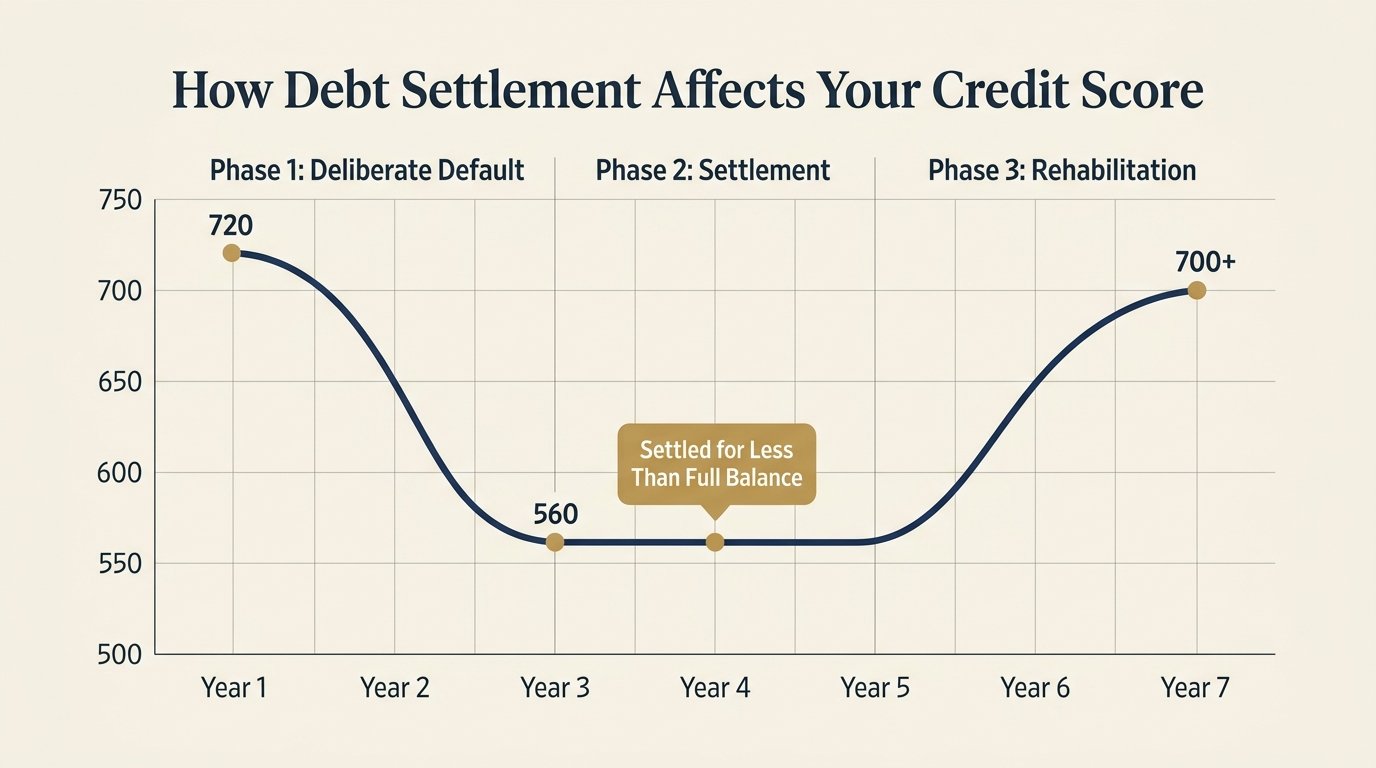
- The Score Drop Reality: Borrowers with good-to-excellent credit (680–740 FICO) typically lose 100 to 160+ points within the first 6 months of entering a settlement program as accounts go 30, 60, 90, and 120 days delinquent.
- “Settled” vs. “Paid in Full”: Settlement does not erase debt from your record. It updates the account to “Settled for Less Than Full Balance”—a derogatory notation that automated mortgage and lending algorithms treat similarly to a Chapter 13 bankruptcy filing.
- The 7-Year Statutory Clock: Under Section 605 of the Fair Credit Reporting Act (FCRA), negative marks purge 7 years from the Date of First Delinquency (DOFD), not the date you pay the settlement.
- The Double Tradeline Nightmare: When a bank charges off your account and transfers it to a third-party collection agency, you often receive two distinct negative tradelines for the same underlying debt.
- The 36-Month Rehabilitation Path: While the derogatory mark remains for 7 years, its mathematical impact fades significantly after 24 to 36 months if you establish fresh positive tradelines and maintain sub-6% credit utilization.
1. The “Temporary Dip” Fallacy
When consumers call for-profit debt settlement firms, enrollment agents frequently reassure them with scripted phrases: “Your credit score will take a temporary hit while we negotiate, but once we settle your accounts and your balance shows zero, your score will bounce right back up.”
This statement is technically deceptive. While it is true that your revolving credit balance drops to zero after settlement, the catastrophic credit score damage does not stem from your balance—it stems from the deliberate payment default required to make settlement possible.
Credit scoring algorithms (FICO and VantageScore) are heavily weighted toward payment history:
2. The Anatomy of the Credit Collapse (Phase-by-Phase)
To understand why your score collapses, examine what credit reporting bureaus (Experian, TransUnion, Equifax) actually record during the settlement lifecycle:
To force banks to negotiate, settlement companies instruct you to stop making payments. Your accounts enter an accelerating cycle of delinquencies:
- 30 Days Past Due: A single 30-day late payment drops a 720 FICO score by 60 to 80 points immediately.
- 60 & 90 Days Past Due: Lenders report escalating delinquencies. FICO treats 90-day late payments as “major derogatory events,” docking another 20 to 40 points. Credit card issuers freeze and permanently close your accounts, causing your overall available credit limit to plunge and spiking your credit utilization ratio to 100%+.
- 120+ Days Past Due: Your credit score reaches the subprime basement (typically 520 to 570).
At approximately 180 days of non-payment, federal regulations mandate that credit card issuers write off the account as a bad-debt loss (a “Charge-Off”). The original creditor reports: “Account Charged Off / Closed by Grantor.”
The bank then sells or assigns the account to a third-party collection agency. That collection agency opens a second negative tradeline on your credit file. You now have two distinct derogatory accounts reporting for the exact same credit card debt—compounding the damage.
When a settlement is finalized (e.g., paying $5,000 on a $11,000 balance), the creditor updates the balance to $0.
However, the account status does not report as “Paid in Full.” It reports as:
"Account Settled for Less Than Full Balance" or "Settled - Paid Less Than Owed".
To human underwriters and automated risk scoring models, this remark explicitly signals that the borrower failed to fulfill their contractual obligation. While having a $0 balance stops ongoing negative payment reporting, the historic derogatory notation remains locked on your file.
3. The 7-Year Clock: When Does It Actually Start?
A frequent source of panic among consumers is the belief that the 7-year credit reporting period restarts the day you pay the settlement.
Under federal law (15 U.S. Code § 1681c), consumer credit bureaus must remove paid collections, charge-offs, and late payment records 7 years from the Date of First Delinquency (DOFD).
The DOFD is defined strictly as the date of the very first missed payment that immediately preceded the charge-off or collection hand-off.
Example: If you stopped making payments in March 2026, the account was charged off in September 2026, and settled in November 2027:
• The 7-year reporting clock started in March 2026.
• The entire record—including the charge-off and the settlement remark—must be completely deleted from your credit reports in March 2033.
The Dangerous Exception: Paying a settlement does not reset the FCRA 7-year credit reporting clock. However, in many states, making a partial payment without a formalized settlement agreement CAN reset the state’s Statute of Limitations (SOL) on debt collection, giving the creditor a fresh 3 to 6 years to sue you in court!
4. Collateral Damage Beyond the 3-Digit FICO Score
A destroyed credit score is not merely an abstract number; it radiates into nearly every aspect of your daily economic life:
1. Mandatory Mortgage Disqualification
If you plan to purchase a home or refinance an existing property, debt settlement halts your plans. Conventional loans backed by Fannie Mae and Freddie Mac require a mandatory 2 to 4 year seasoning period following major charge-offs and settlements. FHA loans require you to explain the derogatory accounts and prove at least 12 to 24 months of re-established, flawless credit history.
2. Soaring Auto and Home Insurance Premiums
In 85% of U.S. states, property and casualty insurance companies use Credit-Based Insurance Scores (CBIS) to calculate premiums. Actuarial data shows a correlation between low credit scores and higher claim frequency. A 150-point drop from debt settlement can increase your annual auto insurance premiums by 40% to 80%, costing you thousands in phantom expenses.
3. Employment Screenings & Security Clearances
Employers in financial services, defense contracting, government administration, and technology frequently pull modified credit reports (without scores) as part of background checks. Unresolved charge-offs or multiple “settled for less” marks are viewed as financial distress flags that can disqualify applicants from sensitive roles or security clearances.
5. Credit Impact Comparison Across 4 Payoff Methods
| Payoff Strategy | Initial Score Impact | 12-Month Score Status | Derogatory Marks on File | Mortgage Eligibility |
|---|---|---|---|---|
| Self-Directed Payoff (Avalanche / LEVEL Blitz) |
Zero negative impact; score rises as utilization falls. | +40 to +80 Points (Prime / Super-Prime) | None (100% on-time record maintained). | Immediate (qualifies for best prime rates). |
| Debt Consolidation Loan | Minor -3 to -5 pt inquiry; immediate +30 pt boost from utilization drop. | +30 to +60 Points (Steady improvement) | None (all cards paid in full). | Immediate (subject to DTI calculations). |
| Non-Profit Debt Management Plan (DMP) | Accounts closed by creditor; minor initial dip (-10 to -20 pts). | +20 to +40 Points (Accounts show paid on time) | Notation: “Managed under credit counseling” (No late marks). | Eligible with FHA after 12 months of on-time DMP payments. |
| For-Profit Debt Settlement | Catastrophic drop: -100 to -160 Points (Deep subprime). | -80 to -120 Points (Mired in collections & charge-offs) | Severe: 30/60/90/120-day lates, charge-offs, “settled for less” (7 yrs). | Blocked for 2 to 4 years minimum. |
6. The 36-Month Post-Settlement Credit Rebuilding Blueprint
If you have already settled debts—or are forced into settlement due to severe hardship—you must execute an aggressive rehabilitation strategy to climb out of subprime territory.
Thirty to sixty days after paying each settlement, pull your official credit reports from AnnualCreditReport.com. Verify that:
- The balance reports as $0 (creditors cannot legally show an active balance after accepting a settlement).
- The account status is updated to “Settled” rather than “Active Collection.”
- The Date of First Delinquency (DOFD) is accurate and has not been artificially advanced. If a collection agency misreports the balance or dates, file formal dispute letters under FCRA Section 623.
You cannot rebuild credit simply by having zero balances; FICO algorithms require active, positive data streams to score.
- Open 2 Secured Credit Cards: Deposit $300 to $500 with a reputable issuer (Discover it Secured or Capital One Platinum Secured) that reports to all three bureaus.
- Open a Credit-Builder Installment Loan: Use a credit union or builder platform (Self, SeedFi) to add installment loan variety to your credit mix (10% of FICO score).
- Enforce the 5% Utilization Cap: Charge a single recurring subscription (e.g., Spotify, $11.99/mo) to the secured card and set autopay for the full balance. Never carry a balance.
As the charge-offs and settlement notations age past 24 months, their mathematical penalty diminishes rapidly. FICO weights recent behavior significantly heavier than historical events:
- Your secured cards will graduate to unsecured cards with higher limits.
- Request moderate credit line increases every 6 months to further suppress your aggregate utilization ratio.
- By Month 36, borrowers who maintain 100% on-time payments on fresh tradelines routinely recover to the 680 to 720 FICO range—even while the aging settlement remarks remain on file until year seven.
7. Pre-Settlement Damage Assessment Checklist
- [ ] Audit Your Current FICO Score: If your score is above 640, settlement will cause acute destruction; explore consolidation or non-profit DMPs first (as detailed in our settlement vs. consolidation breakdown).
- [ ] Check Near-Term Life Goals: Do you need to buy a home, finance a reliable vehicle, or rent an apartment in the next 3 years? If yes, avoid settlement.
- [ ] Calculate the Phantom Tax Liability: Estimate how much forgiven debt will be reported on Form 1099-C and verify if you qualify for the IRS insolvency exception.
- [ ] Assess Lawsuit Exposure: Review whether your creditors (e.g., Discover, American Express) are known for aggressive litigation before settlements conclude.
- [ ] Model Self-Directed Acceleration: Run a mathematical payoff simulation to see if an engineered Avalanche or Blitz can wipe out your balances without credit destruction.
Pay Off Debt Faster Without Incinerating Your Credit Score
Before sacrificing your credit rating to a settlement company, test an engineered approach. LEVEL models dynamic debt blitzes, calculates your true daily interest bleed, and maps your exact finish line—100% privately, with zero bank logins.
Model Your Payoff at DebtFreeArchitect.com →Available on desktop and on mobile via the newly launched LEVEL Mobile View. Zero bank credentials required.