
Post-Holiday Credit Card Debt Recovery Plan: The 90-Day Reset
Holiday debt doesn’t arrive as a single catastrophic bill. It strikes as a fragmented web of retail store cards, Buy Now Pay Later installments, and peak-APR revolving balances. Here is the exact mathematical blueprint to eliminate holiday debt within 90 days—before interest compounds into summer.
The Anatomy of the Holiday Financial Hangover
Every January, millions of households open their banking apps to an unpleasant shock. Yet what surprises most people is not the total number—it is the fragmentation of the debt.
The modern holiday season rarely charges to a single primary credit card. Instead, holiday expenses scatter across a disorienting patchwork of financing channels:
- The Primary Rewards Card: Flights, hotels, family dinners, and major purchases totaling $2,500 to $5,000 at 22% to 26% APR.
- Retail Store Cards: Department stores and online retailers offering “20% off your purchase today if you open a card,” leaving balances carrying punitive interest rates between 29.99% and 34.99% APR.
- Buy Now, Pay Later (BNPL) Stacks: Two or three separate four-installment plans across Klarna, Affirm, or Afterpay, quietly auto-debiting checking accounts every two weeks.
- Deferred Travel and Dining Charges: Incidental charges, ride shares, and end-of-year subscriptions that clear weeks after the festivities conclude.
When debt is fragmented, psychological friction takes over. You see individual minimum payments of $45, $75, and $110, convincing yourself the situation is manageable. But behind those minimum payments lies a compounding math reality: the daily interest bleed.
Credit card issuers calculate interest on your account using your Average Daily Balance, not your end-of-month statement balance. The formula is brutally simple:
Daily Interest Charge = (Current Balance × Annual Percentage Rate) ÷ 365
If you carry a combined holiday balance of $6,800 across cards averaging 27.5% APR, your balances bleed $5.12 every single day in pure interest—over $155 per month—before a single penny touches your principal. Paying only the minimums guarantees that holiday gifts bought in December remain unpaid well into the next decade.
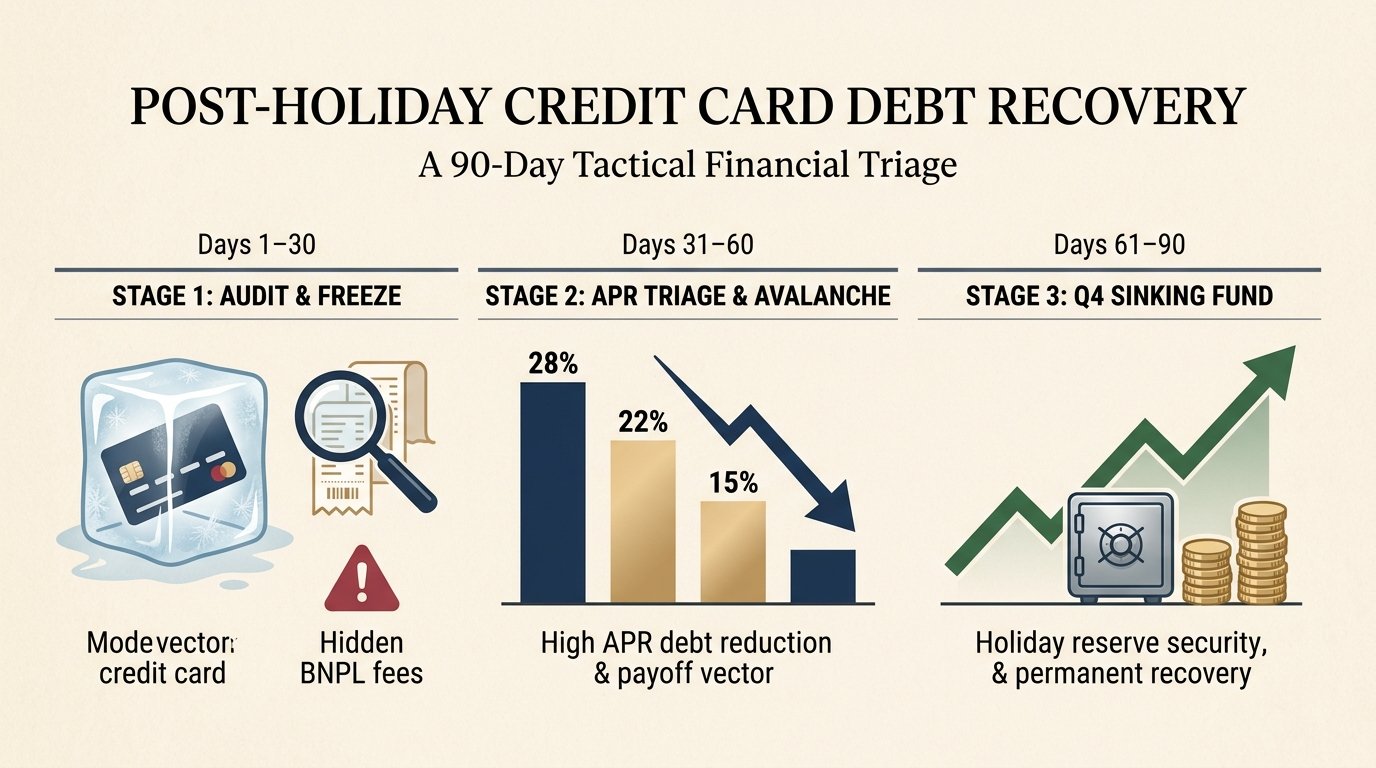
Stage 1: Days 1 to 30 — The Forensic Audit & Digital Friction Protocol
The first 30 days are not about aggressive debt reduction; they are about halting the bleeding and establishing absolute visibility. You cannot eliminate what you have not cataloged.
1. Conduct the Complete Holiday Liability Audit
Set aside 45 minutes to pull every statement and banking portal. Create a simple table listing five columns: Creditor Name, Balance, APR, Minimum Monthly Payment, and Due Date.
Crucially, do not omit non-revolving obligations. As detailed in our guide on Buy Now, Pay Later debt payoff strategies, BNPL loans do not always report to traditional credit bureaus, making them easy to overlook until an overdraft fee hits your primary account.
2. Enforce the Digital Friction Protocol
Willpower is an unreliable financial mechanism. Systemic friction is permanent. To prevent post-holiday “spillover spending” during January clearances, execute three digital lockouts:
- Remove Cards from Digital Wallets: Delete all retail store cards and secondary credit cards from Apple Wallet, Google Pay, and Samsung Pay. When tapping your phone is effortless, micro-spending continues unabated.
- Purge Autofill from Browser & Retail Portals: Erase saved payment information from Amazon, Target, Walmart, and food delivery apps. Forcing yourself to manually type 16 digits and a CVV creates an intentional barrier between impulse and execution.
- Turn Off In-App “One-Click” Checkout: Require dual-factor confirmation or password entry for every digital transaction.
Do not close your retail or rewards credit cards once you stop using them. As explained in our breakdown of credit utilization ratios, closing an account instantly obliterates that card’s credit limit from your overall revolving profile, causing your credit utilization ratio to spike and your credit score to drop. Freeze the card physically in ice or place it in a safe—keep the account open while driving the balance to zero.
Stage 2: Days 31 to 60 — The APR Triage & Avalanche Strike
Once your liability landscape is completely visible and new charges have stopped, Month 2 shifts into high-velocity liquidation.
1. Execute the APR Avalanche Protocol
When dealing with post-holiday debt, emotional “snowball” methods (paying the smallest balance first) cost significantly more money because retail store cards carry obscene interest rates. A retail card with a $1,200 balance at 32% APR costs far more in daily interest bleed than a $2,500 balance on a 15% credit union card.
Under the Debt Avalanche strategy:
- Pay the exact minimum payment on every account except the one carrying the single highest APR.
- Funnel every available dollar of discretionary cash, side-gig income, and spending cuts into an aggressive, focused strike against that highest-rate balance.
- Once that highest APR account hits $0, roll its entire monthly payment into the next highest APR account.
| Recovery Strategy | Primary Mechanism | Best Suited For | Primary Risk to Avoid |
|---|---|---|---|
| Debt Avalanche | Aggressive allocation to highest APR balances first | High-rate retail cards (28%–35%) and mixed card portfolios | Requires financial discipline before seeing the first zero balance |
| 0% Balance Transfer | Moving balances to a 0% promotional APR card (12–18 mos) | Borrowers with credit scores above 680 and $3k–$8k balances | Transfer fees (3%–5%) and failure to pay off balance before promo expiration |
| Cash-Flow Blitz | Deploying seasonal lump sums (tax refund, early bonus) | Anyone receiving an annual tax refund in February/March | Leaving zero emergency cushion; always retain a $1,000 cash buffer |
| Consolidation Loan | Fixed-rate installment loan replacing multiple credit lines | Large balances ($10k+) with high weighted average APRs | Re-running balances on cleared credit cards (“double debt trap”) |
2. Deploy the Early-Year Lump Sum Strike
Between February and April, two major cash-flow windfalls typically occur: federal tax refunds and annual performance bonuses. According to IRS data, the average tax refund hovers between $2,800 and $3,100.
The single most destructive financial mistake is viewing a tax refund as “free money” for spring vacations or home upgrades while carrying 25%+ holiday card balances. Deploying a $3,000 tax refund as an immediate principal strike on a 28% card produces an instant, risk-free 28% return on investment. No index fund, high-yield savings account, or certificate of deposit can compete with that mathematical reality.
Before deploying a lump sum, review our guide on paying off debt versus building an emergency fund to ensure you preserve a basic $1,000 cash shock absorber.
Stage 3: Days 61 to 90 — The Antidote & Q4 Sinking Fund Architecture
Congratulations: your highest-rate holiday balances are crushed, your minimum payments have collapsed, and your daily interest bleed is down to zero. But if your strategy stops here, you are virtually guaranteed to repeat the exact same cycle in nine months.
Holiday debt is not an unpredictable emergency like a blown car transmission or an unexpected medical visit. Christmas and the holiday season occur on December 25 every single year. The permanent antidote to post-holiday debt is the Automated Sinking Fund.
How to Calculate Your Holiday Sinking Fund
Review your total holiday expenditure from the past season—including gifts, wrapping paper, holiday travel, specialty groceries, and entertainment. Let us assume your total realistic cost was $1,800.
Instead of financing $1,800 on credit cards in December and paying $300 in interest through March, reverse-engineer the math over the remaining months of the year:
- Target Amount: $1,800
- Execution Horizon: 9 months (April 1 through December 1)
- Monthly Sinking Fund Contribution: $200 / month ($100 per bi-weekly paycheck)
Open a dedicated High-Yield Savings Account (HYSA) specifically named “Holiday & Year-End Reserve.” Set an automatic transfer from your checking account on the first of each month. When November arrives, you enter the shopping season with 100% liquid cash. You capture credit card cash-back rewards, pay every statement balance in full before interest accrues, and eliminate post-holiday panic permanently.
Map Your 90-Day Debt Payoff Velocity with LEVEL
Eliminating holiday debt requires knowing your exact daily interest bleed and your mathematical debt-free date. LEVEL is a deterministic, privacy-first payoff planner built for disciplined wealth architecture. No bank account linking required—plug in your balances, select your avalanche strategy, and watch your debt-free milestone materialize.
Build Your 90-Day Payoff Plan Free →