
LEVEL vs. Tally: Which Debt Payoff Tool Fits You?
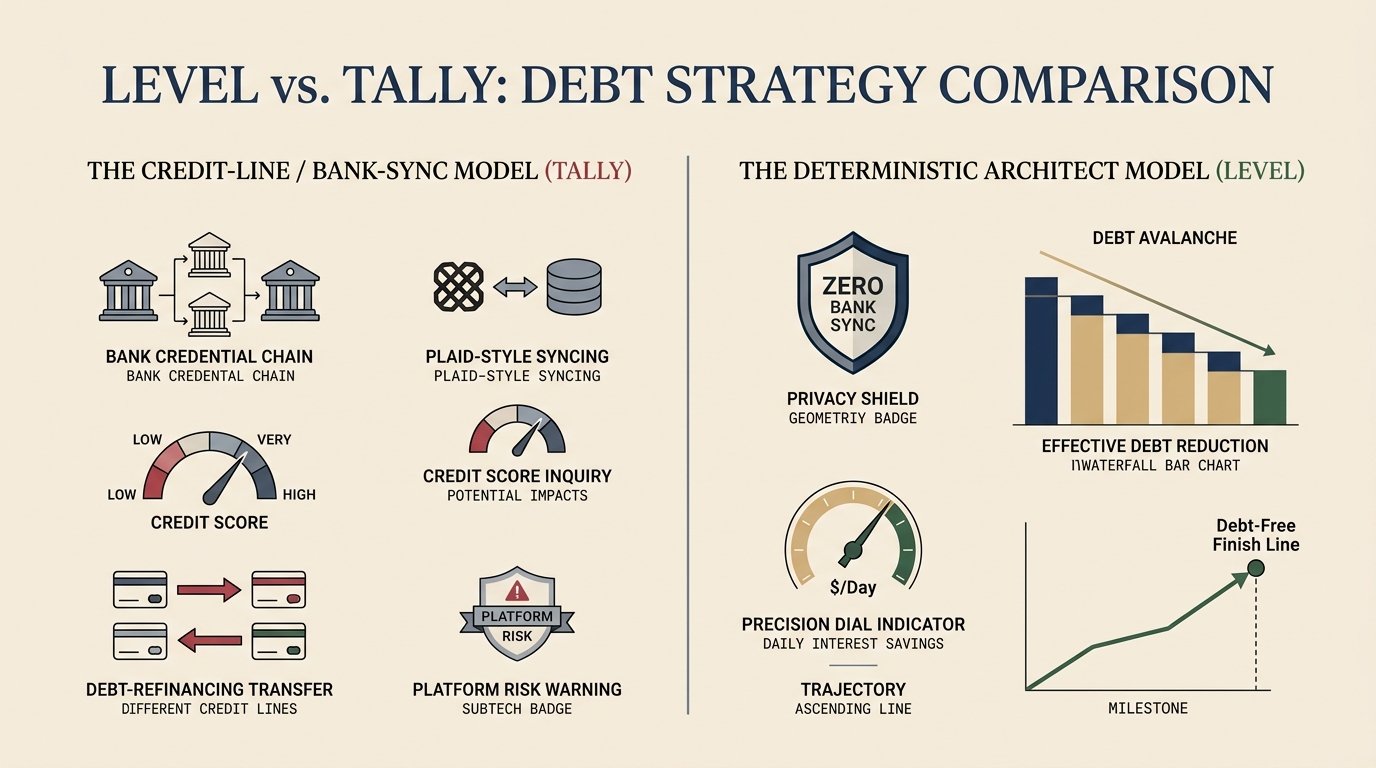
For years, borrowers looking to escape revolving credit card debt were pitched “automated debt apps” like Tally that promised to pay their cards using a third-party line of credit. After Tally’s consumer shutdown exposed the fragility of credit-line arbitrage, a sharper question emerged: do you need another lender shuffling your balances, or a deterministic mathematical blueprint you control?
What Happened to Tally—and Why Borrowers Are Rethinking Debt Apps
If you have been searching for the Tally debt payoff app recently, you likely ran into a wall: after raising over $170 million in venture capital, Tally permanently shut down its consumer app operations in August 2024.
Why did a flagship “automated debt manager” collapse right when national credit card balances crossed $1.14 trillion? Because Tally was never merely a calculator or planner—it was a credit-line arbitrage lender.
Tally’s business model relied on borrowing institutional capital at low interest rates, extending a new revolving line of credit to users with FICO scores above 660, linking to their checking and credit card portals via Plaid, and paying off their higher-APR cards while charging a spread (plus membership fees up to $300 per year). When federal interest rates rose and capital markets tightened, the arbitrage margin evaporated. Existing users suddenly saw credit lines frozen, interest rates hiked, and auto-pay features terminated—leaving thousands scrambling to rebuild manual payment schedules overnight.
When a third-party app sits between your checking account and your credit card issuers, you introduce platform dependency risk. If a bank-sync token breaks on a Friday afternoon or a fintech modifies its terms, a missed payment shows up on your credit report—not the app’s. True debt elimination requires an architecture that never holds your cash flow hostage.
Two Fundamentally Different Approaches to Debt Elimination
Even with Tally offline, dozens of copycat fintech apps still pitch the same core premise: “Link your bank accounts, open a new line of credit with us, and let our algorithm shuffle your balances.”
By contrast, LEVEL (Debt Free Architect) was engineered from the ground up on the exact opposite philosophy: deterministic mathematical clarity without debt shuffling or bank credential harvesting.
1. The Tally / Credit-Line Arbitrage Model
- Mechanism: Issues a new credit line or personal loan to pay down existing cards, turning you into a borrower of the app itself.
- Data & Privacy Cost: Requires full Plaid integration—handing over your primary checking credentials, transaction histories, and credit card logins.
- Qualification Barrier: Rejects borrowers whose credit scores have already been bruised by high credit utilization ratios (typically requiring a 660+ FICO score).
- The “Double Debt” Trap: Once the app pays down your Chase or Amex card using its credit line, your original card shows a $0 balance. Without a structural change in cash-flow discipline, up to 68% of borrowers swipe the cleared card again—ending up with both the app’s loan and fresh credit card debt.
2. The LEVEL / Deterministic Architect Model
- Mechanism: A high-precision mathematical simulation and execution engine (debtfreearchitect.com) that maps out your exact month-by-month principal strikes across every card you own—without opening a single new loan.
- Zero Bank Linking: LEVEL never asks for your bank login, SSN, or Plaid connection. You input your balances, APRs, and minimum payments in 90 seconds. Your financial identity stays 100% private.
- Daily Interest Bleed Visibility: Instead of hiding the math behind an opaque algorithm, LEVEL exposes your exact Daily Interest Bleed ($/day) on every account so you see why each extra dollar routed to your highest-APR balance compresses your timeline by weeks or months.
- No Credit Score Gatekeeping: Whether your credit score is 540 or 780, the mathematical engine works identically—and requires zero hard or soft credit inquiries.
| Feature / Dimension | LEVEL (Debt Free Architect) | Tally / Credit-Line Apps | Manual Spreadsheets |
|---|---|---|---|
| Core Mechanism | Deterministic payoff simulation & cash-flow routing blueprint | Revolving credit line arbitrage & automated balance transfer | Static rows and manual formula maintenance |
| Current Availability | Active (Web & Mobile v2 at debtfreearchitect.com) | Shut Down (Consumer operations ceased Aug 2024) | Active (Requires manual setup) |
| Bank Account Linking | Never required (100% privacy-first) | Mandatory (Plaid checking + credit card login sync) | None |
| Credit Check / FICO Gate | None (Works for any credit score) | Credit pull required (Often denies scores under 660) | None |
| Payoff Strategies Supported | Avalanche, Snowball, Custom Order, & One-Time Blitz Strikes | Locked to platform’s internal APR arbitrage rules | Requires custom macro or formula rebuilds |
| Daily Interest Bleed ($/Day) | Real-time calculation per account and portfolio-wide | Hidden behind monthly statement summaries | Rarely modeled accurately |
| Mobile Experience | Dedicated mobile view (/v2/today, /v2/plan, /v2/roadmap) |
Discontinued mobile app | Clunky pinching and zooming on phone screens |
Why “Automated Debt Shuffling” Fails the Math Test
The pitch behind credit-line apps like Tally was seductive: “Don’t change your habits—just let our software move your debt from a 24% card to a 17% credit line.”
Let us run the actual math on a $15,000 credit card portfolio to see why deterministic principal velocity beats interest-rate shuffling every time.
Suppose you carry $15,000 across three credit cards averaging 24.9% APR, with combined minimum payments of $450/month.
- Scenario A (The Credit-Line Shuffle + $300 Annual Membership Fee): You move a portion of the debt to a 17.9% credit line paying $300/year for the software membership, while paying near-minimums over 60 months. Total interest and membership fees paid: ~$8,940. Time to debt-free: 5.0 years.
- Scenario B (LEVEL Debt Avalanche + $250/mo Extra Principal Velocity): You keep your existing accounts, pay zero membership or origination fees, and use LEVEL to route an extra $250/month strictly to the highest-APR balance first (cascading each freed minimum payment as cards hit $0). Total interest paid: ~$4,110. Time to debt-free: 2.1 years (25 months).
The Result: Deterministic principal velocity saves $4,830 more and eliminates the debt nearly 3 years faster—without opening a single new loan or linking a bank password.
As we explored in our deep dive on debt settlement vs. debt consolidation, moving balances from bucket A to bucket B only works if your monthly principal velocity increases. When you see your exact finish line and watch your daily interest bleed drop from $10.23/day to $8.40/day to $0.00/day, you attack the root cause rather than rearranging the symptom.
Inside LEVEL: How the Deterministic Payoff Engine Works
Borrowers migrating from legacy apps or messy spreadsheets typically look for three specific capabilities that LEVEL delivers instantly:
1. Instant Avalanche vs. Snowball vs. Custom Comparison
Should you attack your $1,800 retail card at 29.99% APR first, or knock out a $650 balance at 19% to free up monthly cash flow? Instead of guessing, LEVEL computes both paths side-by-side in milliseconds—showing you the exact dollar difference in total interest paid and the exact month and year your final balance reaches zero.
2. The “What-If” Cash-Flow Blitz Simulator
Real life is not static. In February you might receive a $2,400 tax refund (a central pillar of our 4-Quarter New Year Debt Payoff Plan), or in July you might pick up $400 from an extra weekend shift. LEVEL allows you to test one-time lump-sum strikes or monthly payment boosts and watch your debt-free date pull closer in real time.
3. Pocket-Ready Clarity on LEVEL Mobile
Traditional spreadsheets break down the moment you try to read them on a smartphone. LEVEL’s dedicated mobile experience divides your journey into four focused views:
- Today: Your current daily interest bleed, next target milestone, and immediate action item.
- Plan: Your prioritized payoff sequence (Avalanche, Snowball, or Custom) and monthly surplus allocation.
- Roadmap: The visual month-by-month amortization curve showing every card’s exact zero-balance date.
- You: Your saved profile and scenario settings—accessible anywhere without exposing bank credentials.
When Does a Consolidation Loan Still Make Sense?
To be completely objective: there is a narrow scenario where a traditional credit-line or consolidation loan (the mechanism Tally tried to automate) makes mathematical sense.
If your credit score is already strong (720+) and you can qualify for a fixed-rate personal loan through a local credit union at 9% to 11% APR with zero origination fee, replacing a 26% APR credit card will lower your daily interest cost immediately. Even then, a consolidation loan is just an interest-rate discount—you still need a deterministic payoff schedule to accelerate principal payments and ensure you never re-accumulate balances on the freed credit cards. And as covered in our credit score payoff timeline guide, paying down revolving utilization directly is the fastest way to unlock those top-tier rates in the first place.
Experience the Smarter Alternative to Tally
No venture-backed middleman. No mandatory bank-account linking. No credit score gatekeeping. See your exact daily interest bleed, compare Avalanche vs. Snowball in one click, and lock in your exact debt-free date with LEVEL.
Launch LEVEL Free at DebtFreeArchitect.com →