
Credit Card Hardship Programs: How They Work and What to Ask For
When card minimums begin consuming your entire monthly margin, calling your card company to “ask for a lower interest rate” almost always gets a polite script and an immediate rejection. But buried deep inside every major card issuer exists an entirely separate institutional mechanism: the internal financial hardship workout program. Here is how they operate, the math behind the interest drop, and the exact phone dialogue that unlocks them.
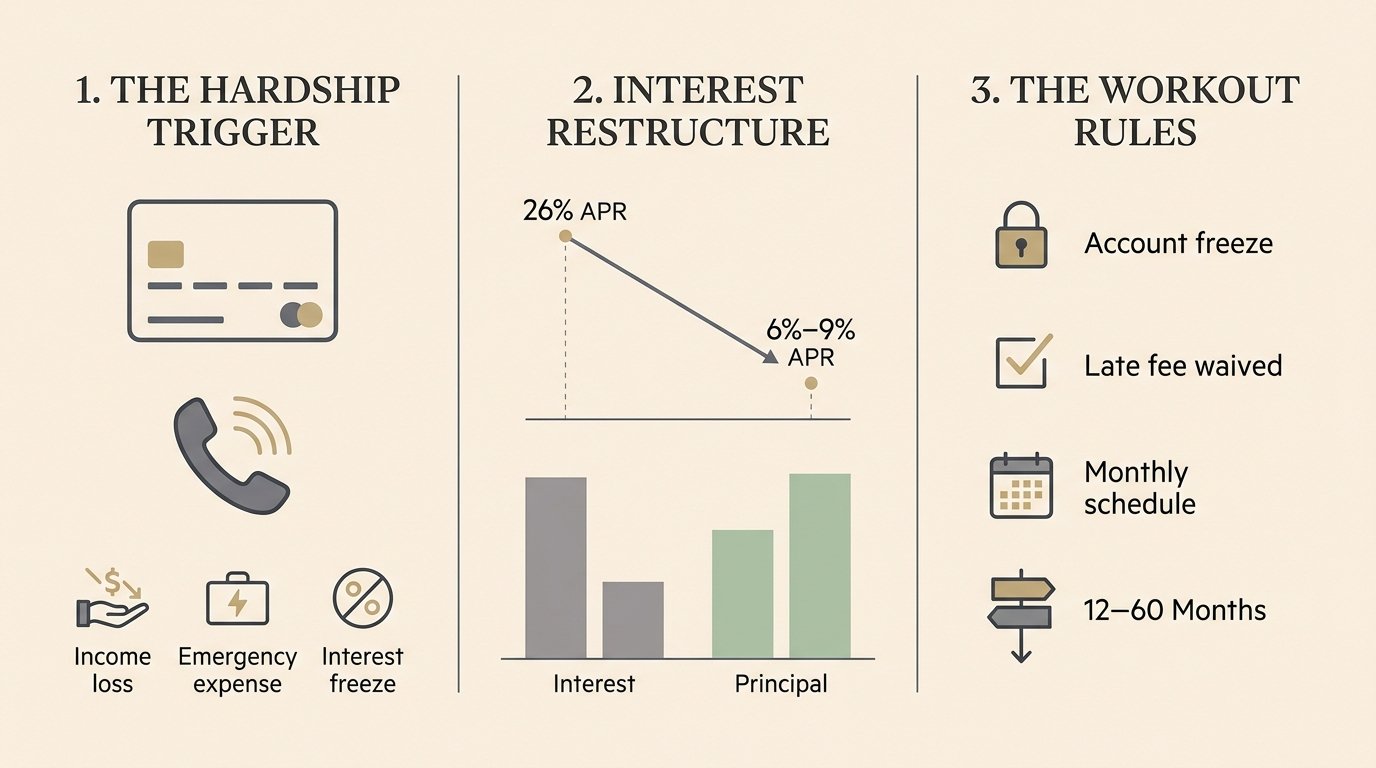
A borrower carries $16,500 in revolving credit card debt across two accounts. Their interest rates sit at 24.5% and 28.5%, generating nearly $370 every month in pure interest charges before a single penny touches the principal. Following an unexpected reduction in overtime hours and an emergency repair, their monthly budget runs a $180 deficit.
They dial the customer service number on the back of their card and ask: “Can you lower my interest rate? I am struggling to keep up.” Within forty seconds, the customer representative responds: “Unfortunately, our system does not currently show any promotional interest offers available for your account.”
The borrower hangs up, assuming they have hit a dead end. In reality, they made one fundamental procedural error: they asked a general frontline representative for a discretionary rate discount, rather than initiating a formal internal financial hardship review.
What Is a Credit Card Hardship Program?
A credit card hardship program is a formal, internal agreement between you and your credit card issuer designed to help you pay off your balance when a verifiable life event impairs your ability to make standard payments. Rather than forcing you to take out an expensive consolidation loan or abandon the balance to collections, your current lender agrees to temporarily or permanently restructure the debt.
In exchange for your commitment to a structured payoff plan, the card issuer typically:
- Slashes your interest rate from standard peak levels (24%–32% APR) down to a fixed rate between 0% and 9.99% APR.
- Waives late fees, penalty interest, and over-limit charges.
- Locks in a fixed, predictable monthly payment structured to eliminate the balance over 12 to 60 months.
- Freezes or permanently closes the account to prevent any additional charges from accumulating while the balance amortizes.
To see why a workout program is so mathematically powerful, observe how an $8,000 balance behaves under standard revolving terms versus a 7.0% hardship plan with a fixed $250 monthly payment:
- Standard Revolving Card (27.99% APR): Out of your $250 payment, $186.60 goes straight to interest and only $63.40 reduces principal. Your daily interest bleed is $6.13 every single day. Payoff time: 71 months (nearly 6 years). Total interest paid: $6,145.
- Internal Hardship Workout (7.00% APR): Out of that exact same $250 payment, $46.67 goes to interest and $203.33 goes directly to principal on day one. Payoff time: 36 months (3 years flat). Total interest paid: $883.
The Takeaway: With zero additional cash outlay, your monthly principal velocity increases by 320%, you shave nearly three years off your timeline, and you keep over $5,260 in your own pocket.
The Three Main Types of Relief Options
Card companies do not operate a one-size-fits-all policy. When evaluating hardship requests, revolving lenders categorize relief into three structured tiers depending on the severity of your financial interruption:
| Program Tier | Typical Duration | Typical APR Concession | Account Status Outcome | Best Suited For |
|---|---|---|---|---|
| Short-Term Relief Plan | 6 to 12 Months | 9.99% – 14.99% APR (or temporary fee waivers) | Account temporarily restricted or frozen; credit line restored once program concludes | Temporary medical leave, short employment gaps, or localized emergency expenses |
| Long-Term Workout Agreement | 36 to 60 Months | 0.00% – 8.99% Fixed APR | Account closed permanently; balance amortizes down to zero on a fixed schedule | Permanent income reductions, divorce, or severe structural debt burden |
| Nonprofit Debt Management Plan (DMP) | 36 to 60 Months | 6.00% – 9.00% Average Concession | All enrolled cards closed; consolidated into a single monthly agency payment | Borrowers carrying cards across multiple issuers whose internal reps refuse individual hardship |
Why Credit Card Companies Agree to Lower Your Rate
Borrowers often feel hesitant to call their card issuers, worrying that admitting financial hardship will prompt immediate legal action or cause panic. Understanding the lender’s internal incentives removes this fear.
To a major revolving lender, credit card debt is unsecured—there is no home, vehicle, or collateral attached that the bank can seize if you stop paying. Once an account passes 180 days delinquent, federal accounting regulations require the bank to classify the balance as a “charge-off” and write it down as a loss. If the bank subsequently sells that charged-off debt to a third-party collection agency, they typically receive pennies on the dollar.
A customer who proactively contacts the bank and says, “I want to pay back 100% of my principal balance, but at 28% interest the math is mathematically impossible,” represents the ideal outcome for a loss-mitigation officer. By dropping the interest rate to single digits, the bank guarantees full principal recovery while avoiding charge-off losses.
Step-by-Step: Exactly What to Say on the Phone
The difference between an immediate rejection and an approved hardship plan comes down to vocabulary and routing. Use this three-step protocol when initiating the call:
Step 1: Bypass Frontline Customer Support
Frontline customer service agents are trained in transaction disputes, replacement cards, and rewards balances. Their software terminals rarely have the security clearance to modify interest rates. Your sole objective in the first two minutes is reaching the correct department.
“Hello. I am reviewing my monthly accounts and am experiencing a temporary financial hardship due to a recent change in household income. I am fully committed to paying my balance in full, but I need to be connected with your internal Account Retention, Loss Mitigation, or Financial Hardship Department to discuss structured workout options.”
Step 2: State Your Qualifying Hardship Clearly
Workout specialists are authorized to grant concessions based on specific, verifiable qualifying life events. Avoid generic complaints about high interest rates or inflation. State the factual event concisely:
- “My household experienced a reduction in income due to reduced working hours / job transition.”
- “I am managing unexpected, non-recurring medical expenses that have constrained my monthly cash flow.”
- “I recently underwent a marital separation and am reorganizing my living expenses onto a single income.”
Step 3: Ask the Three Critical Diagnostic Questions
Before agreeing to any verbal workout terms, write down the answers to these three specific items:
1. “What will my exact fixed interest rate and monthly payment amount be throughout this program?”
2. “Will this account be temporarily frozen for new purchases during the program, or is the account being permanently closed?”
3. “How will this plan be reported to the credit bureaus? Will the account continue to report as ‘Paid as Agreed’?”
How Hardship Programs Impact Your Credit Score
Entering an internal workout program does not inherently damage your credit report in the manner that a debt settlement or charge-off does. However, there are two distinct credit impacts you must understand:
1. Credit Bureau Notations
Under federal reporting standards, card issuers may place a neutral notation on your credit file stating “Account being paid under a partial or modified payment agreement.” While scoring models like FICO 8 do not deduct direct points for the notation itself, third-party lenders reviewing your raw report may treat it as a sign of current financial distress until the program concludes.
2. The Credit Utilization Factor
If your hardship agreement requires closing the account, your overall revolving credit limit will decrease by that card’s limit. As explored in our comprehensive breakdown of credit utilization ratios, losing available credit while carrying balances can cause your utilization percentage to rise, leading to a temporary dip in your score. However, this temporary dip is vastly preferable to the severe, multi-year destruction caused by 30-day, 60-day, or 90-day late marks—and as you steadily eliminate the balance, your score rebounds rapidly, as outlined in our guide on whether paying off debt raises credit scores.
What to Do If Your Card Issuer Refuses
If your card company’s workout desk insists they have no internal hardship options available, you still have two legitimate alternatives:
- Nonprofit Credit Counseling: Organizations affiliated with the National Foundation for Credit Counseling (NFCC) hold institutional, pre-negotiated concession agreements with virtually every major card company in the nation. Even when an issuer refuses an individual caller, enrolling through an accredited Debt Management Plan frequently unlocks automatic rate cuts to 6%–9%. Review our field guide on debt settlement versus consolidation to evaluate this structure.
- Debt-to-Income Optimization: If your credit score remains intact, check your numbers with our Debt-to-Income ratio calculator to determine whether a fixed-rate personal consolidation loan at a local credit union provides a faster, fee-free path to interest reduction.
Map Your New Payoff Velocity with LEVEL
Whether you successfully negotiate a 6% hardship rate or are prioritizing cards at their current APRs, guessing your payoff timeline costs money. LEVEL is a deterministic, privacy-first debt architect that models your exact daily interest bleed and maps your fastest path to zero balances. No bank account sync required.
Model Your Debt Payoff Plan Free →